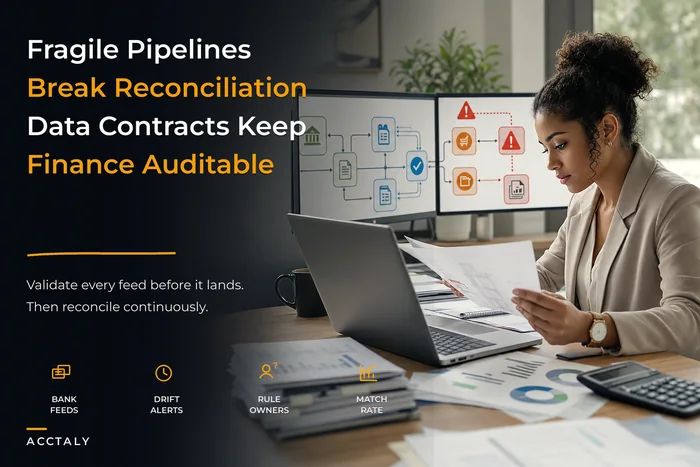


Most finance teams don't have a spreadsheet problem. They have a plumbing problem: the numbers are fine once they land, but getting them to land — from Stripe, the bank, the billing system, payroll, or marketplaces — is where the close gets stuck.
You know the symptom: the first few days of every month spent chasing mismatched totals, webhooks that silently failed, or a vendor CSV that changed a column header and broke an import. Individually these issues are easy; they become costly because they keep happening and are invisible until they cost you days.
This piece explains the architecture patterns and operational rules that make reconciliation reliable for teams without a dedicated data engineering org.
The real reason integrations break (it's rarely the integration)
Integrations rarely fail because the connection drops. They fail because nobody defined what "correct" means on either side. Systems can keep exchanging data while quietly drifting out of agreement.
At small headcounts one person often holds the full map. As you grow, that map fragments and the gaps between slices are where discrepancies appear. The reconciliation playbook in accounting data-governance playbook for continuous reconciliation focuses on fixing discovery; this piece focuses on the layer that prevents those surprises.
Three architecture patterns, and when each one actually fits
| Pattern | Best for | Failure mode | Debuggability |
|---|---|---|---|
| Event-driven | Things that must react fast: payment received, subscription canceled, fraud flag | Silent dropped events; hard to replay | Low — events are gone once processed |
| Batch | Reconciliation, payouts, GL posting, reporting feeds | Latency; a bad batch corrupts a whole day | High — you can re-run the whole file |
| Canonical ledger | The system of record everything reconciles against | Slow to build; requires discipline | Highest — one source of truth |
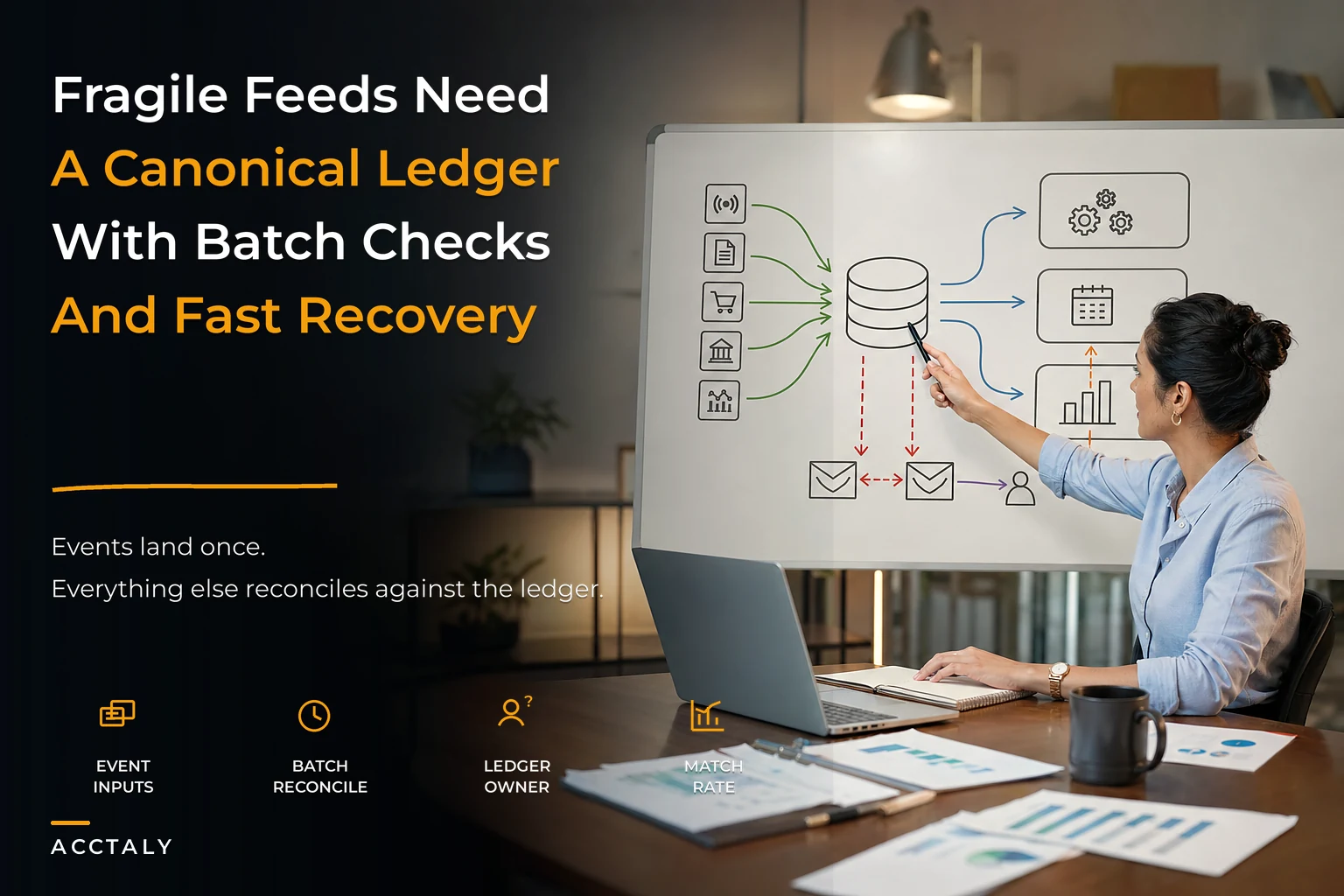
Event-driven is right when timing matters, but unreliable as an accounting backbone because dropped events are often invisible. Batch processes are underrated: you can inspect and replay files, which makes them very debuggable for most finance tasks. A canonical ledger gives you one authoritative store that everything reconciles against instead of trying to keep N-squared pairwise agreement.
Stop letting accounting slow your business down.
Acctaly automates your financial operations so you can focus on growth and compliance.
- Automated bookkeeping
- Real-time financial reporting
- Integrated tax management
No credit card required
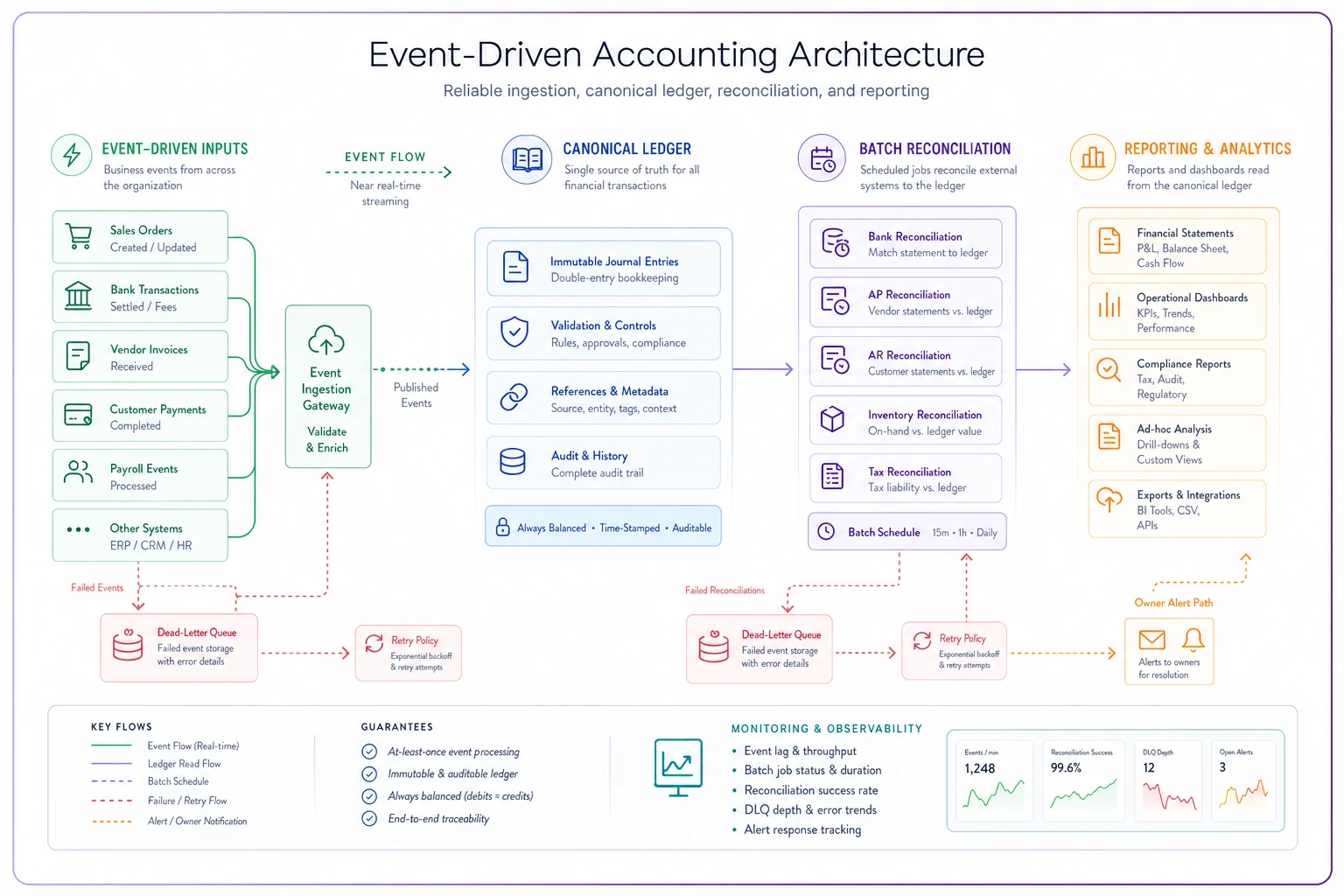
The pragmatic combination
Most SMB stacks run all three patterns: events for immediate reactions, batches for heavy financial work, and a lightweight canonical ledger as the reconciliation anchor. The events feed the canonical layer, batches reconcile against it, and reporting reads from it.
You don't need to build everything at once, but you should know which pattern each integration is supposed to follow. Many integrations are event-driven by accident and would be more reliable as batches.
Data contracts: the thing that prevents 80% of the pain
A data contract is an explicit agreement about the shape and meaning of data crossing a boundary: field names, types, required fields, units, and idempotency rules. Contracts turn silent corruption into loud rejections.
-
Unique key
field that guarantees no double-counting (e.g., Stripe charge ID)
-
Required fields
what must be present for a record to be valid
-
Types and units
amounts in cents or dollars, currency, UTC vs local time
-
Meaning of absence
whether a missing field means "no value" or "unknown"
-
Idempotency rule
how duplicate deliveries are handled (should be no-op)
Treat incoming records as guilty until validated. If a record fails contract checks, quarantine it instead of letting it into the ledger. This prevents more month-end chaos than after-the-fact reconciliation.
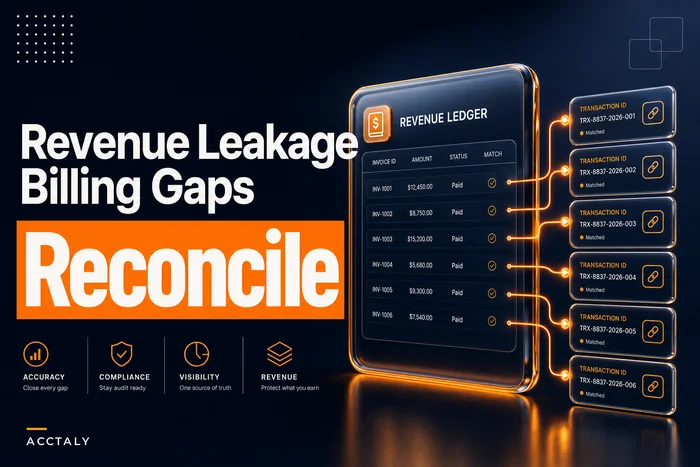
For revenue feeds, see the row-level reconciliation and event-audit approach to finding revenue leakage for control-total examples and quarantine patterns.
The validation layers that actually catch problems
Validation should be a stack of checks, not a single gate. Different layers catch different failure classes.
-
Schema validation
ensure fields and types match the contract
-
Business-rule validation
catch financially impossible records (e.g., negative invoice where not allowed)
-
Referential validation
confirm referenced objects (invoice, customer) exist
-
Reconciliation validation
compare derived totals to independent sources (payout vs bank deposit)
-
Completeness validation
detect missing windows or unusually low counts
Completeness checks are where silent failures hide: every record can be individually valid yet a window of data be missing. Expected counts and control totals turn a three-week discovery into a same-day alert.
Retry and alerting: designed for people who will ignore most alerts
Alert fatigue is real: if you alert on everything, people stop reading alerts. The right approach auto-recovers transient failures and only interrupts humans for non-transient, actionable problems.
Retries handle transient faults; dead-letter queues (DLQs) hold records that need human attention. Retries are safe only if ingestion is idempotent, which depends on the data contract.
| Severity | Example | Response |
|---|---|---|
| Silent / logged | Single retry that succeeded | Nothing — logged for later review |
| Digest | A few records in dead-letter, non-urgent | Rolled into a daily summary |
| Same-day | Completeness check failed; missing a data window | Someone looks today |
| Immediate | Reconciliation break on a payout, or ingestion fully down | Interrupt a human now |
Concrete retry and DLQ triage workflow
When a record exhausts retries it moves to a DLQ with diagnostic metadata so a human can triage. DLQs are vastly better than silent drops or blocking pipelines.
-
Event ID — unique identifier from source
-
Timestamp received — arrival time
-
Failed contract field — validation rule that rejected it
-
Error detail — specific failure reason
-
Retry count — attempts made
-
Original payload — raw record for inspection
-
Owner contact — feed owner
-
1st attempt
immediate
-
2nd attempt
1 minute
-
3rd attempt
5 minutes
-
4th attempt
15 minutes
-
5th attempt
60 minutes
-
After 5 failures
move to DLQ and send digest alert to feed owner
For completeness breaks (e.g., 60 of 400 expected daily records) quarantine the batch, alert immediately, and re-pull the missing window once the source is confirmed up.
Ownership: the part everyone skips
Technical design without named owners rots. Every integration and contract needs a single named owner whose job is to know what 'correct' looks like and respond when it isn't.
-
Feed / integration name
-
Owner (a person, not a team)
-
What it feeds (canonical ledger, reporting, or both)
-
Contract location and escalation contacts
A simple register — even a shared doc — is usually enough. The register makes the difference between catching a vendor change day-of and discovering it during a painful close.
A real scenario
A ~30-person B2B company had billing in a subscription tool, payments in Stripe, GL in QuickBooks, and a reseller channel paying twice monthly. Close took 9–11 business days because everything was wired point-to-point and event-driven by default.
They introduced a thin canonical layer, enforced unique keys and idempotency, added completeness checks on the reseller feed, and routed DLQ breaks to a named owner. Breaks that used to surface at month-end showed up same-day and were cheap to fix.
Close dropped to ~5–6 days not because work sped up, but because surprises stopped — the team was clearing a small visible queue rather than doing archaeological investigations.
When this level of architecture makes sense — and when it doesn't
Build this when transaction volume or cross-system dependencies make manual reconciliation expensive or when you rely on external payout schedules you don't control.
Don't build a canonical ledger for a five-person shop with one payment processor and a clean bank feed. A nightly batch, one completeness check, and clear ownership will usually suffice.
If your underlying data is already a mess — duplicate customers, inconsistent mappings, and untrusted history — clean the data first. Architecture only moves garbage faster. See the prioritization matrix and test-sample reconciliation approach to data cleanup.
Where automation genuinely earns its place
Automation is most valuable for repetitive, high-signal checks: completeness, control-total comparisons, idempotency enforcement, and DLQ triage. These tasks human teams do poorly at scale.
AI-assisted tooling helps by detecting breaks early, surfacing concise diagnostics, and routing issues to the right owner. Automation should handle detection and routing; humans should make the final decisions on ambiguous financial cases.
The takeaway
Fragile integrations are the result of a stack that grew connection-by-connection without defined boundaries. Four deliberate decisions fix most of it: pick the right pattern per feed, write the data contract, layer validation including completeness checks, and name an owner for every connection.
Do those four things and you stop discovering problems during month-end and start clearing a small, visible queue of same-day issues. That shift — from archaeology to maintenance — is the real ROI of financial automation architecture for SMBs.
Related: prevent automation outages with observability and governance, finance access governance for small teams, and tools like Odoo Webhook Engine (https://apps.odoo.com/apps/modules/19.0/odoowebhookengine), BankLingo webhooks (https://banklingo.app/platform/webhooks-automation/), and APIDeck (https://www.apideck.com/).
The work to make integrations resilient isn't glamorous, but it is high leverage: patterns, contracts, validation, retries, and clear ownership change the character of close from reactive to maintainable.
Ready to take control of your finances?
Join over 2,000 businesses using Acctaly to simplify accounting, accelerate cash flow, and ensure tax readiness.