



Most finance access problems don't announce themselves. Permissions pile up: a controller who left in March still has bank portal access in October; an intern who
For a small finance team, access governance sounds like something only companies with a CISO worry about. But the reality runs the other way: when three people do the work of ten, one over-permissioned account or one stale vendor login is a bigger risk, not a smaller one.
This is a systems article, not a tips list. The goal is to show how access controls connect across your tools, where they quietly break as you grow, and how to build something you can actually enforce with a small team. If you've already worked through your internal-controls recipes sized by team stage, this is the access layer that sits underneath all of it.
Why finance access governance breaks in SMBs specifically
The failure pattern is almost always the same, and it has almost nothing to do with malice.
In the early days, access is generous because trust is high and headcount is low. Broad permissions are quicker than designing roles, and nothing gets documented because everyone knows everyone.
-
Speed beats structure early
broad access wins over role design under time pressure.
-
Nobody owns offboarding
finance-specific access lives in a gray zone between HR and IT.
-
Tools multiply faster than policies
each system has its own model and no one looks across them.
The real failure occurs in the gaps between tools: someone can be read-only in accounting but have full payment authority in bill-pay, and those differences never get reviewed side by side.
What actually breaks as you scale from 3 to 50
| Team size | Dominant access risk | What usually goes wrong | What good looks like |
|---|---|---|---|
| 1–3 | Everyone is admin | One person can create, approve, and pay. No separation at all. | Compensating controls: owner reviews all payments over a threshold; monthly access glance. |
| 4–10 | Stale access + no offboarding | Departed staff keep logins; roles blur as people cover for each other. | Defined roles, a real offboarding checklist, quarterly access reviews. |
| 10–25 | Privilege creep | People collect permissions from old roles they never shed. | Role-based templates, privileged-access rotation, semi-annual recertification. |
| 25–50 | Vendor + system sprawl | Dozens of integrations and third-party logins, no central inventory. | Vendor-access register, audit-log sampling, incident playbooks. |
You don't fix these problems all at once, and you don't need enterprise tooling. A team of five with a spreadsheet access register and disciplined quarterly review is better than a team of thirty with unused expensive software.
Stop letting accounting slow your business down.
Acctaly automates your financial operations so you can focus on growth and compliance.
- Automated bookkeeping
- Real-time financial reporting
- Integrated tax management
No credit card required
Teams often over-invest in tooling and under-invest in cadence: the tool won't notice an ex-employee with bank access, the scheduled human review will.
The core building block: role-based access control that you can enforce
Role-based access control (RBAC) means defining a handful of roles, deciding what each role can touch, and assigning people to those roles. When someone changes jobs or leaves, you change their role — not fourteen individual settings across six systems.
Keep the number of roles small for SMBs. You usually need five or six roles to cover most 1–50 finance operations.
-
Bookkeeper / Staff Accountant — create/edit journal entries, bills, invoices and reconcile; cannot approve payments or change vendors/banking.
-
Approver / Controller — approves payments up to a set limit and new vendors; cannot be the same person who created the payment or vendor.
-
Payment Executor — releases approved payments through bank or bill-pay; cannot create or approve those payments.
-
Finance Leader (CFO / Head of Finance) — approves above-controller limits, sets thresholds, broad read access with limited write access.
-
Read-Only / Reporting — view and export reports only; zero write access.
-
Vendor / External — scoped, time-limited access for contractors or auditors; always set an expiry date.
The rule that makes RBAC work: no single role can complete a full payment cycle alone. Creating, approving, and releasing a payment must involve at least two people.
A note on thresholds
Don't set a single approval limit and forget it. Tie thresholds to your payment patterns so meaningful payments get a second look.
If most bills are $500–$8,000, a controller limit of $10k skips nearly everything. For many small teams a $2,500–$5,000 controller threshold routes meaningful payments to a finance leader.
Privileged access and rotation cadences
Privileged access (bank admin, wire instruction changes, payment master accounts) must be rare, tracked, and rotated on schedule.
-
Bank portal admins
rotate passwords every 90 days and confirm admin list quarterly; max two admins.
-
Payment platform master account
rotate every 90 days; review authorized users monthly.
-
Accounting system admin
review admin list quarterly; limit to one or two people.
-
Shared service accounts (integrations)
rotate every 6 months and immediately on departure.
-
Enforce MFA on all money-touching accounts and verify quarterly that devices are current.
Rotation is about re-verifying who holds the keys, not just changing passwords. Use rotation events to ask whether each person still needs access.
Shared logins destroy attribution. For financial systems, kill shared credentials as early as possible so actions can be tied to named users.
Vendor and third-party access: the part everyone forgets
External parties frequently keep access after engagements end. Treat vendor access as first-class: define scope, expire it, and record it centrally.
-
Define exactly what systems and data the vendor needs; avoid blanket admin.
-
Set an expiration date when granting access.
-
Create a named account for the vendor; never use a shared login.
-
Enable MFA on the vendor's account.
-
Record the access in your vendor-access register (who, system, scope, start, expiry, approver).
-
Schedule offboarding tasks as calendar items assigned to a real owner.
-
Revoke access on the engagement's last day.
-
Rotate any shared credentials the vendor touched.
-
Confirm the vendor no longer appears in user lists across financial tools.
-
Update the register to mark the vendor offboarded.
The vendor-access register is the single most valuable artifact. A spreadsheet is fine; the important part is one living document listing every external party, scope, and expiry.
Audit-log sampling: catching problems without drowning in data
You can't review every action. Sample intelligently, focusing on events that carry the most financial risk.
-
Any change to vendor banking details.
-
New vendor creation followed quickly by a payment.
-
Approval-threshold changes.
-
After-hours or weekend activity in payment systems.
-
Any admin or permission changes.
-
Payments to newly added or recently edited payees.
A workable monthly routine: pull all vendor-bank-detail changes plus a random selection of new-vendor-then-payment sequences and have someone who didn't perform the action confirm legitimacy.
Sampling's goal is deterrence as much as detection. If vendor-bank-detail edits are reviewed monthly, both temptation and carelessness drop. This pairs naturally with the reconciliation discipline in the accounting data-governance playbook for continuous reconciliation.
Audit-Ready Feature Checklist (Must / Should / Could)
Product-level controls should satisfy external examiners without blocking daily work. Combine these with continuous control monitoring for continuous compliance.
-
Append-only audit trail capturing create, edit, reversal, and void actions.
-
Evidence capture
require and lock source attachments to ledger line items.
-
RBAC and segregation of duties to prevent identical users from creating vendors and releasing disbursements.
-
Tax and retention controls to protect archives per IRS recordkeeping guidance.
-
Adjustment reason prompts for prior-period edits or bank changes.
-
Audit bundle export packaging ledgers, reconciliations, and locked attachments.
-
Tax code lineage preserving historical tax rules for prior filings.
-
Scoped reviewer access
time-bounded, read-only accounts restricted to fiscal periods.
-
Automated mismatch detection for duplicate vendor billing or out-of-policy approvals.
| Audit Field | Purpose | Recommended Export / Storage Format |
|---|---|---|
| Event identifier | Unique, sequential tracking key for each system action | Permanent append-only ledger log |
| Timestamp | Chronological sequencing in universal coordinated time | Standard ISO date-time string |
| User ID & role | Attribution of actor and permission profile at execution | Immutable user audit profile |
| Action type | Explicit operation (e.g., create, modify, approve, void) | Structured event classification |
| Target record ID | Links directly to modified transaction or master record | Unique entity key with ledger link |
| Prior & revised values | Captures state changes for modified data fields | Dual-state delta record |
| Business justification | Documents operational rationale for overrides or edits | Mandatory text note linked to entry |
When lighter-weight governance actually makes sense
Not every control belongs on every team. Over-engineering a three-person shop creates friction that people route around, which is worse than no policy.
When to keep it light: If you're a team of one to three, focus on MFA on all financial systems and an owner who reviews every outgoing payment weekly.
When to invest more: Once you exceed roughly ten finance staff or move enough money that a single fraudulent payment could hurt you, adopt role templates, rotation schedules, and a vendor register.
Who should NOT do a full rollout at once: teams mid-system migration or in an active fundraise. Apply access changes when operations are stable and roll them out in a focused push.
A real scenario: a services firm with 14 people
A 14-person professional services firm arrived with a textbook access mess: two former employees had active accounting logins, the office manager could create vendors and approve payments, and the bank portal used a shared login.
The fix took about three weeks part time: map people to five roles, split vendor creation from approval, give named bank logins with MFA, kill the shared credential, and build a simple vendor-access register.
Outcome: stale accounts shut off, an unknown integration scoped down, and a monthly review caught an unauthorized vendor-bank-detail change before it became a loss.
Putting it together: the governance rhythm
Most teams treat access governance as a one-time cleanup. The sustainable approach is a recurring rhythm: set small recurring reviews and enforce checklists on join/role-change/exit.
-
Monthly
review privileged-account users and sample high-risk log events.
-
Quarterly
recertify admin access and confirm MFA is intact.
-
On every join/role change/exit
run the role-change or offboarding checklist that day.
This requires no security team — just a few well-defined roles, recurring calendar events, and the discipline to perform reviews. For a 1–50 person finance operation, that habit is the difference between catching an issue in twenty minutes and finding out from the bank.
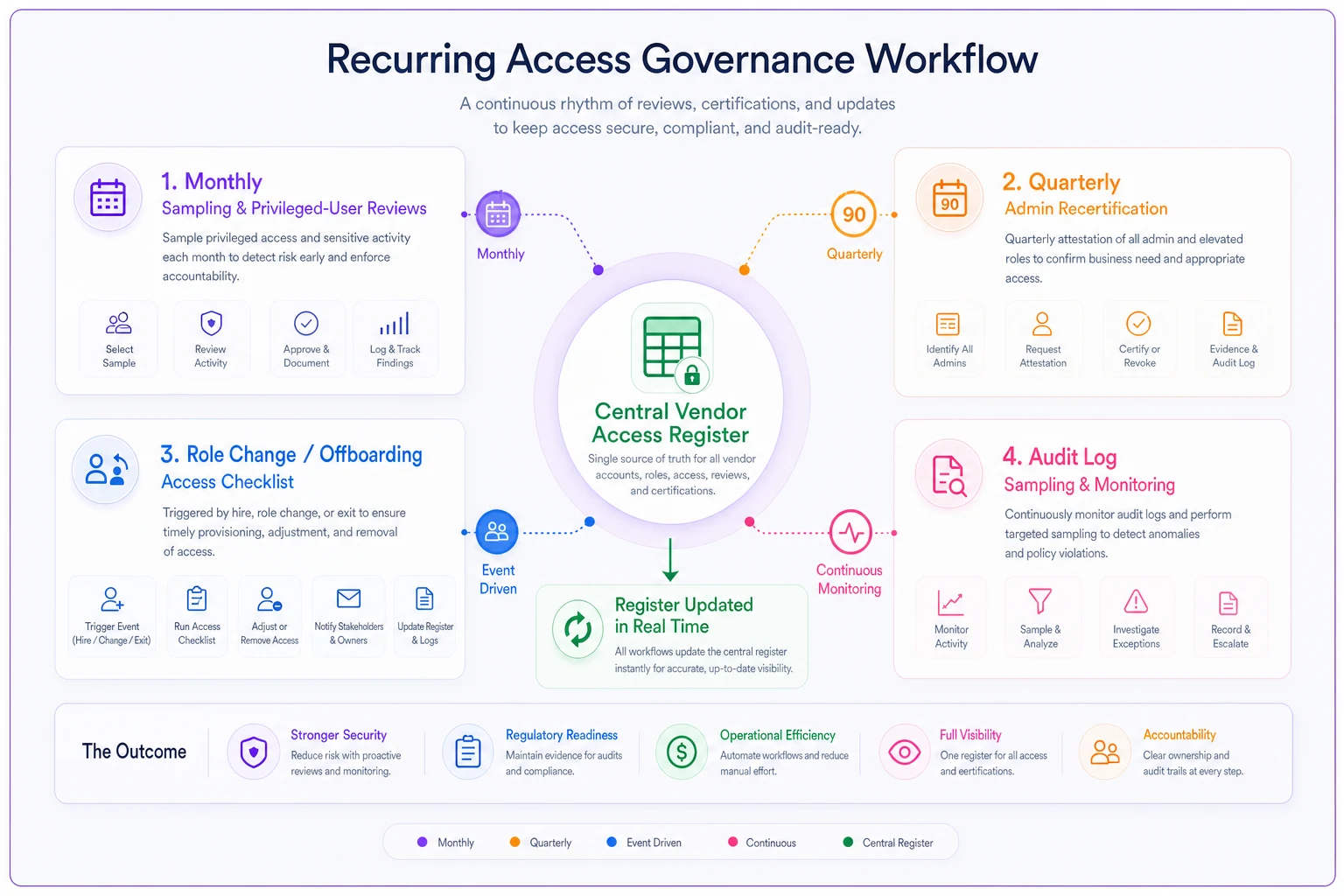
Turn access governance from a project into a habit: small role sets, simple registers, scheduled reviews, and enforced offboarding keep small finance teams resilient without enterprise overhead.
Ready to take control of your finances?
Join over 2,000 businesses using Acctaly to simplify accounting, accelerate cash flow, and ensure tax readiness.