
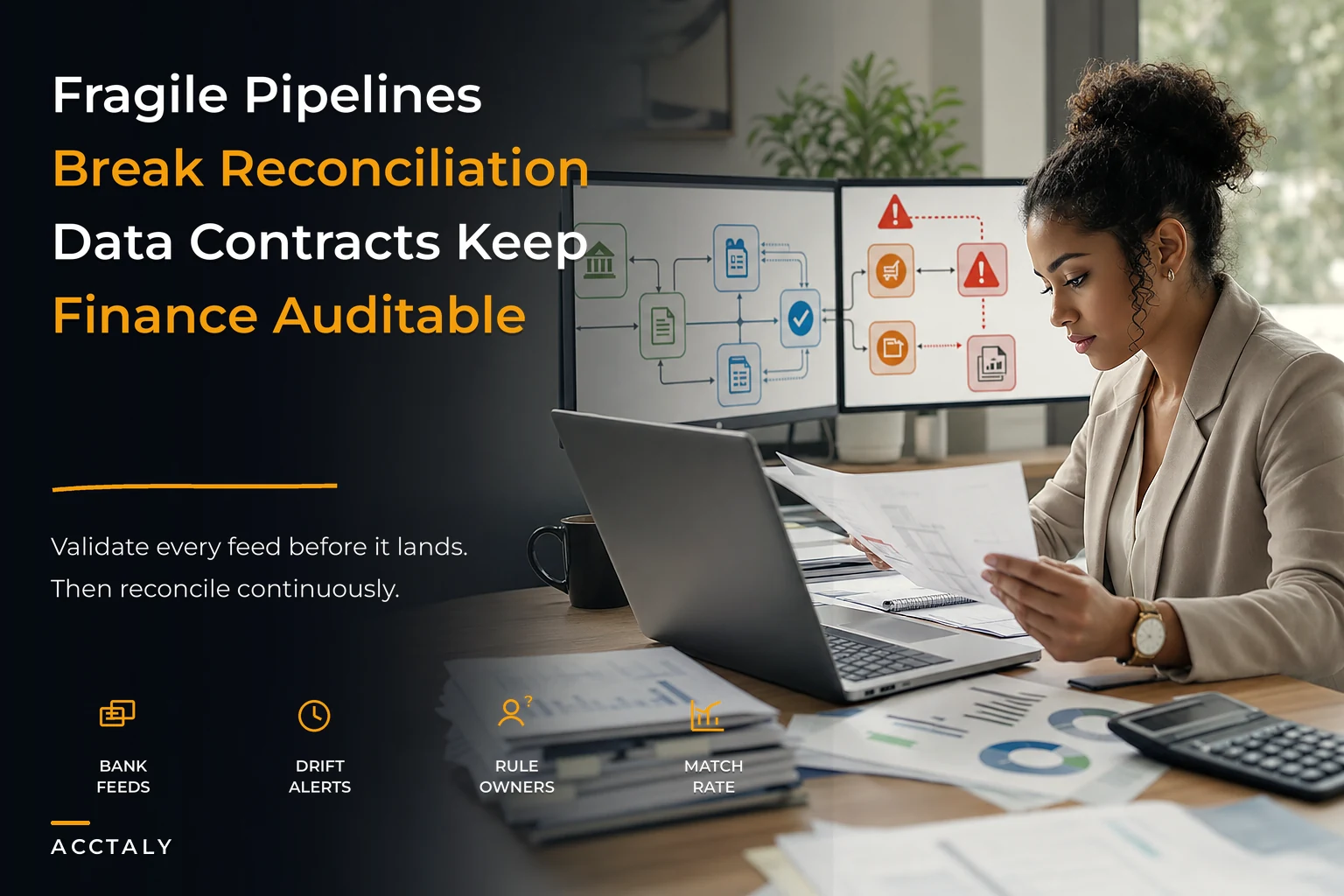

Most SMB finance teams discover data problems the same way – during month-end close when nothing reconciles. The sales system shows $847k in revenue, the bank shows $823k collected, and the accounting software landed somewhere around $841k after an overnight sync failed halfway through.
That gap between "what happened" and "what got recorded" kills trust in financial reporting. You end up with controllers manually verifying every transaction, CFOs second-guessing dashboards, and entire teams losing days to reconciliation work that should be automated.
The real issue isn't the individual system failures. It's that most SMBs treat their financial data flows like plumbing – they only check when something floods. Accounting data governance for SMBs doesn't need enterprise-level complexity. You need practical controls that catch breaks before they corrupt downstream reporting.
Why financial data breaks differently than operational data
Financial data has stricter requirements than your marketing metrics or inventory counts. A missed customer email is annoying. A missed invoice destroys your cash flow forecast.
The challenge multiplies because financial data touches everything. Your payment processor talks to your billing system, which feeds your accounting software, which populates your reporting dashboards. Each handoff is a failure point.
Take a typical ecommerce business processing around 200 orders daily. Their Shopify store records the sale, Stripe processes payment, the inventory system deducts stock, and QuickBooks creates the journal entry. Four systems, four potential breaks. When Stripe's webhook fails at 2am and drops 47 transactions, nobody notices until the bank reconciliation shows a $6,800 gap three weeks later.
The traditional response is adding manual checks everywhere. Finance teams build elaborate spreadsheets comparing system outputs, run daily reports looking for discrepancies, create approval workflows for every data movement. But manual validation doesn't scale. At 50 transactions per day you can spot-check. At 500, you're drowning.
The hidden cost of reconciliation firefighting
Most SMBs underestimate how much time gets burned on data reconciliation. A controller at a 40-person SaaS company can easily spend 8–12 hours a month just matching transactions across systems – and that's before investigating discrepancies or actually fixing anything.
Stop letting accounting slow your business down.
Acctaly automates your financial operations so you can focus on growth and compliance.
- Automated bookkeeping
- Real-time financial reporting
- Integrated tax management
No credit card required
The real damage happens in decision-making. When executives can't trust the numbers, they delay decisions. That acquisition target looks profitable based on your P&L, but are those revenue numbers actually accurate? The board wants updated metrics, but last month's data still has unexplained variances.
Companies lose deals because they couldn't produce clean financials fast enough. One manufacturing business missed a $2M credit line because their revenue recognition was so tangled across systems that producing auditable statements took three weeks.
The worst part is how problems compound. A schema change in your billing system breaks your ETL pipeline. Nobody notices for two weeks. Now you have 14 days of corrupted data flowing into reports, forecasts, and investor updates. Fixing it means unwinding everything downstream.
Building data contracts between financial systems
Data contracts are agreements about what information flows between systems and how it should look. Think of them as financial data treaties – your billing system promises to send customer invoices in a specific format, and your accounting system promises to process them correctly.
-
Invoice ID (unique, alphanumeric, max 20 characters)
-
Customer ID (must exist in customer master)
-
Amount (decimal, two places, positive values only)
-
Date (ISO 8601 format)
-
Status (enum
draft, sent, paid, void)
Without these contracts, systems make assumptions. Your billing platform sends dates as MM/DD/YYYY but your accounting system expects YYYY-MM-DD. Half your invoices import with dates in 1969. Nobody notices until an auditor asks why you have receivables older than your company.
The contract needs enforcement mechanisms. When data arrives that violates the contract, the system should reject it immediately – not silently corrupt your database. A payment processor sending negative invoice amounts should trigger alerts, not create mystery credits in your books.
For SMBs, start with contracts around money movement – invoices, payments, refunds. These directly impact cash flow and financial statements. Inventory and customer data can come later.
Validation tests that catch problems before month-end
Running validation tests on financial data isn't about perfection – it's about catching the big breaks before they cascade. The key is building tests that run automatically and alert the right people.
Start with balance tests. Every night, your test suite should verify:
-
Total invoiced = sum of line items
-
Bank deposits = processed payments
-
Refunds issued = refunds recorded
-
Tax collected = tax remitted
Then add trend tests. A 40% spike in revenue might be great news or a data duplicate. Your tests should flag unusual patterns:
-
Daily revenue variance > 25% from 7-day average
-
New customers > 2x normal rate
-
Average transaction size shifts > 15%
Format tests catch the subtle breaks. Check that account numbers maintain their structure, tax IDs follow valid patterns, and currency codes stay consistent. A European subsidiary accidentally sending amounts in cents instead of euros will pass balance tests but destroy your consolidation.
The validation framework needs to run continuously, not just at month-end. Set up tests to run after each data import, with results logged and anomalies flagged. A simple pass/fail dashboard keeps everyone aware of data health.
Reconciliation pipelines that run themselves
Reconciliation shouldn't be a monthly scramble. Build pipelines that continuously match transactions across systems and flag discrepancies in real-time.
-
Extract transactions from payment processor (every 4 hours)
-
Match against invoices in billing system
-
Verify amounts and dates align
-
Flag unmatched items for review
-
Push matched items to accounting system
-
Generate exception report for finance team
The pipeline needs tolerance for normal variation. Payment processors might batch deposits differently than you invoice. International payments arrive days late. Set reasonable matching windows – within 3 days and within $10 for small transactions is usually workable.
| Exception Size | Routing |
|---|---|
| Under $100 | Log for weekly review |
| $100–$1,000 | Email controller daily |
| Over $1,000 | Immediate alert to finance team |
The goal is reducing manual reconciliation from hours to minutes.
Route exceptions based on materiality to reduce noise and focus human review where it matters.
When month-end arrives, you're reviewing exceptions, not discovering problems.
Here's a simple visual of that pipeline.
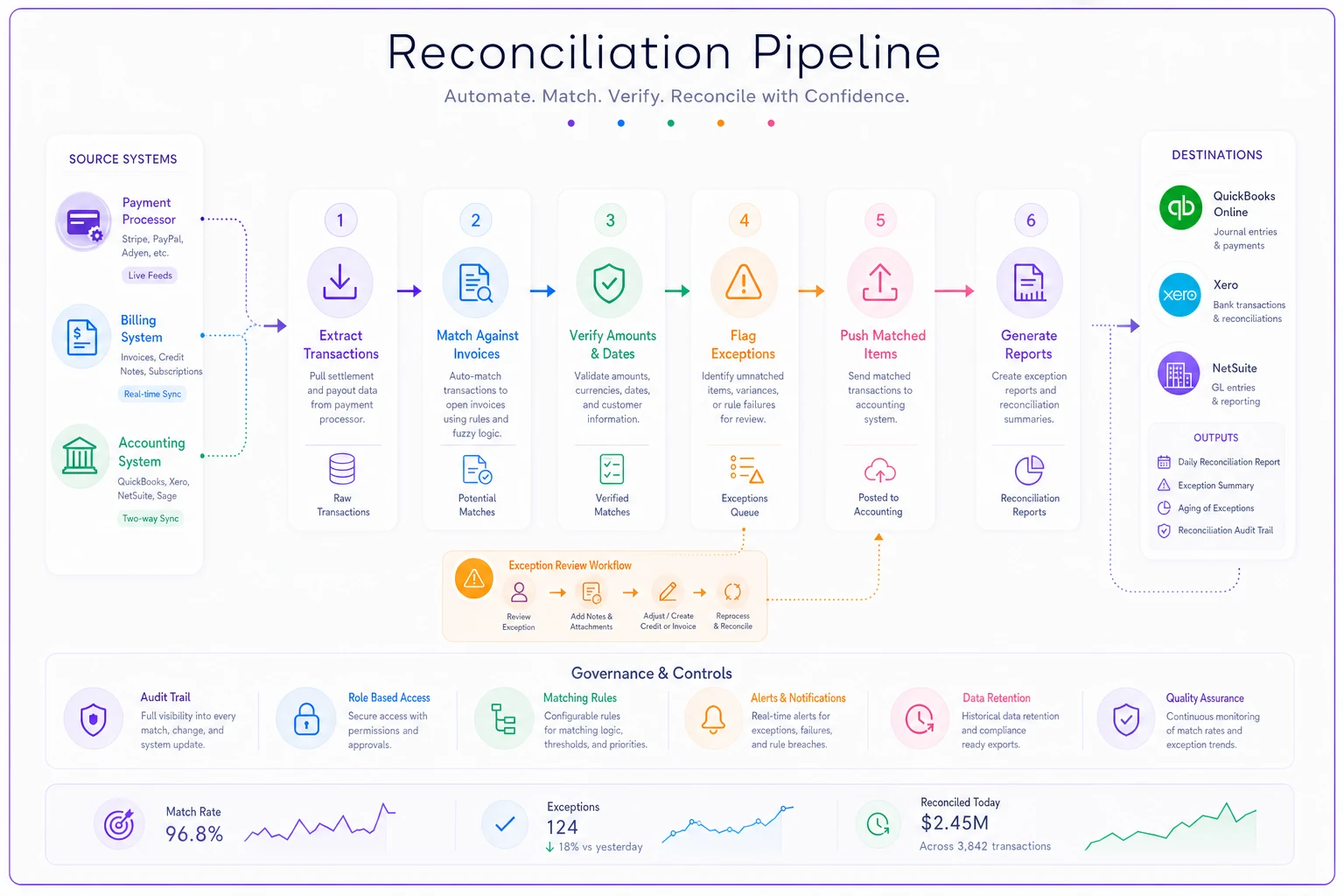
This visual maps the extract, match, verify, flag, and push workflow.
Schema versioning rules to prevent migration disasters
Every software upgrade threatens your financial data integrity. That innocent "update to customer fields" in your CRM cascades into broken revenue reports because nobody tracked how the schema change would impact downstream systems.
Version your schemas like code. When your billing system changes invoice structure, that's version 2.0, not a silent update. Your data contracts specify which version each system expects. When versions diverge, you know exactly what needs updating.
Document every field's lineage. That "customer_type" field in your database might feed seven different reports and two tax calculations. When you're preparing for a system migration, knowing these dependencies prevents nasty surprises.
-
No schema changes during close periods
-
All changes documented 14 days before implementation
-
Test migrations run against production data copies
-
Rollback procedures defined before changes go live
-
Downstream systems notified and tested
Keep a schema registry showing current and historical structures. When something breaks six months from now, you need to know exactly what changed and when. That mystery variance in Q2 revenue might trace back to a field rename everyone forgot about.
Setting up alerts before schema drift corrupts your books
Schema drift happens gradually. A field that stored currency as "USD" starts accepting "US Dollar" and "$USD." Three months later, your forex calculations are off by $47,000 because nobody noticed the inconsistency spreading.
-
New values in enumerated fields
-
Field size exceeding historical maximum
-
Data type mismatches
-
Null values in required fields
-
Referential integrity violations
These aren't just technical checks – they're protecting your financial accuracy. A product SKU field that starts accepting special characters might break your inventory valuation. A tax rate field that silently truncates decimals could trigger an audit.
Set up monitoring at data entry points, not just endpoints. If garbage gets into your source systems, it pollutes everything downstream. Alert when a new integration starts sending data, when volume spikes unexpectedly, when field patterns shift significantly, or when required relationships break.
Your alerting strategy also needs business context. A 10% increase in transaction volume might be normal during sales season but suspicious in February. Build seasonal adjustments into your thresholds.
What breaks when you scale from 50 to 500 transactions daily
At 50 daily transactions, Excel and manual checks work fine. At 500, your processes collapse. The breaking points are predictable.
First breakdown: manual matching becomes impossible. The controller who knew every customer payment by heart now faces a wall of transactions. Duplicate payments slip through. Refunds get missed. Your AR aging becomes fiction because nobody can track what's real versus timing differences.
Second breakdown: system limits emerge. The accounting software that handled 1,500 monthly transactions starts choking at 15,000. Syncs timeout. Reports take 20 minutes to generate. That nightly backup job that ran in 10 minutes now conflicts with your morning data imports.
Third breakdown: error rates compound. A 1% error rate on 50 transactions means one problem every other day. At 500 transactions, you're investigating five errors daily. Your finance team shifts from analysis to firefighting.
The solution isn't just better tools – it's different processes. Batch processing replaces real-time syncs. Exception-based reviews replace line-by-line checking. Statistical sampling replaces complete verification.
Building audit trails that auditors actually trust
Auditors don't care about your beautiful dashboards. They want to trace a transaction from source to financial statement. Most SMBs fail this test because their audit trails are scattered across systems, spreadsheets, and someone's memory.
-
What moved (transaction details)
-
When it moved (timestamp)
-
Where from/to (source and destination)
-
Who authorized (user or system)
-
Why it moved (business rule or manual override)
Store logs immutably. Once written, logs shouldn't change. Use append-only tables or write-once storage. When auditors see edited logs, they assume you're hiding something.
Make logs queryable and linkable. An auditor should be able to pick any GL entry and trace it back through your reconciliation pipeline to the original source document. This means maintaining transaction IDs across every system hop.
The audit trail also protects you operationally. When the CFO asks why last month's revenue dropped 8%, you can show exactly which transactions were delayed, reversed, or reclassified. Your chart of accounts structure only tells part of the story – the audit trail provides the evidence.
The real cost of broken financial data trust
When financial data breaks repeatedly, teams stop trusting systems entirely. Finance teams maintain shadow spreadsheets for everything because they don't believe what's in the ERP. Sales keeps their own commission calculations. Operations tracks inventory outside the official system.
This shadow accounting creates dangerous divergence. The board sees numbers from the CFO's spreadsheet. The ops team makes decisions from their own tracking. Sales argues about commissions based on their calculations. Nobody agrees on basic facts like monthly revenue or customer count.
The cultural damage extends beyond finance. When employees see broken financial systems, they assume everything else is broken too. That startup energy gets replaced with bureaucratic checking and double-checking. Bold decisions stop because nobody trusts the data enough to move confidently.
Recovery takes months. Even after fixing the technical problems, rebuilding trust requires consistent accuracy over multiple reporting cycles. Teams need to see that the numbers match reality before they'll abandon their shadow systems.
Simple governance that actually gets followed
Complex governance frameworks die in SMBs. That 47-page data governance manual looks impressive but nobody reads it. The 15-step approval process for schema changes gets bypassed during emergencies – which is always.
-
One person owns each data flow
-
Changes require notification, not complex approval
-
Break-glass procedures for emergencies
-
Regular reviews that actually happen
Start with critical flows. Payment data needs governance before marketing metrics. Revenue recognition before expense categorization. Customer invoicing before vendor management.
Make compliance painless. If following governance requires six forms and three meetings, people will find workarounds. Good governance feels like guardrails, not roadblocks.
Document decisions, not just processes. When you change how revenue gets recognized, write down why. Six months later when someone questions the logic, you have context. These decision logs become invaluable during audits, due diligence, and system migrations.
AI-powered operational platforms help here by automatically documenting data lineage and changes. When every transformation gets logged automatically, governance becomes about reviewing and approving rather than manual documentation.
Building your financial data immune system
Think of accounting data governance less like a project and more like an immune system – constantly monitoring, responding quickly to threats, and getting better from each incident.
Start with continuous monitoring. Set up daily health checks on critical data flows. Monitor both technical metrics (pipeline success rates, data volumes) and business metrics (revenue trends, payment patterns). When patterns shift unexpectedly, investigate before it compounds.
Build response playbooks. When reconciliation fails, everyone should know the steps: check source system status, verify network connectivity, review error logs, attempt manual sync, escalate if unresolved within two hours. Clear playbooks prevent panic and ensure consistent response.
Create feedback loops. Every incident should improve your system. That schema change that broke reporting becomes a new validation test. The payment batch that processed twice adds a duplicate check. Your governance grows from real failures, not theoretical risks.
The controls you need at $1M revenue won't work at $10M. The companies that handle this well aren't the ones with perfect systems – they're the ones that catch problems quickly, fix them systematically, and don't repeat the same break twice.
The path from fragile pipelines to trusted financials isn't through massive technology investments or enterprise software. It's through practical controls, continuous validation, and governance that matches your business reality. Start with payment reconciliation, add invoice validation, then expand to full pipeline monitoring. Each step reduces risk and builds confidence in your financial data. When month-end comes, your team is verifying accuracy, not discovering disasters. And that 3am pipeline failure gets caught, logged, and fixed before anyone even notices it happened.
Ready to take control of your finances?
Join over 2,000 businesses using Acctaly to simplify accounting, accelerate cash flow, and ensure tax readiness.