


Most finance risk conversations inside small companies die in the same spot: someone flags a gap — "we don't have dual approval on wires," "our vendor master is a mess," "anyone can issue a refund" — and everyone nods. Then nothing happens, because nobody can say what the gap is worth. It stays in the bucket of things that feel bad but don't have a price tag, and it loses every budget fight to things that do.
That's the actual problem. Not that owners don't care about controls. It's that a control gap without a dollar figure can't compete for attention against a sales hire or a new piece of equipment. So the whole thing stalls until something expensive breaks, and then you're doing remediation at 2am instead of on a roadmap.
This piece is about fixing that specific failure — how to quantify finance risk for an SMB so that every gap carries an expected-loss number, and that number drives what you fix first. No audit-firm jargon, no 80-page risk register nobody opens. A working method sized for teams of 1 to 50.
Why control gaps never get priced (and why that's the real bottleneck)
The reason gaps stay unpriced isn't laziness. It's that the people who see the gaps and the people who control the budget are usually the same one or two overloaded humans, doing this translation in their heads. "Feels risky" never gets converted into "costs roughly $X per year in expected loss," so it never gets compared apples-to-apples against anything else.
-
Everything is either "fine" or "a disaster." No middle ground. A gap leaking $400/month gets treated the same as one that could sink the company, because both are just "a risk."
-
Rare-but-huge risks get ignored. A wire-fraud exposure that happens once every three years but costs $90k feels less urgent than a daily $50 annoyance, even though the math says otherwise.
-
Remediation cost is invisible. People will spend $6k of engineering time to fix a $900/year problem because nobody put the two numbers side by side.
The fix is a framework that forces three dimensions into the open — how often something goes wrong, how bad it is when it does, and how likely you are to catch it before it hurts. That last one is the piece almost everyone skips, and it's what separates a tolerable gap from a genuinely dangerous one.
The frequency × impact × detectability lattice
Expected annual loss isn't just "how bad times how often." A problem you catch immediately costs far less than the same problem discovered three months later, buried in a reconciliation. So the model has three inputs, not two.
Stop letting accounting slow your business down.
Acctaly automates your financial operations so you can focus on growth and compliance.
- Automated bookkeeping
- Real-time financial reporting
- Integrated tax management
No credit card required
In plain terms: Expected Annual Loss ≈ Frequency (events/year) × Impact ($/event) × Detectability multiplier
The detectability multiplier is where judgment comes in. If a control gap produces errors you'd catch same-day, the real exposure is a fraction of the raw number. If it festers undetected, the multiplier pushes the exposure up.
| Dimension | Low | Medium | High |
|---|---|---|---|
| Frequency (how often it happens) | 1–2x/year | monthly-ish (~12x) | weekly+ (50x+) |
| Impact ($ per occurrence) | under ~$500 | ~$500–$5k | $5k+ |
| Detectability (how fast you'd catch it) | caught same-day → 0.5x | caught within the close → 1.0x | slips past close → 2.0x |
The detectability multiplier does something useful: it rewards the controls you already have. If you run a tight monthly close with real reconciliation, a lot of your "scary" gaps are actually medium-exposure because you'd catch the damage fast. If your close is slow and manual, the same gaps are genuinely dangerous because errors compound before anyone notices.
A quick worked example. Say duplicate vendor payments slip through because there's no three-way match:
-
Frequency
happens maybe 8 times a year → ~8
-
Impact
average duplicate is around $1,200 → $1,200
-
Detectability
usually caught in the next close, so 1.0x
Raw expected loss ≈ 8 × $1,200 × 1.0 = ~$9,600/year.
Now compare that to wire fraud via a spoofed vendor email:
-
Frequency
rare, maybe once every 3 years → ~0.33/year
-
Impact
realistically $25k–$40k if it lands, call it $30k
-
Detectability
by the time you notice, the money's gone → 2.0x
Expected loss ≈ 0.33 × $30,000 × 2.0 = ~$19,800/year.
That second one feels less urgent day to day — it almost never happens. But priced out, it's roughly double the duplicate-payment problem. Without the lattice, you'd fix the thing that annoys you weekly and leave the expensive one alone. This is the single most common prioritization mistake in small finance teams.
Mapping the gaps worth pricing
Before you can price anything you need an inventory, and the trap here is making it enormous. A 200-line risk register is where good intentions go to die. For a team under 50 people, you're looking at maybe 15–25 gaps that actually matter. Everything else is noise.
-
Cash out AP approvals, wire/ACH initiation, vendor master changes, corporate cards, reimbursements
-
Cash in billing accuracy, refund issuance, collections, revenue recognition timing
-
Record integrity who can edit the ledger, who reconciles, segregation between the person who pays and the person who records
-
Access who has admin rights in the banking portal, the accounting system, and the payment processors
If you've already done work on sizing internal controls to your team's headcount — the recipes in this breakdown of control gaps by team size are a solid starting point — you already have half this inventory. The goal here isn't to re-list controls. It's to attach a dollar number to the ones you've identified as weak.
One pattern worth naming: the gaps that cost the most are almost never the exotic ones. They're boring. Unreviewed vendor bank-detail changes, a single person who can both approve and pay, refund authority with no cap. The expensive risks hide inside routine workflows precisely because nobody looks at routine workflows.
Remediation-cost bands: pricing the fix, not just the risk
An expected-loss number alone will still mislead you, because a $9k risk that costs $400 to fix and a $9k risk that costs $15k to fix are completely different decisions. You need the cost side of the ledger too.
Keep the cost estimates in bands — trying to budget remediation to the dollar is false precision.
| Band | Rough cost | What it looks like |
|---|---|---|
| Quick fix | under ~$500 / a few hours | Turn on an existing approval setting, change permissions, add a required field |
| Moderate | ~$500–$3k | Build a reconciliation routine, write and roll out a policy, configure an integration |
| Heavy | $3k+ / multi-week | New system, custom tooling, process redesign across multiple people |
Most SMBs are surprised by how many high-exposure gaps fall into the "quick fix" band. Vendor bank-detail verification is often a free setting plus a 15-minute callback policy. Segregation between approver and payer is frequently a permissions change, not a hire. The reason these stay open isn't cost — it's that nobody priced the exposure, so the quick fix never got prioritized.
The decision rule that falls out of this is simple: sort by exposure-to-cost ratio. A $19k risk you can close for $500 is a 38-to-1 return. A $3k risk that costs $12k to fix can wait, or get accepted as a known risk. You're not fixing everything. You're fixing in the order that buys the most risk reduction per dollar.
Building the budget-aware backlog
This is the part that turns analysis into motion.
-
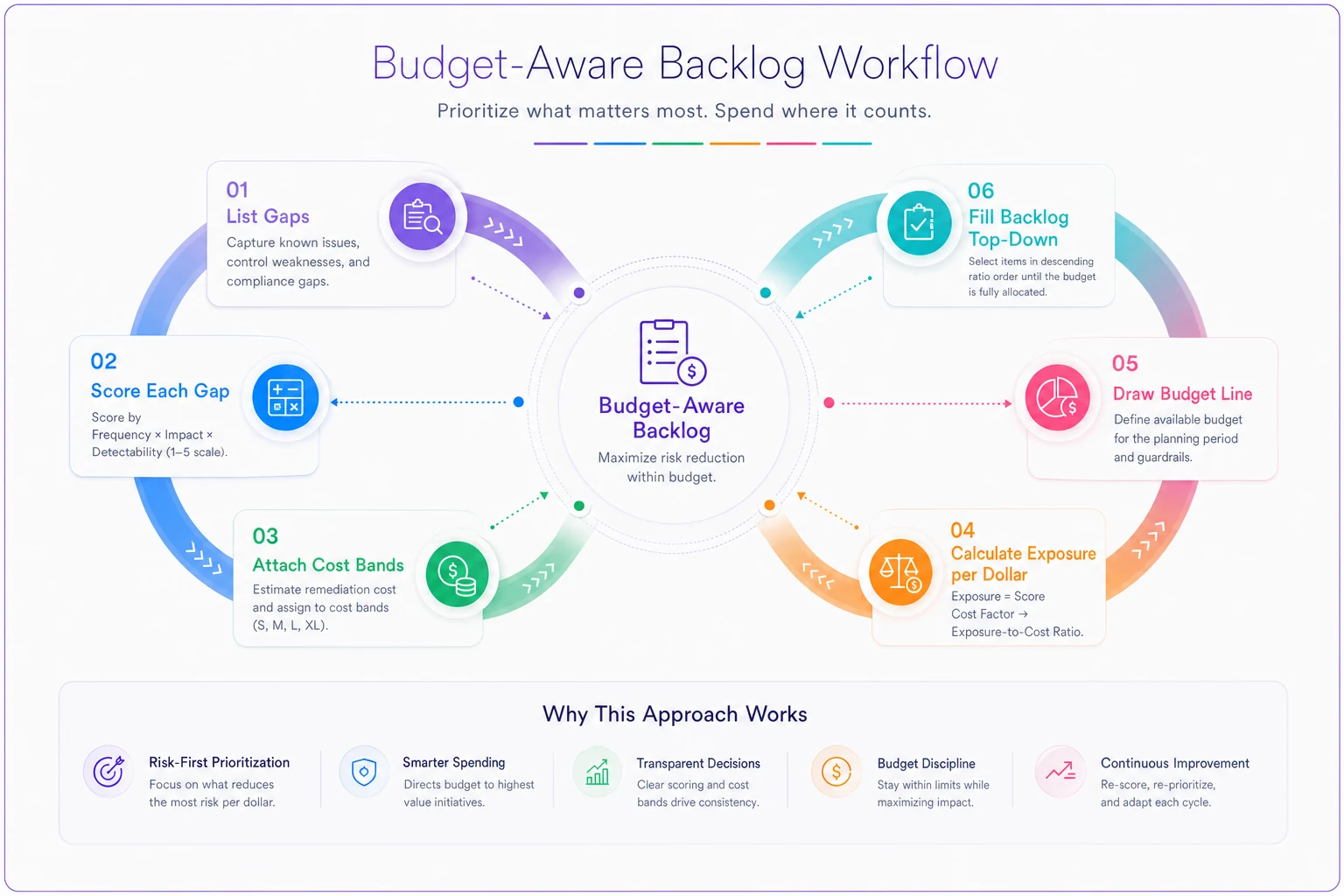
List each gap with its expected annual loss from the lattice. Don't agonize over the exact figure — the band matters more than the decimal.
-
Attach a remediation-cost band to each.
-
Calculate the ratio (expected loss ÷ remediation cost). This is your rough priority score.
-
Draw your budget line. Say you have $8k and two weeks of someone's time this quarter for risk work. That's your constraint.
-
Fill the backlog top-down until you hit the budget line. Everything above the line is this quarter's work. Everything below is either next quarter or an accepted risk.
-
Document the accepted risks explicitly. The gaps you chose not to fix are a decision, not an oversight. Write down why. This matters enormously if one of them ever bites you — "we evaluated it, priced it at $2k/year, and deprioritized it against higher exposures" is a defensible position. "We never noticed" is not.
A quick visual of the budget-aware backlog workflow.
Document accepted risks explicitly — write down why you deprioritized them so decisions are defensible later.
That last step is underrated. Half the value of this exercise is converting silent, forgotten risks into documented, deliberate decisions. Even the stuff you don't fix is now tracked, priced, and revisitable.
-
Does every item have a frequency, impact, and detectability score — not just a gut feeling?
-
Did you actually include the rare-but-huge risks, or did your list drift toward frequent-but-cheap annoyances?
-
Is the detectability score honest about your current close speed, not aspirational?
-
Did the quick-fix, high-exposure items float to the top where they belong?
-
Are the accepted risks written down with a reason?
-
Does the backlog fit the budget and time you actually have — not an imaginary unlimited one?
A quick sanity-check for the backlog before you commit to it:
A real scenario: a 22-person agency
A digital agency, around 22 people, roughly $4M in revenue. Finance was one controller plus a part-time bookkeeper. They knew they had control weaknesses but had never ranked them, so remediation was whatever the controller felt nervous about that month.
When they ran the lattice across their money-movement workflows, a few things surfaced:
-
No cap on refund/credit authority — account managers could issue client credits with no approval. Frequency was high (happening most months), impact was moderate ($800–$2,500 per credit), and detectability was poor because credits got buried in client billing. Expected loss landed somewhere around $14k–$18k/year. Fix: a $0 approval setting in their billing tool plus a one-page policy. Quick-fix band.
-
Vendor bank-detail changes went unverified. Rare but the classic high-impact fraud vector. Priced at roughly $12k/year expected loss, fixable with a callback policy and a required second reviewer. Quick-fix band.
-
The bookkeeper could both enter and pay bills. Segregation gap. Moderate exposure, fixable with a permissions change — essentially free.
Against those, the thing the controller had been most anxious about — building a fancier month-end variance process — scored low on exposure and sat in the heavy-cost band. It had been eating her attention for months while three quick-fix, high-exposure gaps stayed wide open.
They closed all three in about two weeks for under $1k total, mostly configuration and policy work. The refund-authority fix showed up in the numbers within a quarter — credit leakage dropped noticeably once approvals were required. The point wasn't the specific dollars saved. It was that they'd been spending their limited risk attention on the wrong things entirely, and a half-day of pricing exposure redirected it.
When this framework helps — and when it doesn't
When it makes sense: You've got more identified risks than budget to fix them — which is basically everyone — and you need a defensible way to choose. It's especially useful right before a funding round, a bank covenant review, or bringing on a new finance hire who needs to know what's already been triaged.
When it's overkill: If you're a two-person shop with three known gaps and the budget to fix all three, skip the spreadsheet and just fix them. The framework earns its keep when you have to say no to something.
Who should be careful with it: Don't let the scoring become theater. If you spend four weeks perfecting detectability multipliers to the second decimal, you've missed the point — you could've closed half your quick fixes in that time. The lattice is a decision tool, not a deliverable. Rough-and-fast beats precise-and-late every time.
Where this connects to the rest of your finance operation
Risk pricing doesn't live in isolation. The detectability dimension is directly a function of how tight your close and reconciliation are — improve those and your whole risk profile shifts without touching individual controls. Access rights feed straight into several of your highest-exposure gaps, which is why getting finance access governance right quietly closes multiple lattice items at once.
And when the backlog points toward automation or tooling as a remediation, that's where spend discipline matters — because not every gap is worth a tool. The same ratio thinking applies to deciding which automation investments actually pay off, which is the whole argument behind using a portfolio scoring framework for finance automation rather than buying software every time something feels broken.
The thread running through all of it: control work only gets done when it can compete for budget, and it can only compete when it carries a number. Turning "that feels risky" into "that's roughly $15k/year of exposure we can close for under $1k" is the entire game. Do that translation once, and the decisions about what to fix first stop being arguments and start being arithmetic.
Ready to take control of your finances?
Join over 2,000 businesses using Acctaly to simplify accounting, accelerate cash flow, and ensure tax readiness.