



Most SMB finance teams don't have a workload problem. They have a demand problem. Requests arrive from everywhere — Slack DMs, hallway asks, a founder forwarding an investor email at 9pm, sales wanting a custom margin breakdown "real quick," ops needing a vendor set up "today." None of it is unreasonable on its own. But together it forms an invisible tax that eats the close, delays reporting, and quietly burns out the two or three people holding the numbers together.
The fix isn't hiring. It's treating finance like an internal service provider — a defined menu of services, defined turnaround times, priority rules, and a way to say "yes, and here's when" instead of "yes" to everything simultaneously. That's what a finance-as-a-service operating model gives you. It converts an unpredictable request firehose into a queue with rules.
This isn't the same thing as writing SLAs for your reports (that's upstream of this). It's the operating layer that sits between everyone who wants something from finance and the small team that has to deliver it.
The pattern behind the chaos: finance has demand it never priced
Almost nobody names this out loud. Sales has a pipeline. Support has a ticket queue. Engineering has a sprint. Finance has… whatever landed today. The other functions have interfaces that shape and throttle incoming work. Finance usually has an open door and a reputation for being helpful, which is exactly how it drowns.
What you tend to see across small teams is that the work splits roughly like this:
-
Recurring committed work — close, payroll, AR/AP runs, board reporting. Non-negotiable, calendar-driven.
-
Standing service work — vendor onboarding, expense questions, access requests, ad-hoc report pulls.
-
Project work — a pricing model, a diligence pack, a systems migration.
-
Interrupts — "can you check this transaction," "why is this number different," "quick favor."
The recurring work has a natural rhythm, so it defends itself. Everything else competes for the same hours with no referee. And interrupts win, because they feel urgent and they come with a face attached. So the close slips, the person doing it context-switches nine times before lunch, and errors creep in — not because anyone's careless, but because the system has no way to protect focused work.
A finance-as-a-service model gives you the referee. You publish what finance offers, how fast, at what priority, and who pays for it (even if "pays" is just budget attribution, not real cash). Once those rules exist, ad-hoc requests stop being infinite.
What breaks as you scale — and why "we'll just be responsive" stops working
At three people, informal works. Everyone knows everything, the founder can pull a report, and the bookkeeper remembers which vendor is which. The cost of an interrupt is low because the whole system fits in a few heads.
Stop letting accounting slow your business down.
Acctaly automates your financial operations so you can focus on growth and compliance.
- Automated bookkeeping
- Real-time financial reporting
- Integrated tax management
No credit card required
Somewhere between 15 and 40 employees, that quietly collapses. The number of requesters grows faster than the number of fulfillers. A single new department head can generate more finance requests than three individual contributors combined. And because nobody wrote down what finance actually does, every new manager invents their own expectation of turnaround, format, and priority.
-
No shared definition of "done." Someone asks for a "margin report." Finance builds one. It's wrong — not technically, but it didn't answer the actual question. Two more round trips follow. Multiply that across dozens of requests a month.
-
Priority by volume, not value. The loudest requester or the most senior person jumps the queue. Meanwhile the thing that actually protects cash sits untouched.
-
Invisible cost. Nobody knows that "quick" custom reporting for the sales team eats maybe a day and a half of finance capacity every week. Because it's never priced, it never gets questioned.
-
Knowledge locked in people. One person knows how to run the payout reconciliation, and when they're out, the request just doesn't happen.
Responsiveness feels like good service but it's actually the enemy of predictable delivery. Every "yes, right now" is a hidden "no, later" to something calendar-critical.
The core building blocks of a finance service catalog
The whole model rests on one artifact: a service catalog. A plain list of what finance offers, described from the requester's point of view, each with an owner, an SLA, a priority class, and acceptance criteria. Nothing fancy. A shared doc or a table in your ticketing tool is enough to start.
A workable catalog entry has five fields:
| Field | What it answers | Example |
|---|---|---|
| Service name | What can I ask for? | "New vendor setup" |
| Inputs required | What must I provide? | W-9, banking details, approver name, GL category |
| SLA (standard tier) | When will it be done? | 2 business days after complete inputs |
| Priority class | How does it get queued? | P3 — standard |
| Acceptance test | How do we know it's right? | Vendor payable in system, tax form on file, first invoice routes correctly |
The magic is in the "inputs required" column. Most ad-hoc chaos comes from incomplete requests. When you specify inputs up front, the SLA clock only starts when the request is complete. That single rule kills a surprising amount of back-and-forth. Requesters learn to bring the whole ask, because they know a half-request just sits.
A starter catalog for a 20–50 person company usually covers somewhere around 12–18 services. You don't need more. If a service only gets requested once in a blue moon, it's project work — handle it separately.
A minimal starter catalog
-
New vendor / supplier setup
-
Expense reimbursement question or exception
-
System access request or change
-
Ad-hoc report pull (from a fixed list of report types)
-
Custom analysis / new report build (project-classed)
-
Customer / contract billing setup or change
-
Refund or credit processing
-
Payroll change (off-cycle)
-
Month-end variance question
-
Chart-of-accounts change request
-
Cash / payment status inquiry
-
Diligence or lender document request
If a service only gets requested once in a blue moon, it's project work — handle it separately.
SLA tiers that survive real constraints
A lot of SMBs overreach here. They copy an enterprise SLA framework with five tiers, response-time-vs-resolution-time distinctions, and 24/7 coverage language. Then they can't staff it, so it becomes a document nobody honors — which is worse than no SLA at all, because now people distrust the whole system.
Three tiers is genuinely enough.
| Tier | Turnaround (standard) | What it's for | Priority behavior |
|---|---|---|---|
| Priority (P1) | Same day / next business morning | Payment failures, payroll blockers, lender/board deadlines, anything that stops cash moving | Preempts standing work; owner notified directly |
| Standard (P2) | 2–3 business days | Vendor setup, report pulls, access changes, most reimbursement questions | Normal queue, first-in-first-out within tier |
| Scheduled (P3) | Next close cycle or agreed date | New report builds, analysis projects, non-urgent COA changes | Batched, planned into capacity |
Two rules make this hold.
Rule one: escalation to P1 requires a name. Anyone can flag something urgent, but a P1 has to be tied to a specific real-world consequence and a person who owns that consequence. "It's urgent" doesn't qualify. "The bank needs this reconciliation by Thursday or the covenant certificate is late" does. This stops priority inflation cold.
Rule two: during close, only P1 gets touched. For the first five business days of your close, P2 and P3 work is frozen and everyone knows it. This is the single most protective rule you can install. If your close is chronically late, this alone often fixes it.
If you haven't already formalized turnaround expectations for your recurring reporting, the SLA language and KPI mapping in our guide on enforceable finance SLAs is the layer this operating model sits on top of.
Copy-ready SLA language
> Finance Service Levels > Finance operates as an internal service team. Requests are handled by priority tier. The SLA clock begins when a request includes all required inputs listed for that service. > > - Priority (P1): Resolved same business day or by next business morning. Reserved for cash-blocking issues, payroll blockers, and external deadlines (lender, board, regulator). Must reference the specific deadline or consequence. > - Standard (P2): Resolved within 2–3 business days. Covers routine setup, changes, and report pulls from the standard list. > - Scheduled (P3): Planned into the next available capacity window; delivery date agreed at intake. Covers new builds, analysis, and non-urgent structural changes. > > During the monthly close (business days 1–5), only P1 requests are actioned. All other requests are queued and resumed on business day 6. > > Incomplete requests are held, not started. The requester will be notified of missing inputs within one business day.
That last line does heavy lifting. It reframes a delay as the requester's incomplete input, not finance being slow — which is usually the accurate story anyway.
Chargeback and attribution: making cost visible without becoming a bank
Real internal invoicing is overkill at SMB scale and creates its own admin burden. What you actually need is attribution — a lightweight way to show which department is consuming finance capacity, so the conversation about priorities has data behind it.
The simplest version: tag every ticket with a requesting department and a rough effort size (S / M / L, or 0.5 / 2 / 8 hours). At the end of the quarter you can show, plainly, that "custom sales analysis" consumed the equivalent of a day a week. Now the head of sales either sponsors that as budgeted work, or it drops to P3.
A typical pattern: a services company mapped a quarter of finance requests and found roughly 40% of ad-hoc effort came from a single department that generated maybe 12% of the total ticket volume — they were just large, custom builds. Nobody had ever seen that number. Once it was visible, three of those recurring builds got templatized into standard reports, and the ad-hoc volume from that team dropped noticeably within two months.
Real chargeback — moving actual budget between departments — only makes sense once you're closer to 50+ people with real cost centers and leadership that actually uses internal margin by department. Below that, attribution alone changes behavior. Charging real money mostly creates resentment and gaming.
Onboarding and acceptance tests: the part everyone skips
A service catalog that nobody knows about is just a doc. The operating model only works if requesters are onboarded to it — meaning when someone new joins or a new department spins up, they get a five-minute walkthrough: here's what finance offers, here's how to ask, here's what "urgent" actually means.
Acceptance tests are what stop the endless revision loop. Every catalog service should have a short, checkable definition of done. Not a vibe — a checklist.
Here's an acceptance-test checklist for new vendor setup:
-
[ ] Tax form (W-9 or equivalent) received and stored
-
[ ] Banking / payment details captured and verified against a second source
-
[ ] Vendor record created with correct default GL category
-
[ ] Approver assigned and confirmed
-
[ ] Duplicate check run against existing vendor list
-
[ ] Test that first invoice routes to the correct approval path
-
[ ] Requester notified with vendor ID
When acceptance tests exist, "done" isn't a matter of opinion, and requests don't bounce back three times. It also means the work can be handed to a less-senior person and still land correctly — which is how you actually free up your senior finance people.
Access requests deserve their own tighter acceptance test, because getting them wrong creates real risk. If access and permissions are a soft spot for you, the controls laid out in finance access governance for small teams slot in directly as the acceptance criteria for that specific service.
A real scenario
A roughly 35-person e-commerce and wholesale business ran finance with two people: a controller and a bookkeeper. The close was consistently landing on business day 11 or 12, which meant leadership was making decisions on numbers that were nearly six weeks stale by the time anyone acted on them.
When they mapped where the time went, the close itself wasn't bloated. The problem was interruption. The controller was fielding somewhere around 30–40 ad-hoc requests a week — vendor setups, "can you check this charge," custom pulls for a marketing campaign, reimbursement disputes. Each one small. Together, most of two days a week gone.
They stood up a service catalog with 14 entries, three SLA tiers, and the close-week freeze rule. No new hires, no new software beyond the ticketing tool they already had. Requests moved from DMs into a single intake form.
The first month was bumpy — people grumbled about "filling out a form for everything." By month two the pattern shifted. Incomplete requests dropped because the intake form required the inputs. The close moved to business day 7, then settled around day 6. The controller got back roughly a day a week of focused time. And the department attribution data started an overdue conversation about which "quick" reports should just become standing dashboards.
Nothing dramatic. No transformation. Just demand that finally had a shape.
How request intake actually flows in practice
Once the catalog is live, the intake-to-resolution flow follows a consistent path. Here's how a standard request moves through the model:
Requester submits intake form (with required inputs) ↓ Intake check: complete or incomplete? ↓ Incomplete → held, requester notified within 1 business day ↓ Complete → classified by service type + priority tier ↓ P1 → routed directly to owner, actioned same day P2 → added to standard queue, first-in-first-out P3 → batched into next available capacity window ↓ Fulfillment runs against acceptance test checklist ↓ Pass → requester notified, ticket closed, effort tagged by department Fail → back to fulfillment, not closed
The flow isn't complicated. What matters is that every step has a rule and a responsible party — which is exactly what makes it different from the open-door model it replaces.
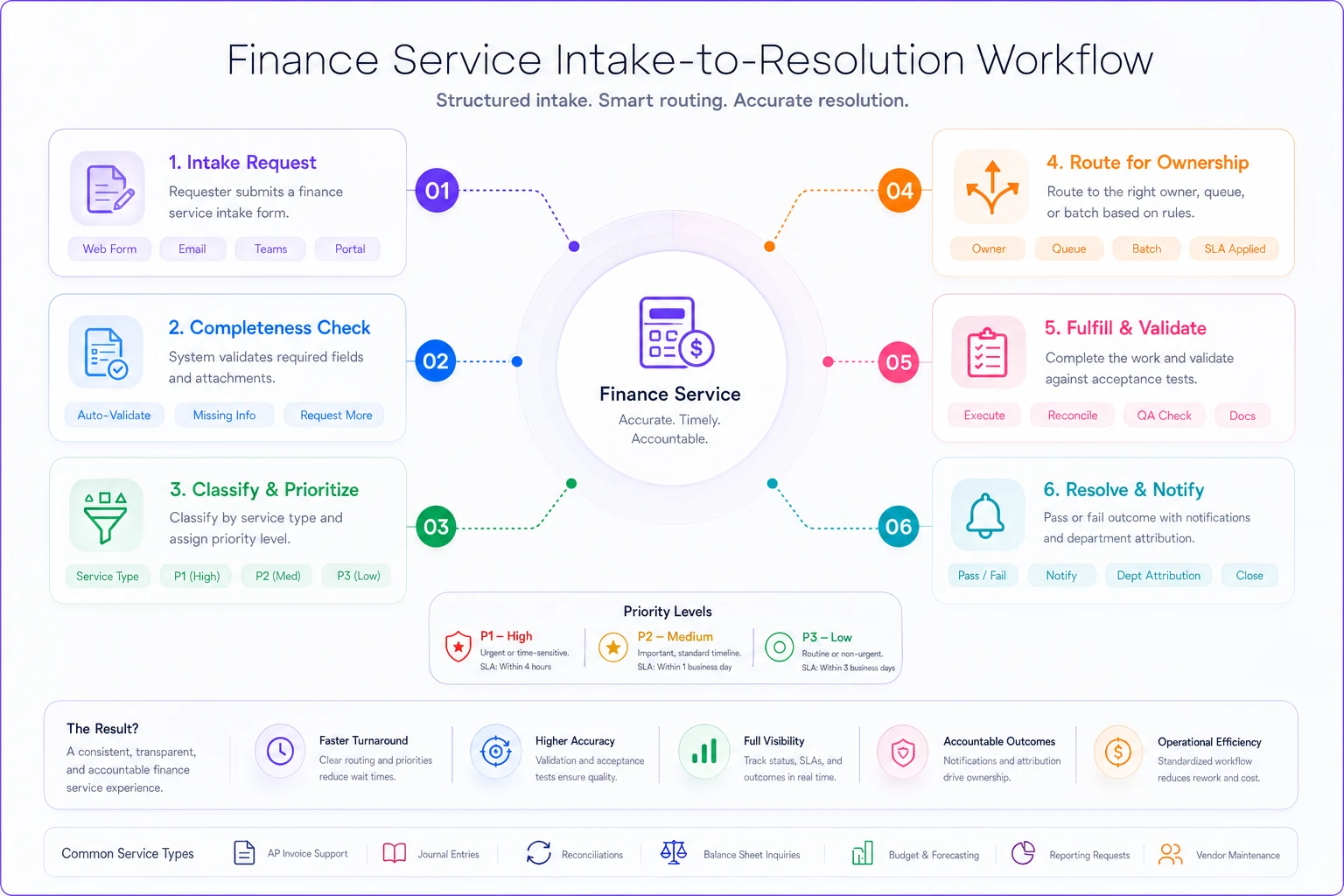
This diagram shows the straight-through steps and decision points for intake, completeness checks, tiering, fulfillment, and closure.
Where AI automation quietly helps
Once you've got a catalog with defined inputs and acceptance tests, a lot of the repetitive fulfillment becomes automatable — and this is where AI-assisted operational tooling earns its place, not as a gimmick but as a practical way to hold the SLAs you actually promised.
Intake is the obvious starting point. AI can read an incoming request in plain language, classify which catalog service it maps to, check whether the required inputs are present, and route it to the right tier and owner — instead of someone triaging every ticket by hand. Vendor setup, access changes, and standard report pulls have enough structure that much of the fulfillment and acceptance-test checks can run with automation doing the first pass and a person approving.
The point isn't to remove people from finance. It's that a two-person team shouldn't spend scarce judgment on classifying and routing tickets. Let the operational platform handle intake, matching, and routine checks; let your people spend their attention where judgment actually matters. That's the difference between an SLA you wrote and an SLA you can actually keep as request volume grows.
When this model makes sense — and when it doesn't
It makes sense when:
-
You have more than a handful of people generating finance requests
-
Your close or reporting is slipping and interrupts are a visible cause
-
You've got two or more finance people and coordination between them is getting fuzzy
-
Different departments have wildly different expectations of finance turnaround
It's premature when:
-
You're under roughly 10 people and finance is one person who knows everyone. The overhead of a catalog and tiers outweighs the benefit. Just protect close week and move on.
-
Your request volume is genuinely low and predictable. Don't build a queue for a trickle.
Who should not do this: a solo founder-bookkeeper serving a tiny team. You'll spend more time maintaining the catalog than you'd ever save. And if you're currently deciding whether finance should even live in-house at all, sort that first — the tradeoffs in when to outsource finance vs keep it in-house shape whether an internal service model is even the right container for the work.
The mindset shift that makes it stick
The hardest part of this isn't the templates. It's the culture change — finance going from "always available helper" to "internal service team with rules." That feels less generous. Some people push back.
But that generosity was always an illusion. A finance team that says yes to everything immediately is a team that's late on the things that actually matter, buried in interrupts, and one sick day away from a missed payroll or a blown board deadline. Rules aren't the opposite of good service. At any real scale, they are good service — because they're the only way to make delivery predictable enough to trust.
Start small. Catalog the ten or twelve things people ask for most. Write three tiers. Install the close-week freeze. Require complete inputs before the clock starts. The chaos was never about too much work. It was about work that arrived with no shape and no rules — and shape is something you can build in an afternoon.
Start small. Catalog the ten or twelve things people ask for most. Write three tiers. Install the close-week freeze. Require complete inputs before the clock starts. The chaos was never about too much work. It was about work that arrived with no shape and no rules — and shape is something you can build in an afternoon.
Ready to take control of your finances?
Join over 2,000 businesses using Acctaly to simplify accounting, accelerate cash flow, and ensure tax readiness.