


Most finance teams don't fall apart because someone is bad at their job. They fall apart because nobody ever wrote down what "on time" actually means, who owns each piece, and what happens when a number shows up three days late. The work gets done — eventually — but "eventually" is exactly the problem when you're trying to run cash off numbers you can't trust to arrive.
That gap is where finance SLAs come in. Not the enterprise-flavored, 40-page document version. The practical kind: a short set of promises about timing, ownership, and escalation, mapped to the KPIs that actually move decisions. Done right, it's the difference between a founder asking "where's the cash report?" every Monday and a founder who already has it before they think to ask.
Why "we'll get to it" quietly costs you real money
The hidden cost of unpredictable reporting isn't the missing report. It's the decisions people make without it.
When the AR aging is two weeks stale, someone approves a big order for a customer who's already 60 days past due. When the cash position lands Thursday instead of Monday, a payroll run and a supplier payment collide and you eat an overdraft fee — or worse, you sit on cash you could've deployed because nobody was confident enough to move.
Worth naming: the businesses with the worst reporting reliability are almost never the ones with the least data. They usually have plenty of data. What they lack is a shared definition of when it's supposed to be final. Ask five people when the month is "closed" and you'll get five different answers — one says when the bank rec is done, another says when the P&L looks reasonable, a third says when the founder stops asking questions.
Without SLAs, close and reporting run on social pressure. And social pressure doesn't scale. It works when you're three people in a Slack channel. It breaks the moment you add a controller, an outsourced bookkeeper, and a founder in a different time zone who all assume someone else is watching the deadline.
The three things every finance SLA needs (and most skip)
An SLA that actually gets followed has three parts. Skip any one and the whole thing turns into a document nobody reads.
Stop letting accounting slow your business down.
Acctaly automates your financial operations so you can focus on growth and compliance.
- Automated bookkeeping
- Real-time financial reporting
- Integrated tax management
No credit card required
Timing. Not "monthly" — a specific business day. "Flash P&L by BD+3" means something. "Around the beginning of the month" means nothing and everyone knows it.
Ownership. A single named role per deliverable. Not a team. The second two people own something, zero people own it. This is the most common failure — teams write SLAs where "Finance" owns the cash report, then act surprised when the cash report is late.
Escalation. What happens when the timing slips. Who gets pinged, when, and what they're supposed to do about it. Most SLAs die here because the "what happens when it's late" section is blank, which tells everyone the deadline is optional.
An SLA with no consequence isn't an SLA — it's a wish. You don't need harsh penalties. You need predictable ones. A comp rule, a re-prioritization, an escalation that's automatic rather than one where someone has to decide whether to make it awkward.
Mapping KPIs to SLAs (this is the part people get backwards)
Most teams pick metrics first and worry about delivery later. Flip it. Start from the decisions you make on a cadence, then work backward to the KPI, then to the SLA that guarantees the KPI shows up in time to matter.
A KPI that arrives after the decision window is worse than useless — it creates the illusion of a data-driven process while the actual decisions get made on gut. If you've already worked through which numbers actually matter versus which ones just look impressive, our take on that lives in the financial reporting framework that maps KPIs to services, SaaS and retail businesses. SLAs are how you make those chosen KPIs reliable, not just defined.
| KPI | Decision it drives | Required freshness | SLA (delivery) | Owner |
|---|---|---|---|---|
| Cash position | Payables timing, payroll safety | Daily | By 9:30am each business day | Bookkeeper |
| AR aging (30/60/90) | Collections push, credit holds | Weekly | Monday BD, by noon | AR lead |
| 13-week cash forecast | CapEx, hiring, big supplier orders | Weekly refresh | Friday EOD | Controller |
| Flash P&L | Early read on the month | Monthly | BD+3 | Controller |
| Final close package | Board, lenders, tax | Monthly | BD+8 | Controller |
| Gross margin by line | Pricing, mix decisions | Monthly | BD+10 | FP&A / founder |
Notice the freshness column doesn't match the SLA column exactly — that's intentional. Freshness is how current the data needs to be. The SLA is when the packaged, checked version lands. A cash position that's technically current but sitting unreviewed in a spreadsheet isn't a delivered KPI.
A prescriptive SLA template you can copy
Here's the structure we'd hand a team building this for the first time. It fits on one page per deliverable, which is the point — nobody maintains a template that takes an hour to fill out.
Deliverable: Weekly cash report
Owner (single role): Bookkeeper
Backup owner: Controller
Timing: Every business day by 9:30am; weekly summary Monday by noon
Inputs it depends on: Prior-day bank feeds reconciled, pending payables list current
Definition of done: Bank balances tie to feed, no unreconciled items older than 2 days, variance vs forecast noted if over ±10%
Escalation trigger: Not delivered by 10:00am
Escalation path: Auto-notify controller at 10:00am → founder at 11:00am if still missing
Penalty / comp rule: Two misses in a month → the deliverable moves to the front of that person's queue and a root-cause note is required at the next weekly finance sync
That "definition of done" line does more work than anything else on the page. Late is easy to spot. Wrong but on time is the real killer, and it's what a definition of done catches. A cash report delivered at 9:15am with an unreconciled $14k transfer sitting in it isn't a hit — it's a miss dressed up as a win.
The penalty and comp rules that actually work at SMB scale
-
Root-cause requirement every miss needs a one-sentence "why" at the next sync. Nobody wants to write "forgot" three weeks in a row.
-
Queue re-prioritization a missed SLA jumps to the top of the owner's list, which naturally displaces the lower-value work that caused the slip.
-
Streak tracking on-time streaks are surprisingly motivating. People protect a 20-week clean record.
-
Escalation as the consequence for many teams, "the founder gets auto-pinged" is the penalty, and it's enough.
For lender or board reporting specifically, a real dollar-linked SLA sometimes makes sense — think a covenant reporting deadline where lateness has an actual cost. Keep those rare and reserve the hard consequences for the few deliverables where lateness genuinely burns cash.
What breaks as you grow (the part nobody warns you about)
At 1–3 people, you don't need SLAs. You need one person who remembers everything, and it works fine until it doesn't. The failure mode here is a bus-factor of one — the person who "just knows when things are due" takes two weeks off and the close silently slips.
At 4–10 people, the handoffs multiply. The bookkeeper closes the sub-ledger, hands to the controller for review, who hands to the founder for sign-off. Every handoff is a place the SLA can die, and without written ownership each person assumes the next person is watching the clock. This is the stage where "we thought you had it" becomes the most expensive sentence in finance.
At 10–50 people, you've got parallel workstreams — AR, AP, payroll, revenue recognition — all feeding the close, all with their own timing. Now a single late input (say, a sales team that hasn't confirmed a deal's terms) cascades into a late revenue number, a late P&L, and a board deck that goes out Friday night instead of Wednesday. The whole point of a predictable monthly close falls apart when upstream SLAs aren't enforced. If your close itself is the thing slipping, the mechanics of fixing that live in our predictable monthly close system for 1–50 person businesses.
The pattern across all three stages: the SLA isn't really about the finance team's diligence. It's about making the dependencies visible. Most late reports aren't a finance failure — they're a "the data finance needs arrived late" failure, and until you write down the upstream inputs and their timing, you'll keep blaming the wrong people.
Building the monitoring dashboard (sized for a small team)
A monitoring dashboard for SLAs doesn't need to be fancy. It needs to answer one question at a glance: is anything at risk right now?
-
List every SLA deliverable with its owner, due time, and escalation trigger. Start with the 6–8 that actually drive decisions. Don't try to SLA everything.
-
Add a status column with three states
on track, at risk, missed. "At risk" is anything approaching its trigger time without inputs ready — this is the column that prevents misses instead of just recording them.
-
Track the input dependencies, not just the output. If the bank feed hasn't landed, the cash report is at risk before it's late.
-
Log every miss with a reason code. After a month you'll see the pattern — it's almost always the same two or three upstream inputs causing 80% of the slips.
-
Review the miss log at your weekly finance sync, not the misses themselves. The point is fixing the recurring cause, not scolding the person.
The dashboard columns that earn their keep for a small team:
-
Deliverable name
-
Owner + backup
-
Due time
-
Current status (on track / at risk / missed)
-
Input readiness (are the dependencies in?)
-
Last 4-week hit rate
-
Open root-cause notes
That "input readiness" column is the one that separates a dashboard that prevents problems from one that just documents them after the fact. Watching outputs tells you what already went wrong. Watching inputs tells you what's about to.
Use the input-readiness column to trigger escalations before a deliverable becomes late.
Visualize the dashboard workflow:
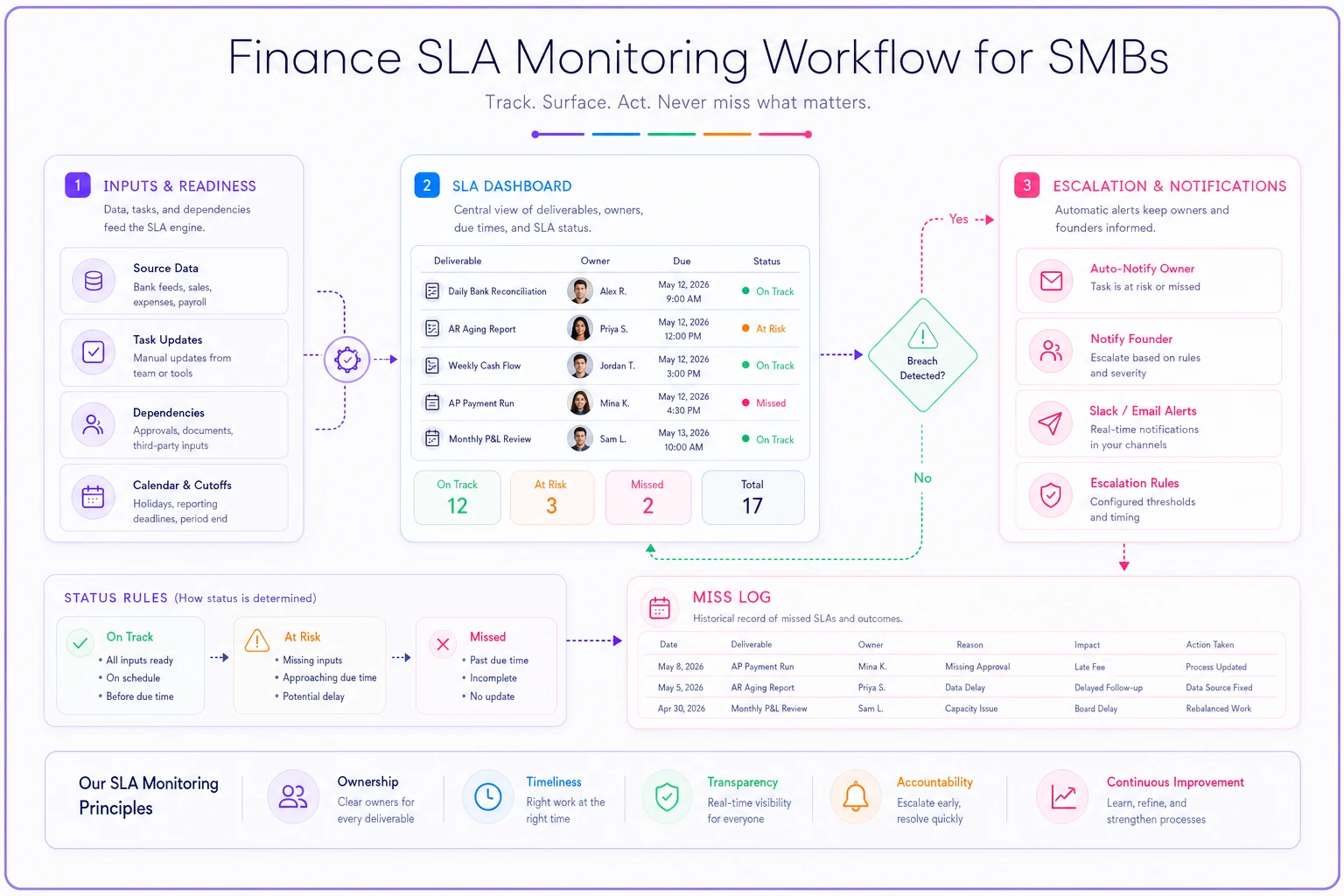
This visualization shows the flow from inputs to dashboard to escalation.
A real scenario: the close that kept slipping
A services business, roughly 25 people, was closing the month somewhere between BD+11 and BD+15 — and the range was the problem more than the lateness. The founder couldn't plan around a close that might land on the 11th or might land on the 15th, so hiring and vendor decisions kept getting made on stale numbers.
When they dug into the miss log, the pattern was boring and specific: two upstream inputs were almost always the cause. The AR team hadn't finalized a handful of customer credits, and the project leads hadn't confirmed which milestones had actually been delivered, so revenue couldn't be booked. Finance was getting blamed for a close they didn't control.
They wrote three SLAs — one for AR credits (final by BD+3), one for milestone confirmation (project leads confirm by BD+2), and one for the close itself (package by BD+8). Ownership was named. The escalation on the two upstream inputs auto-pinged the department leads, not finance.
Within about two months the close was landing consistently around BD+7 to BD+8. Not because anyone worked harder — the actual finance work didn't change much. What changed was that the two chronic upstream delays now had owners, deadlines, and an escalation that fired on its own. The founder got a close date they could plan against, which turned out to be worth more than the couple of days they saved.
When enforceable SLAs make sense — and when they don't
When this makes sense: You're past the point where one person can hold it all in their head. You have handoffs between roles. You're making cash, hiring, or credit decisions on a cadence and the numbers keep arriving late or inconsistent. You've got outside parties — an outsourced bookkeeper, a fractional controller — whose timing you can't see into.
When this is a bad idea: You're two people and you genuinely both know the state of everything at all times. Formalizing SLAs at that stage adds process overhead that buys you nothing, and it can make a tiny team feel bureaucratic in a way that quietly kills morale. Wait until the coordination is actually costing you.
Who should not do this yet: Anyone whose underlying data is unreliable. An SLA on a number that's wrong just makes you reliably wrong. Fix the data foundation and the definition of "done" first — an on-time report built on numbers nobody trusts is worse than a late one, because people will act on it.
The takeaway
Unpredictable reports don't cost you the report. They cost you every decision made in the fog while the report is late. The fix isn't more discipline or a smarter team — it's writing down what "on time" means, who owns it, and what happens when it slips, then mapping those commitments to the specific KPIs that actually drive your cash and close. Start with six deliverables, not sixty. Name a single owner for each. Write the definition of done. Set the escalation to fire on its own. Then watch the inputs, not just the outputs, because the reason your reports are late almost always lives upstream of the people you're tempted to blame.
Ready to take control of your finances?
Join over 2,000 businesses using Acctaly to simplify accounting, accelerate cash flow, and ensure tax readiness.