



Most owners get the outsourcing question backwards. They ask "can I afford a controller?" when the real question is "what does my transaction volume and error tolerance actually require right now?" Those are different questions. Answering the wrong one is how you end up either overpaying a full-time hire for work a bookkeeper could handle, or trusting a $400/month virtual bookkeeper with a revenue-recognition problem they were never equipped to deal with.
Your finance operating model — the mix of who does what, in-house versus outsourced versus software-assisted — isn't a single decision. It's a series of decisions that should shift as your volume, complexity, and risk exposure grow. The trap is that most businesses set it once, early, and never revisit it until something breaks.
Below is a framework with actual bands and numbers you can map your business against.
Why the "hire vs outsource" framing fails
The standard debate — full-time hire versus outsourced firm — skips the two variables that actually determine the right answer: transaction volume and variance tolerance.
Transaction volume is straightforward. A business processing 80 invoices a month has different needs than one processing 2,000. Variance tolerance is the one people ignore, and it's usually the more expensive mistake.
Variance tolerance is how much financial error your business can absorb before it hurts. A cash-heavy retail shop with tight margins and a bank covenant has near-zero tolerance for a misstated month. A bootstrapped agency with fat margins and no debt can survive a close that's two weeks late and slightly off. Same headcount, completely different finance requirements.
The businesses that outsource badly usually aren't the ones that picked the wrong provider — they're the ones that never defined their own tolerance before shopping. They bought on price, got service calibrated to a lower risk band, and then acted surprised when the provider couldn't handle a payout reconciliation or a lender request.
So before any make-vs-buy decision, answer three things:
-
What's my monthly transaction volume (invoices in + out, payroll runs, bank/card lines)?
-
What's my variance tolerance (how wrong can a month be before it costs me real money or a relationship)?
-
What's my complexity (multiple entities, deferred revenue, inventory, multi-state payroll, foreign currency)?
Those three map to a stage. The stage tells you the model.
The stage-based decision matrix
Here's the core framework. The bands overlap on purpose — real businesses live on the edges, and the right answer usually depends on complexity, not just volume.
Stop letting accounting slow your business down.
Acctaly automates your financial operations so you can focus on growth and compliance.
- Automated bookkeeping
- Real-time financial reporting
- Integrated tax management
No credit card required
| Stage | Monthly txn volume | Variance tolerance | Typical model | Monthly cost band |
|---|---|---|---|---|
| 1. Solo / early | Under ~200 | High (few relationships at risk) | Outsourced bookkeeping + owner review | ~$300–$900 |
| 2. Growing | ~200–800 | Medium | Outsourced bookkeeping + fractional controller + software | ~$1,500–$4,000 |
| 3. Scaling | ~800–2,500 | Low-to-medium | Hybrid: in-house AP/AR clerk + outsourced controller/CFO | ~$5,000–$10,000 |
| 4. Established | 2,500+ | Low (covenants, board, audit) | Mostly in-house team + outsourced specialties (tax, technical accounting) | $12,000+ |
A few things worth noting here.
Almost nobody should be fully in-house or fully outsourced at any stage. The right model is a blend that shifts. Even a 40-person company keeps tax and technical accounting outsourced because it's cheaper than carrying a full-time specialist. Even a solo operator should be doing their own weekly review instead of blindly trusting a monthly file.
Also notice how cost roughly triples between each stage while volume roughly triples too. That's not a coincidence — it's the ratio you should be checking. If your finance cost is climbing faster than your transaction volume, your model is misaligned. If it's flat while volume doubles, something is being neglected and you'll pay for it eventually.
For a deeper look at how roles evolve across these stages, the breakdown in scaling finance from solo bookkeeping to 50 people maps the headcount triggers well and pairs directly with this cost framing.
The banded cost math nobody runs
Here's the calculation that should drive the decision, and almost no one does it explicitly.
Take your fully-loaded cost of a given model and divide it by your monthly transaction volume to get cost per transaction handled. Then compare that against the risk-adjusted cost of getting it wrong.
-
Outsourced bookkeeping + fractional controller roughly $3,200/month → about $5.30 per transaction
-
Full-time junior bookkeeper in-house roughly $4,800/month fully loaded (salary, payroll tax, benefits, software, their own errors) → about $8.00 per transaction
On raw cost, outsourcing wins. But then you layer in the risk side. This business has a line of credit with a monthly reporting covenant. A late or misstated close risks a technical default conversation with the bank — low variance tolerance, which means the controller review layer matters more than the per-transaction cost.
So the real comparison isn't "$3,200 vs $4,800." It's which model reliably produces a clean, on-time close given their tolerance. In this case the outsourced model with a controller review scores better on both cost and risk — but only because they included the controller. The $900 bookkeeping-only option would have failed the risk test entirely.
The mistake that keeps showing up: businesses run the cost-per-transaction math, pick the cheapest option, and skip the risk multiplier. Then a covenant breach or a botched audit prep costs them 10x what they saved.
Service levels: what to actually expect from each model
Cost bands are meaningless without matched service-level expectations. Here's what "good" looks like by model.
Outsourced bookkeeping (Stage 1–2):
-
Monthly close delivered by day 10–15
-
Bank/card reconciliations complete, no unexplained variances
-
Basic P&L and balance sheet
-
Response time
1–2 business days
-
What it does NOT include
cash forecasting, variance analysis, or answering "why did margin drop"
Outsourced controller / fractional (Stage 2–3):
-
Close by day 5–8
-
Variance commentary, not just numbers
-
Cash flow visibility and forecast maintenance
-
Board/lender-ready reporting
-
Someone who will get on a call and explain what the numbers mean
In-house team + outsourced specialties (Stage 3–4):
-
Close by day 3–5
-
Real-time-ish AP/AR management
-
Continuous reconciliation rather than monthly batch
-
Dedicated support for audit, tax, and technical questions
If you're paying Stage 3 prices and getting Stage 1 service — a file dropped in your inbox on day 15 with no commentary — that's not a pricing problem, it's a mismatch you should fix.
When outsourcing actually makes sense
Outsourcing wins clearly in a few specific situations:
-
Volume is low and stable. Under ~200 transactions, hiring anyone full-time is dead weight.
-
You lack specialized knowledge in-house. Revenue recognition, multi-state payroll, R&D credits — buy the expertise, don't build it.
-
Your work is spiky. Seasonal businesses shouldn't carry a full-time salary through a dead quarter.
-
You need coverage continuity. A firm doesn't quit on two weeks' notice or take a three-week vacation during close.
Outsourcing also works best when your process is already clean. Providers are efficient when your data is structured and your workflows are documented. They get expensive and error-prone when they're constantly cleaning up chaos.
When keeping it in-house makes sense
In-house wins when:
-
Volume justifies the salary and you're paying an outsourced provider so much that a hire is cheaper per transaction.
-
Speed matters constantly. If you need same-day answers on cash or AR daily, an external partner's 1–2 day response window becomes a real bottleneck.
-
Complexity is deeply tied to your operations — inventory-heavy businesses, marketplaces with payout liabilities, anything where finance and operations are inseparable.
-
You have low variance tolerance and high stakes — active fundraising, covenants, or a coming audit where you need someone accountable in the room.
You have low variance tolerance and high stakes — active fundraising, covenants, or a coming audit where you need someone accountable in the room.
Who should NOT do this
Don't hire in-house too early. A 12-person company bringing on a full-time controller at $110k before their volume or complexity justifies it is buying prestige, not value. That person will be underutilized, get bored, and leave — and you'll have spent a year overpaying.
Don't fully outsource if you have zero internal financial literacy. If nobody on your team can read the reports critically, you've outsourced not just the work but the judgment. That's how errors go undetected for months. Someone internal — even the owner — has to own the review, always.
The stepwise transition playbook
The hardest part isn't picking the model. It's moving between models without dropping the ball during the handoff.
Here's a checkpoint-based transition process.
-
Freeze the current state. Before changing anything, document how the current close works, where data lives, who touches what. You can't hand off a process you can't describe.
-
Define target service levels in writing. Close date, deliverables, response times, escalation path. Both sides sign off. Vague expectations are where most transitions fall apart.
-
Run a parallel period. For one full month, both the old and new setup produce the numbers. Compare them line by line. Discrepancies here are cheap; discrepancies after cutover are not.
-
Reconcile the parallel results. Every variance between old and new must be explained, not hand-waved. If the new provider's numbers differ from yours, one of you is wrong and you need to know which.
-
Cut over with a rollback plan. Officially switch, but keep the old access and knowledge available for 60 days in case something surfaces.
-
Review at 30, 60, 90 days. Are service levels being met? Is the close on time? Are variances explained? This is where you catch a mismatch before it becomes a year-long problem.
A visual workflow of the checkpoints can help keep both sides aligned.
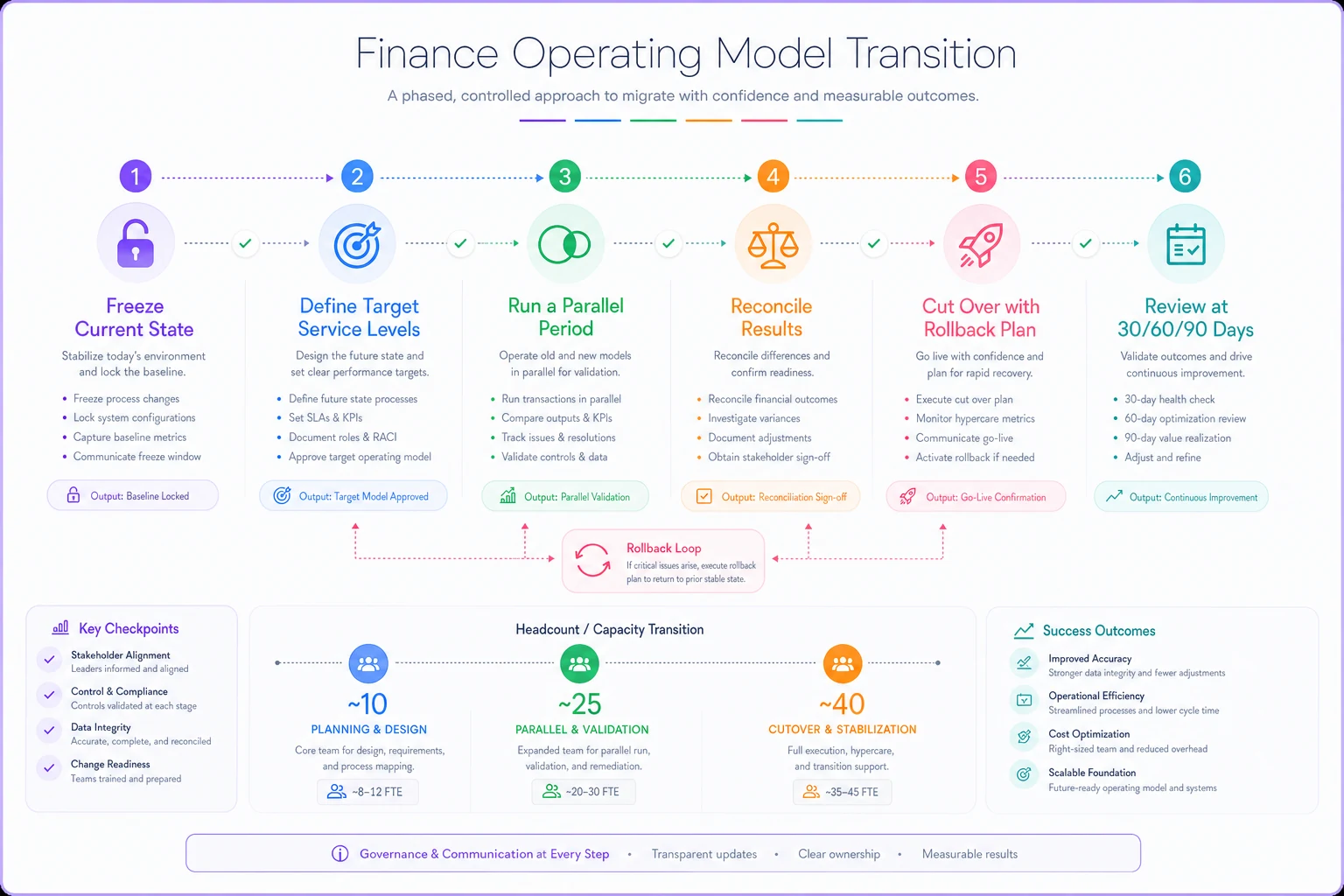
Migration checkpoints by headcount stage
-
Crossing ~10 people Move from pure bookkeeping to bookkeeping + fractional controller. Checkpoint: is your close taking longer than 10 days? Are you flying blind on cash between months?
-
Crossing ~25 people Bring AP/AR partially in-house for responsiveness. Checkpoint: is your outsourced provider's response time now a daily bottleneck?
-
Crossing ~40 people Build the in-house core team, keep tax and technical accounting outsourced. Checkpoint: is your finance spend now higher than a full-time salaried team would cost?
Each of these transitions maps to a maturity progression. The sequencing in the staged finance-ops maturity model for SMBs is a useful companion here — it lays out which capabilities to add in what order, which prevents the common mistake of buying the org before you have the process.
How software changes the math
One thing the classic make-vs-buy debate tends to miss: software has quietly shifted the bands upward. Work that used to require a dedicated person now runs on rules and automated reconciliation, which means a smaller team — in-house or outsourced — can handle significantly more volume before things break.
In practice, a business that would have needed a full-time bookkeeper at 500 transactions might now stay comfortably outsourced to 800 or even 1,000, because automated categorization and continuous reconciliation absorb the manual load. The right operational platform doesn't replace the make-vs-buy decision — it raises the threshold at which you need to move to the next stage.
The signal worth watching: when your finance costs are climbing but the actual judgment work hasn't increased, you're usually paying humans to do work that automation should be handling. That's the moment to fix your tooling before you change your staffing.
A real scenario
A regional e-commerce business — roughly $4M in revenue, around 1,100 transactions a month across two sales channels — was running everything through a $700/month outsourced bookkeeper. Closes came in around day 18, with no commentary and recurring reconciliation gaps between their payment processor and their books.
They almost hired a full-time controller at ~$95k. Instead they ran the banded math and moved to a hybrid: kept an outsourced controller for review and reporting (~$3,500/month), brought one part-time in-house person for daily AP/AR, and cleaned up their reconciliation workflow so the volume was actually manageable.
Close dropped to around day 6. The processor-to-books gaps that had been quietly hiding a few thousand in fees got caught monthly instead of never. Total cost landed near $5k/month — more than the $700 they started with, but far less than the $8k+ a full in-house team would have cost, and calibrated to their actual situation (they were prepping for a debt raise and had genuinely low tolerance for errors).
The point isn't the specific numbers. It's that they matched the model to the stage instead of jumping to the most expensive option out of anxiety.
The takeaway
Your finance operating model isn't a hire-or-outsource coin flip. It's a staged progression driven by transaction volume, variance tolerance, and complexity — and the right answer at 8 people is almost never the right answer at 30.
Run the banded cost-per-transaction math. Layer in your actual risk tolerance. Match service levels to what you're paying. And when you cross a stage boundary, transition deliberately — parallel period, real checkpoints, rollback plan — instead of a rushed cutover. Do that, and you stop overpaying for capacity you don't need while also stop under-protecting the areas where an error would genuinely hurt.
Ready to take control of your finances?
Join over 2,000 businesses using Acctaly to simplify accounting, accelerate cash flow, and ensure tax readiness.