

Most reconciliation breakdowns in small and mid-sized businesses don't come from bad math. They come from bad master data. Two systems each think they're right, but one is calling a customer "ACME Inc," the other has it as "Acme Incorporated," and a third has two records because someone retyped it during onboarding. Now your revenue-by-customer report doesn't tie to your billing system, and your controller is manually mapping accounts at 9pm during close.
That's the real problem hiding under most reconciliation failures. The transactions are fine. The entities and codes those transactions attach to are a mess. And unlike a one-off error, master-data problems compound quietly until a report you've trusted for a year turns out to have been wrong the whole time.
This is a systems article, not a tips article. Master data governance in an SMB finance context isn't a policy document you write once — it's an operating discipline connecting your chart of accounts, your customer and vendor lists, your product catalog, and every integration that moves data between them. When one part drifts, everything downstream inherits the drift.
The master data that actually breaks reconciliations
When people hear "master data," they picture some enterprise data-management project. In practice, for a 5–50 person business, master data is a short and boring list:
-
Chart of accounts (the GL codes everything rolls into)
-
Customer master (the entity list your AR and revenue attach to)
-
Vendor master (the entity list your AP and spend attach to)
-
Product / SKU / service catalog (what you actually sell)
-
Cost centers, departments, or locations (how you slice everything)
-
Bank and payment-processor account mappings
Reference data is what dies quietly. Transactions are visible — someone notices a missing invoice. But a duplicate vendor record or a mislabeled cost center doesn't throw an error. It just spreads a small amount of wrong into every report that touches it.
The most damaging master-data errors are the ones that don't break anything. A broken integration gets fixed fast because the sync fails loudly. A vendor that exists twice keeps working perfectly — you just can't trust your spend-by-vendor totals, and nobody realizes it until you're negotiating a contract using half the real number.
Why this happens across almost every growing business
It's not carelessness. It's the natural byproduct of how SMBs actually grow.
Stop letting accounting slow your business down.
Acctaly automates your financial operations so you can focus on growth and compliance.
- Automated bookkeeping
- Real-time financial reporting
- Integrated tax management
No credit card required
In the beginning, one person owns everything. The founder or the bookkeeper knows that "the Google bill goes to 6200" and that the customer name is always spelled the way it appears in Stripe. The knowledge lives in a head, not a system. Reconciliation works because one person is quietly enforcing consistency without calling it governance.
Then you add people. A salesperson creates customers in the CRM. An ops person adds vendors in the bill-pay tool. Someone in marketing spins up a new SaaS subscription and expenses it under whatever category the card app suggested. Suddenly there are three or four places where master records get created, and nobody owns consistency across them.
Then you add integrations, which is where it gets genuinely dangerous. Your CRM syncs to your billing platform, which syncs to your accounting system, which feeds your reporting tool. Each hop is a place where a name, an ID, or a mapping can silently diverge. If you've dealt with brittle syncs, this connects directly to what we covered in Fragile integrations are slowing your close — integrations don't just move transactions, they propagate whatever master-data mess you already have, faster.
The root cause is almost always the same: creation is distributed, but ownership is undefined. Anyone can make a record. Nobody is accountable for whether it's correct, unique, and consistent with everywhere else.
What breaks at scale
At the small end, master data problems are annoying but survivable. A few duplicate vendors, some miscoded expenses. Close takes a day longer than it should. You can brute-force it.
In the middle, the manual reconciliation load starts eating real time. Finance spends the first three days of close just normalizing data — matching customer names, re-mapping expenses, chasing down what a new SKU should roll up to. This is the stage where people start saying "our books are always a little behind."
At the larger end, it stops being a time problem and becomes a trust problem. Reports contradict each other. The board deck shows one revenue number, the billing system shows another, and both are technically correct given their own master data. Now you're not just losing hours — you're making decisions on numbers you can't fully stand behind.
This is the same fragility we broke down in the accounting data-governance playbook for continuous reconciliation; master data is the layer underneath that determines whether continuous reconciliation is even possible.
A failure mode worth flagging specifically: a business changes its chart of accounts to get better reporting, but the integration mappings from the billing and expense tools still point at the old codes. For a month or two, transactions land in a mix of old and new accounts. The P&L looks plausible enough that nobody catches it until quarter-end, and then someone spends a full week untangling where everything landed.
The governance layer that actually holds
You don't fix this with more manual review. You fix it by defining ownership, standards, and detection once, and enforcing them continuously. There are five pieces.
1. Ownership matrix — who owns each master domain
| Master domain | Owner | Who can create | Who approves changes |
|---|---|---|---|
| Chart of accounts | Controller / Head of Finance | Finance only | Controller |
| Customer master | RevOps / Finance | Sales (draft) → Finance (activate) | Finance |
| Vendor master | AP lead | AP requests | AP lead + second review for banking details |
| Product / SKU catalog | Product ops | Product / Sales | Finance + Product |
| Cost centers / departments | Controller | Finance only | Controller |
| Bank / processor mappings | Controller | Finance only | Controller |
The key move here is the draft-then-activate split. Salespeople can create a customer so they're not blocked, but that record isn't financially live until finance activates it against the standard. That single distinction prevents most duplicate and malformed records without slowing anyone down.
2. Naming and coding standards
Standards are boring and they're the whole game. Write them down, keep them short, and make them unambiguous. A workable set for an SMB:
-
Legal entity name for customers/vendors, not the trade name. "Acme Incorporated" not "Acme," matched to a tax ID or registration number when possible.
-
No free-text where a code will do. Cost centers, departments, and categories should be pick-lists, never typed.
-
One identifier that travels. Every customer and vendor gets a single canonical ID that follows it through every system, so joins across tools don't depend on name-matching.
-
GL codes follow a documented logic, and that logic ties back to how you actually report. If your chart of accounts wasn't built with reporting in mind, that's worth fixing first — see designing a reporting-first chart of accounts, because naming standards downstream inherit whatever structure you set at the top.
The mistake people make: they document the standard and then never enforce it at the point of creation. A standard that lives in a Notion doc but not in the tool where records are made is decorative.
3. Reconciliation cadences
Match the cadence to how fast each domain drifts.
-
Daily bank and processor mappings — new payout types or fee categories show up constantly and misroute if unmapped.
-
Weekly new customer and vendor records created in the last 7 days, checked for duplicates and completeness.
-
Monthly (at close) full tie-out of subledgers to GL by entity and account; SKU-to-revenue-account mapping review.
-
Quarterly dedupe pass across the entire customer and vendor master; review of any accounts that received unexpected activity.
The point of cadence is catching drift while it's small. A duplicate vendor caught in the weekly check is a two-minute merge. The same duplicate caught at year-end is a forensic exercise across twelve months of transactions.
Prioritize weekly checks for new records — they catch most duplicates cheaply.
4. Drift-detection triggers
This is where governance becomes proactive instead of reactive. Instead of hoping someone notices, you define specific conditions that should raise a flag. Some triggers worth running:
-
A transaction posts to a GL account that had zero activity in the prior 6 months.
-
A new customer or vendor name is a fuzzy match (above roughly 85% similarity) to an existing record.
-
A vendor's bank details changed since the last payment — always a flag, always a second set of eyes.
-
A SKU or service has no mapped revenue account.
-
A subledger-to-GL variance for any entity exceeds more than a rounding difference.
-
An expense category is used that isn't on the approved pick-list.
Good drift detection doesn't require expensive tooling to start. Even a weekly spreadsheet export run through a few formulas catches most of these. The goal is to move from "someone eventually notices something looks off" to "the check runs on a schedule and surfaces problems while they're still cheap to fix."
5. Remediation SLAs
A flag with no deadline is a flag that gets ignored. Attach a response window to each trigger based on how much damage it can do.
| Trigger | Severity | Remediation SLA |
|---|---|---|
| Vendor bank-detail change | Critical | Verify before next payment run |
| Duplicate entity fuzzy-match | High | Resolve within 2 business days |
| Unmapped SKU / revenue account | High | Resolve before next invoice batch |
| Posting to dormant GL account | Medium | Review within weekly cadence |
| Off-list expense category | Medium | Recode by next close |
| Minor subledger-GL variance | Low | Clear during monthly close |
Attach a response window to each trigger based on how much damage it can do.
Sample reconciliation checks you can run now
You don't need a fancy tool to start. If you can query your data, these checks catch the most common master-data failures.
The process for working through them looks roughly like this:
-
Duplicate entity check — group customers and vendors by normalized name (lowercased, punctuation stripped) and flag any group with more than one ID.
-
Orphan mapping check — list every product or SKU with no assigned revenue account, and every active vendor with no assigned default expense account.
-
Subledger-to-GL tie-out by entity — sum AR by customer and compare to the GL AR control account; the delta should be zero.
-
Dormant-account activity check — list accounts with no activity for 6+ months that received a posting this period.
-
Cross-system ID coverage — count customers in billing that don't have a matching canonical ID in accounting; every miss is a manual reconciliation waiting to happen.
-
Category compliance check — list any transactions with an expense category not present in the approved list.
Run checks 1–3 weekly, 4–6 monthly. Even doing this in a spreadsheet export beats discovering the problems at year-end. The first time you run these, expect to find something. Most businesses that haven't done this before turn up at least a handful of duplicates and a few unmapped SKUs — that's normal, not a sign something is catastrophically broken.
Change control that doesn't strangle the business
The reason master data drifts is that changes happen with no record of who, when, or why. A lightweight change-control log fixes most of it without turning into bureaucracy.
| Field | Example |
|---|---|
| Change ID | CoA-2024-014 |
| Domain | Chart of accounts |
| What changed | Split "Software" into "Software – Ops" and "Software – R&D" |
| Requested by | Controller |
| Approved by | Head of Finance |
| Effective date | First of next month |
| Downstream mappings updated | Bill-pay, card tool, reporting layer |
| Reconciliation check after change | Tie out software spend for one full period |
That last row is the one everyone forgets. Every master-data change should have a paired reconciliation check confirming the change landed cleanly everywhere. Changing a GL code without updating the integration mappings — and then verifying — is how you end up with the split-month P&L mess described earlier.
Automation-ready mapping rules
If you want any of this to survive growth, the mappings have to live somewhere machine-readable, not in someone's memory. The idea is a set of explicit rules that a system can apply consistently:
-
Entity resolution rule normalize names → match against canonical ID → if no match above threshold, route to review, don't auto-create.
-
GL mapping rule each product category maps to exactly one revenue account; each vendor category maps to a default expense account; anything unmapped halts and flags rather than guessing.
-
Cost-center rule derived from department or location on the source record, never free-typed.
-
Fee/payout mapping rule each processor transaction type maps to a specific GL account, with new types flagged on first appearance.
The value of writing rules this way is that the logic becomes reviewable. When something reconciles wrong, you look at the rule, not at a mystery. And when you're ready to move from manual checks to automated ones — whether through your accounting platform, a workflow tool, or AI-powered operational software that can run these checks continuously — the rules are already in a form your tooling can enforce. The triggers above run on a schedule instead of whenever someone remembers to look.
A quick visual of the mapping-rule workflow helps.
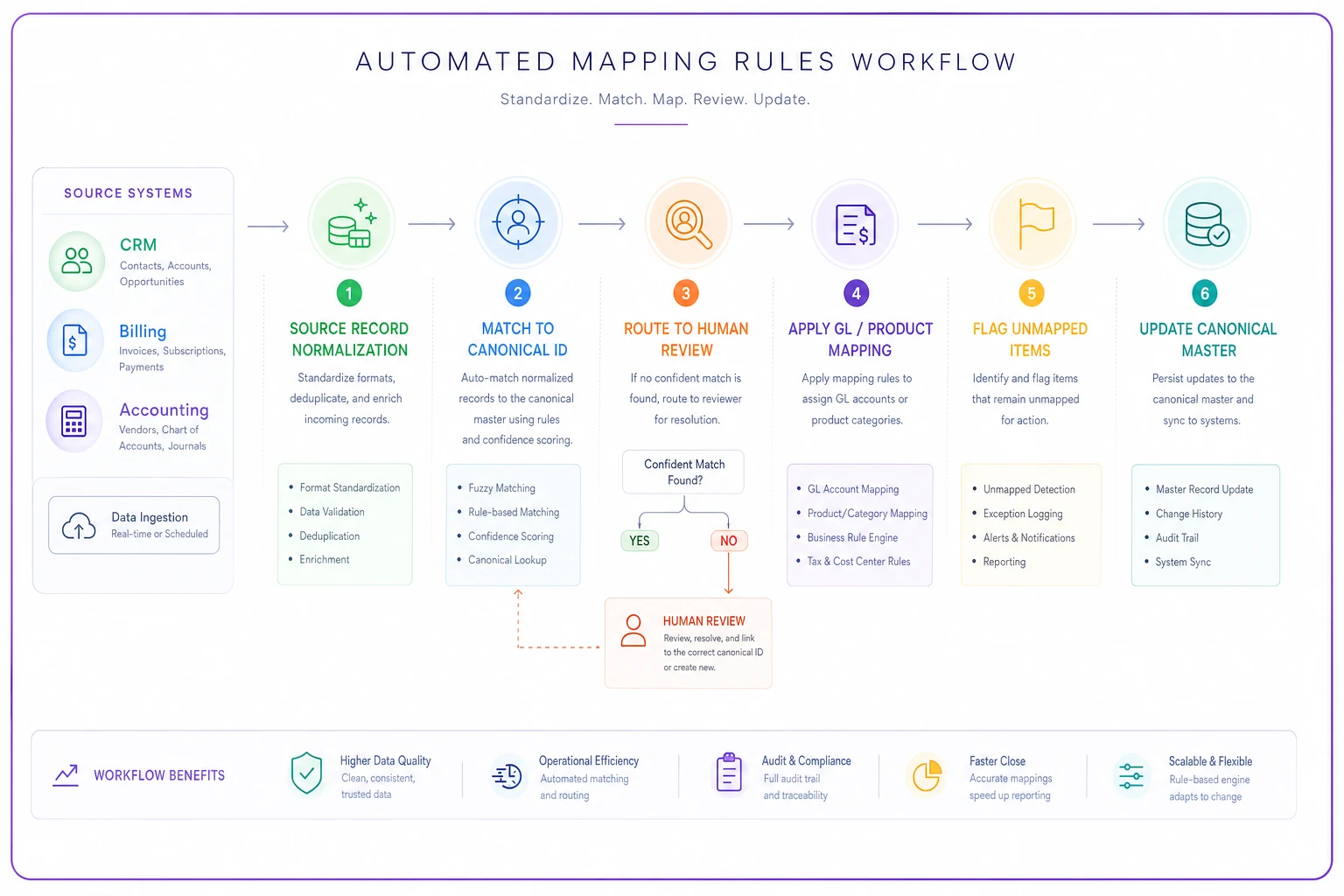
The triggers above run on a schedule instead of whenever someone remembers to look.
A realistic scenario
A roughly 30-person B2B services company at around $6M in revenue was closing about ten business days after month-end and never fully trusting its customer-profitability reporting. The cause wasn't complicated. Sales created customers in the CRM freely, finance re-created them in the accounting system, and the billing tool had its own list. The same client existed under slightly different names in all three, so no report tied out cleanly.
They didn't buy anything new first. They ran the duplicate-entity check and found around 40 duplicate customer records and a handful of vendors with two entries. They assigned a single owner for the customer master, added a draft-then-activate step, and set a weekly check on new records. They wrote down the GL mapping rules that had been living in the controller's head.
Within about two months, close dropped to roughly six days, most of the improvement coming from not re-normalizing customer data by hand every cycle. The bigger win was softer: leadership stopped arguing about which revenue number was real. That trust ended up being worth more than the days saved.
When this is worth doing — and when it isn't
When it makes sense: You have more than one system creating master records, more than one person touching the books, or any integrations moving data between tools. If reports from different systems don't agree, or close keeps slipping, you're past due.
When it's overkill: A true solo operation with one accounting system and no integrations doesn't need an ownership matrix — the owner is you, enforced automatically. Don't build governance ceremony for a problem you don't have yet. Just document the standards so the person who inherits the books isn't guessing.
Who should not start here: If your transactions themselves are chaotic — missing invoices, unreconciled bank feeds, no monthly close discipline — fix that foundation first. Master data governance makes good reconciliation reliable; it can't rescue a process that isn't happening at all.
The takeaway
Reconciliation reliability is a master-data property, not a math property. The businesses that close fast and trust their numbers aren't better at arithmetic — they've quietly defined who owns each master domain, standardized how records get named and coded, set cadences to catch drift while it's small, and built checks that flag problems before they compound into something expensive.
Start with ownership and one duplicate check this week. Add standards and cadences next. The goal isn't a perfect data-governance program — it's a system where a wrong record gets caught in days instead of surfacing as a mystery variance a year later, after it's already shaped a decision you can't take back.
Start with ownership and one duplicate check this week. Add standards and cadences next. The goal isn't a perfect data-governance program — it's a system where a wrong record gets caught in days instead of surfacing as a mystery variance a year later, after it's already shaped a decision you can't take back.
Ready to take control of your finances?
Join over 2,000 businesses using Acctaly to simplify accounting, accelerate cash flow, and ensure tax readiness.