
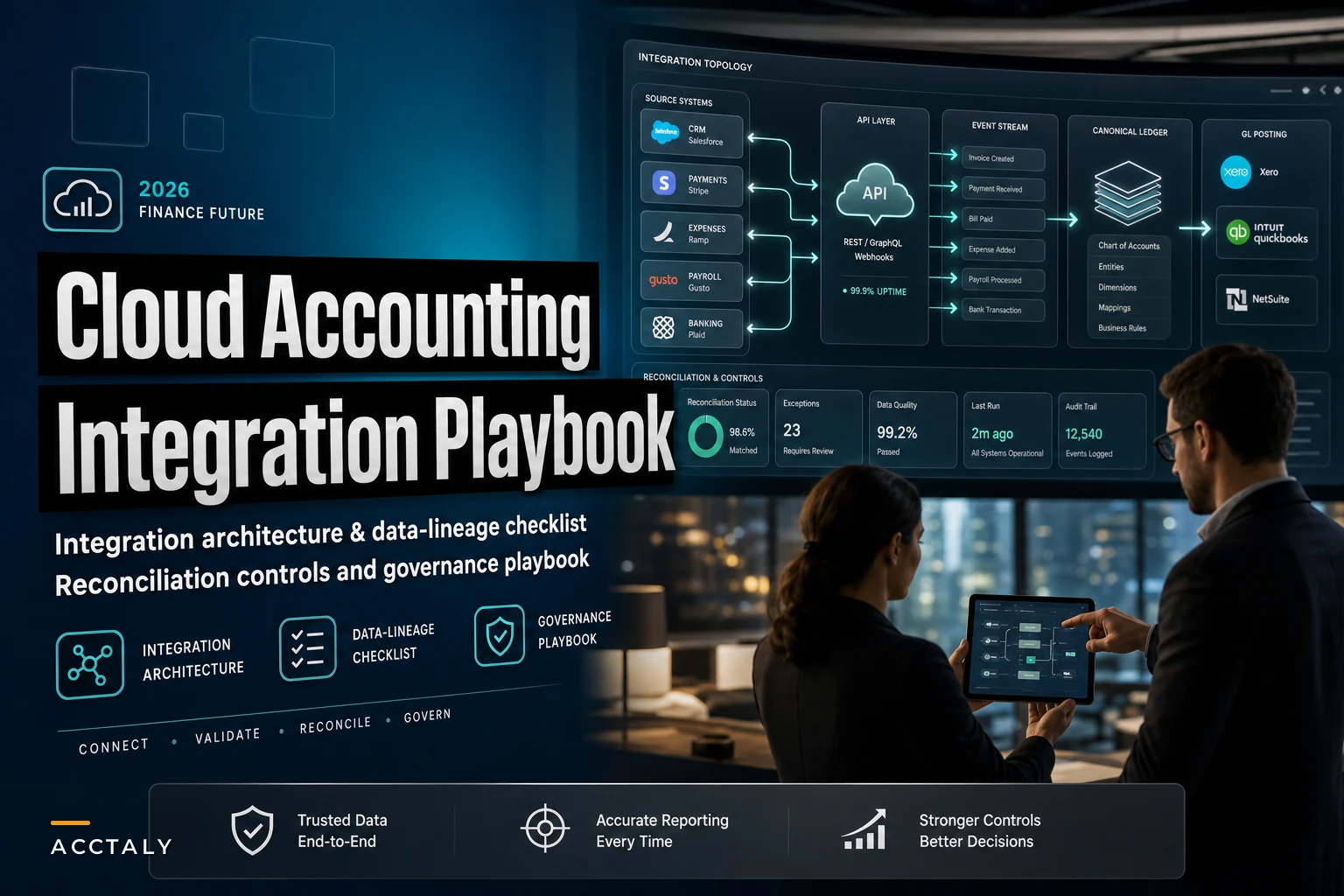

Most guides on cloud accounting software spend their energy telling you which product to pick. That's the easy part. The hard part — the part that actually breaks month-end — is everything that happens after you've signed the contract: how transactions flow in, how they map to your ledger, and whether anyone can prove the numbers are complete at close.
This is written for the people who own that risk: the finance lead who signs off on the close, and the engineer (or fractional ops person) wiring the integrations. The goal is to get you to a state where you can run your first real close on the new system without a 3-day reconciliation scramble.
No marketing comparisons here. Instead: integration patterns, canonical ledger mapping, data-contracts, reconciliation checks, a cutover sequence, a RACI, and a one-page governance checklist you can actually use.
Start with the failure mode, not the feature list
The most expensive migration mistakes aren't missing features. They're silent data gaps that nobody catches until the bank rec is off by a few thousand dollars and nobody can explain why.
A typical example: a services business moves to a new cloud accounting platform and wires up their Stripe connector through a third-party sync tool. Everything looks fine for three weeks. Then at close, revenue is short by about $11k. The cause? The sync tool skipped refunds issued through a secondary payment method because the connector only subscribed to charge.succeeded events, not charge.refunded. No error. No alert. Just missing rows.
That's the core problem with integrations into accounting systems — they fail quietly. A broken pipeline that throws a loud error gets fixed the same day. A pipeline that drops 2% of transactions silently gets discovered during an audit.
So before picking an integration pattern, decide what "complete" means and how you'll verify it. Everything else follows from that.
Three integration patterns, and when each one actually fits
There are really only three ways data gets into your cloud accounting software, and most SMBs end up with some mix. The mistake is defaulting to whatever the vendor's marketplace connector offers without asking whether it matches your reconciliation needs.
Stop letting accounting slow your business down.
Acctaly automates your financial operations so you can focus on growth and compliance.
- Automated bookkeeping
- Real-time financial reporting
- Integrated tax management
No credit card required
| Pattern | How it works | Best for | Where it bites you |
|---|---|---|---|
| Native/API connector | Prebuilt app from the marketplace pulls data on a schedule | Standard sources (Stripe, Shopify, payroll) with low customization | You don't control the mapping or the polling window; refunds, partial captures, and multi-currency often mishandled |
| ETL (batch) | Scheduled job extracts, transforms, loads into the ledger | High volume, predictable sources, where you need control over mapping | Latency — you're always working with yesterday's data; late-arriving transactions straddle periods |
| Event-driven | Source emits events (webhooks/queue), you process each one | Real-time needs, marketplaces, anything with complex state (refunds, chargebacks, holds) | Hard to guarantee ordering and exactly-once delivery; duplicate or missed events corrupt balances |
One pattern most teams underrate: you rarely want pure event-driven for financial data. Events are great for freshness but terrible for completeness guarantees. The reliable architecture is usually event-driven for capture, batch for reconciliation — process webhooks in near-real-time, but also run a daily batch pull against the source's full API to catch anything the event stream missed. The batch pull is your safety net, not your primary path.
Typical reliable workflow:
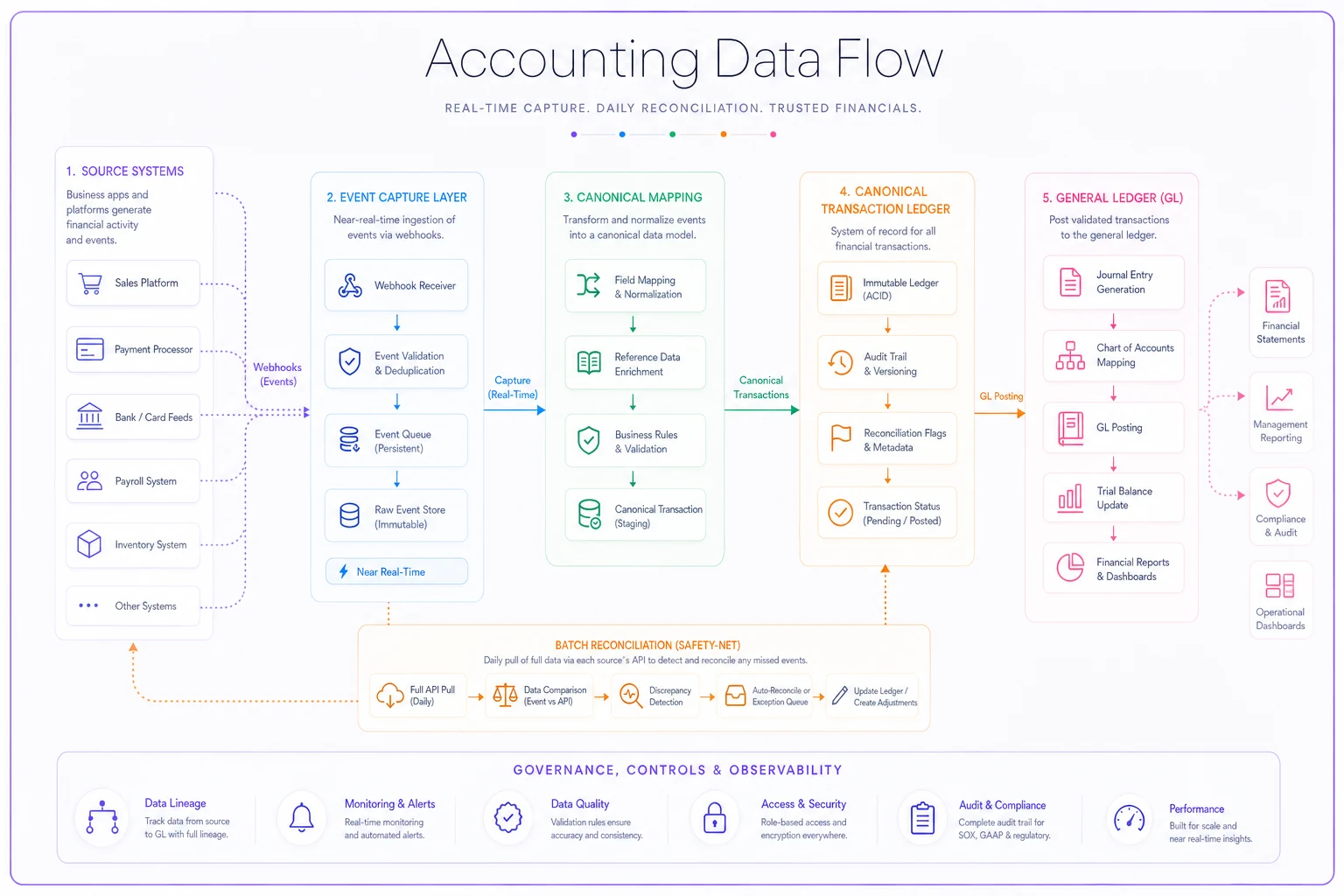
When this matters: if your source can emit out-of-order or retried events (nearly all payment processors do), a pure webhook pipeline will eventually double-count or miss something. The daily reconciliation pull catches it before close.
When it doesn't: if you're pulling a clean monthly payroll journal from one provider, a simple scheduled ETL is fine. Don't over-engineer a quarterly payroll feed into an event bus.
Map to a canonical ledger before you touch the target system
The second-biggest failure mode is mapping each source directly to the chart of accounts in your new system. Do that with three sources and you have three fragile, one-off mappings. Add a fourth source and you're editing four places when the COA changes.
Instead, define a canonical transaction model — a neutral internal representation that every source maps into, and that maps out to your GL once. This is the single most durable decision in the whole project. The canonical ledger and data-lineage blueprint for SMB finance goes deeper on the structure, but the short version is: standardize the shape of a transaction once, and every integration becomes a translation into that shape.
A minimal canonical transaction looks something like:
``
canonicaltxn {
  txnid            // globally unique, prefixed by source
  sourcesystem     // 'stripe', 'shopify', 'payrollx'
  sourcetxnid     // original ID from the source
  eventtype        // sale, refund, fee, payout, adjustment
  occurredat       // business event timestamp (source of truth for period)
  amountgross
  amountfee
  amountnet
  currency
  customerref
  glaccount        // resolved during mapping, not at source
  memo
  ingestedat       // when we received it (for lineage)
}
``
-
occurredatvsingestedat— the first drives which accounting period the transaction belongs to; the second drives your lineage and lets you find late-arriving data. Collapsing these into one timestamp guarantees period-cutoff errors. -
sourcetxnidkept separate from your owntxn_id— you need both for idempotency (don't reprocess the same event) and for tracing a GL line back to the original charge during an audit.
Two fields people forget and regret:
Write data-contracts so a source change doesn't break your close silently
A data-contract is just a written, enforced agreement about the shape and meaning of data coming from each source. Boring? Yes. Also the thing that saves your close when a vendor changes their API or someone adds a new product type.
Contract: Stripe → canonical
-
amountis an integer in cents; divide by 100, never store as float -
event_typemust be one of a known set; any new type triggers an alert, not a silent default to "sale" -
Every
chargemust eventually resolve to apayoutwithin 7 days; unresolved charges past that get flagged -
Refunds reference an original
sourcetxnid; orphan refunds (no matching charge) are an exception, not an auto-post -
Currency is always present; mixed-currency batches are rejected, not auto-converted
The insight most teams miss: the contract's job is to fail loudly on the unexpected. The worst default behavior is "if we don't recognize this, treat it as a standard sale." That's exactly how unexpected transaction types get buried in the wrong account and surface three months later.
The reconciliation and observability checks that actually catch problems
You don't need a monitoring platform. You need a handful of checks that run every day and flag something when it's off. Think of these in three layers.
1. Completeness checks — did everything that happened in the source make it into the ledger?
The cheapest high-value check is a daily count-and-sum comparison between the source and your canonical store. A simple SQL pattern to validate transaction completeness:
``sql
-- Compare source daily totals to what made it into the canonical ledger
WITH sourcedaily AS (
SELECT
DATE(occurredat) AS day,
COUNT() AS srccount,
SUM(amountnet) AS srcnet
FROM sourceextractstripe
WHERE occurredat >= CURRENTDATE - INTERVAL '3 days'
GROUP BY 1
),
ledgerdaily AS (
SELECT
DATE(occurredat) AS day,
COUNT() AS ledcount,
SUM(amountnet) AS lednet
FROM canonicaltxn
WHERE sourcesystem = 'stripe'
AND occurredat >= CURRENTDATE - INTERVAL '3 days'
GROUP BY 1
)
SELECT
s.day,
s.srccount, l.ledcount,
s.srccount - COALESCE(l.ledcount, 0) AS countgap,
s.srcnet, l.lednet,
ROUND(s.srcnet - COALESCE(l.lednet, 0), 2) AS netgap
FROM sourcedaily s
LEFT JOIN ledgerdaily l ON s.day = l.day
WHERE s.srccount <> COALESCE(l.ledcount, 0)
OR ABS(s.srcnet - COALESCE(l.lednet, 0)) > 0.01;
``
Any row returned is a problem. Run this on a rolling 3-day window because of late-arriving data — a transaction that occurred yesterday but arrived this morning should reconcile by the next run. If a gap persists across two runs, it's real.
2. Consistency checks — does the internal data make sense?
-
Every refund has a matching original charge (no orphans)
-
amountgross - amountfee = amount_netfor every row -
No duplicate
sourcetxnidwithin a source -
Every posted transaction has a resolved
gl_account
3. Freshness checks — is data actually flowing?
-
Alert if any source has posted zero transactions in a window where it normally posts (a connector that silently stopped is the classic silent killer)
-
Alert if the gap between
occurredatandingestedatexceeds your expected latency
Use a rolling 3-day window for completeness checks to allow late-arriving data to reconcile.
Worth internalizing: completeness catches missing data, consistency catches wrong data, freshness catches stopped pipelines. Teams that only monitor for errors miss all three, because the dangerous failures don't throw errors.
If you're thinking about where to invest monitoring effort first, the same prioritization logic from a portfolio scoring framework for finance automation applies here — focus on the highest-volume, highest-dollar sources before building coverage for the long tail.
Migration and cutover: the sequence that doesn't break the close
The riskiest window is the first close on the new system. The way to de-risk it is parallel running — you don't flip a switch, you run both systems for one full period and prove they agree before you trust the new one alone.
A sequence that works:
-
Freeze the mapping. COA and canonical mapping are locked before any transaction data moves. Changing the map mid-migration is how you get numbers that never tie out.
-
Load opening balances and reconcile them. Trial balance on the new system must equal the old system to the penny at a fixed cutover date. Don't proceed until it does.
-
Backfill a sample period, not everything. Load one recent closed month into the new system and reconcile it line-by-line against the old. This proves your mappings and contracts before you commit volume. If source data quality is shaky, clean before you load — migrating bad data just moves the problem.
-
Run parallel for one full period. Both systems process live transactions. At period end, compare trial balances, bank recs, and the completeness query output.
-
Review the deltas. Every difference gets explained before cutover. "We'll figure it out later" is how a $200 variance becomes a $20k mystery.
-
Cut over with a rollback plan. Keep the old system readable (not just archived) for at least two closes after cutover.
The non-obvious part of step 2: opening balances include things that aren't in the trial balance, like open AR/AP detail, undeposited funds, and in-flight payouts. A trial balance that ties but AR aging that doesn't will blow up your next cash forecast.
Who owns what: a working RACI
Migrations stall when "the integration broke" has no clear owner. Here's a RACI that keeps the lines clean for a small team. Collapse roles if you need to — one person can hold several — but keep the accountability unambiguous.
| Activity | Finance Lead | Engineer/Integrator | Ops/Controller | External Accountant |
|---|---|---|---|---|
| Canonical + COA mapping | A | C | R | C |
| Data-contract definitions | C | A/R | C | I |
| Integration build & deploy | I | A/R | I | – |
| Daily reconciliation checks | A | R | R | I |
| Opening balance sign-off | A/R | C | C | C |
| Parallel-run delta review | A | C | R | C |
| Cutover go/no-go | A | C | C | C |
| Post-cutover close | A/R | I | R | C |
The one row people consistently get wrong: daily reconciliation checks accountability sits with Finance, not Engineering. Engineers can run the queries, but finance owns whether the numbers are right. When accountability drifts to engineering, reconciliation quietly becomes "is the pipeline up?" instead of "are the books complete?"
Keeping these responsibilities explicit is part of why a defined operating model matters more than tooling — covered in depth in the context of building an internal Finance-as-a-Service operating model so finance work doesn't collapse into ad-hoc firefighting.
A real scenario
Business: an e-commerce + wholesale company, roughly $6M revenue, moving from desktop accounting to a cloud platform. Three transaction sources: a storefront, a payment processor, and a marketplace with held-fund payouts.
The problem before: their initial connector-only setup synced storefront orders directly to revenue accounts. Marketplace payouts came in as lump sums that nobody decomposed into gross sales, fees, and refunds. Every month the controller spent about two full days manually unpicking payout statements to make the bank rec tie. Variance at close routinely ran in the $4k–$9k range before manual correction.
What changed: they introduced a canonical transaction layer, wrote data-contracts for each source (the marketplace contract specifically required every payout to decompose into its component transactions before posting), and added the daily completeness query across all three sources.
After: marketplace decomposition happened automatically into the canonical model, so payouts reconciled against component transactions instead of being eyeballed. Pre-correction close variance dropped to under a few hundred dollars most months, and the controller's monthly reconciliation time fell from roughly two days to a few hours. Nothing exotic — the win came entirely from standardizing the transaction shape and checking completeness daily instead of monthly.
When this level of rigor is overkill
Not every business needs a canonical layer and daily SQL checks.
-
Single clean source, low volume if you're a small services firm invoicing manually through one tool, a native connector plus a monthly review is plenty. Building an event pipeline would be wasted effort.
-
You're pre-revenue or very early get the chart of accounts right first; the integration architecture can wait until you have real transaction volume to protect.
Where it does pay off: multiple transaction sources, any payment processor with refunds or chargebacks, marketplace or held-fund payouts, or any situation where a silent 1–2% data gap would materially change your reported numbers. If a missing transaction would embarrass you in front of a lender or an auditor, build the checks.
One-page governance checklist
Print this. Walk through it before you call the migration done.
-
[ ] Canonical transaction model defined, with
occurredatseparate fromingestedat -
[ ] Every source mapped into canonical, canonical mapped once into the GL
-
[ ] Data-contract written for each source, with explicit "unknown = alert, not auto-post" behavior
-
[ ] Idempotency keys in place (no reprocessed event double-counts)
-
[ ] Daily completeness check (count + sum) running on a rolling multi-day window
-
[ ] Consistency checks
no orphan refunds, gross − fee = net, no duplicate source IDs
-
[ ] Freshness check
alert when a normally-active source goes silent
-
[ ] Opening balances reconciled to the penny, including AR/AP detail and in-flight funds
-
[ ] Sample period backfilled and reconciled line-by-line before full load
-
[ ] One full parallel-run period completed with all deltas explained
-
[ ] RACI agreed, with reconciliation accountability sitting in finance
-
[ ] Old system kept readable for at least two closes post-cutover
-
[ ] Rollback plan documented and tested
Print this. Walk through it before you call the migration done.
The point to hold onto
A cloud accounting software migration doesn't fail because you picked the wrong platform. It fails because transactions arrive incomplete, map inconsistently, and nobody notices until the numbers are already wrong. The work that protects your close is unglamorous: one canonical model, enforced contracts, and a few daily checks that fail loudly.
Get those three in place and the actual cutover becomes almost boring — which, when you're moving the system your entire business runs its books on, is exactly what you want.
Ready to take control of your finances?
Join over 2,000 businesses using Acctaly to simplify accounting, accelerate cash flow, and ensure tax readiness.