


Most SMB finance teams don't have a data problem. They have a truth problem.
Ask three people what revenue was last month and you'll get three different answers—all technically correct, all pulled from different systems, all measured slightly differently. The billing tool says one thing, the accounting system says another, and the board deck (built by whoever had time in Excel that week) says a third. Nobody's lying. The numbers just never agreed to begin with, because nothing in the operation ever forced them to.
This is the gap a canonical ledger closes. Not a fancier report. Not another dashboard. A defined, owned, versioned layer that decides what a "customer," a "transaction," and "recognized revenue" actually mean—and where every number in your reports came from. That's the core of a real finance data strategy for SMBs: making financial truth auditable instead of negotiable.
This post is the blueprint. Ownership models, versioning rules, data contracts, lineage, light verification tests, consumer SLAs, plus sample mapping and drift-detection checks you can copy. It's long, but it's the pillar the rest of your finance operations hang off of.
Why "correct" numbers still disagree
The root cause is almost never a broken formula. It's that the same concept lives in five places with five slightly different definitions, and no layer sits in the middle to reconcile them.
A typical example: a services business runs Stripe for payments, a PSA tool for project time, QuickBooks for the GL, and a spreadsheet for the monthly board pack. "Revenue" in Stripe includes tips and processing gross. "Revenue" in the PSA is billed hours regardless of collection. QuickBooks recognizes on invoice. The board deck uses cash received. Every one of those is a defensible definition. Together they guarantee that no two reports ever tie out, and every close involves someone manually reconciling the difference from memory.
This tends to work fine at low volume. When you're doing 40 invoices a month, the controller just knows the adjustments. The logic lives in their head. The reconciliation is tribal.
Then volume triples, the controller goes on vacation, or you hire a junior analyst—and the whole thing quietly falls apart. Nobody can reproduce last quarter's numbers because the logic was never written down. That's not a tooling failure. It's a missing canonical layer.
What a canonical ledger actually is (and isn't)
It's not your GL. Your general ledger is one source, not the canonical truth. The canonical ledger is a governed, modeled layer that sits above your raw systems and defines:
Stop letting accounting slow your business down.
Acctaly automates your financial operations so you can focus on growth and compliance.
- Automated bookkeeping
- Real-time financial reporting
- Integrated tax management
No credit card required
-
- The entities that matter (customer, contract, transaction, payout, refund)
-
- The definitions of each metric (what counts as recognized revenue, net revenue, active customer)
-
- The grain of each table (one row per what?)
-
- The lineage—which raw source each field came from and how it was transformed
Think of it as the contract between messy operational systems and clean financial reporting. Everything downstream—board decks, tax prep, investor updates, unit economics—pulls from this layer, never from raw sources directly.
The distinction that trips people up: canonical doesn't mean "one big table." It means one agreed definition per concept, with a documented path from raw data to reported number. You can have twenty tables. You just can't have two competing definitions of gross margin floating around unowned.
The ownership model: who owns what, exactly
The most common failure mode isn't technical. It's that nobody owns the definition. When revenue recognition logic breaks, three people each assume someone else handles it. So it doesn't get handled.
| Role | Owns | Responsible for | Typical SMB owner |
|---|---|---|---|
| Data producer | The raw source system | Feed reliability, schema stability, telling consumers before they change a field | Ops lead / RevOps / whoever runs Stripe |
| Canonical steward | The definitions and models | What "revenue" means, the mapping logic, versioning the definitions | Controller / senior accountant |
| Consumer | Downstream reports | Flagging when numbers look wrong, respecting the published definitions | FP&A / founder / board-deck builder |
The steward role is the one SMBs skip and shouldn't. Somebody has to be the single person who can answer "what does this number mean and where did it come from" without hedging. If that person doesn't exist, your financial truth is undefined by default.
One pattern worth watching: when the producer and steward are the same overworked person, changes to source systems never get communicated because there's no one to communicate to. They change a Stripe product name and three reports silently break next month. Even if it's the same human wearing both hats, force the handoff to be explicit—a note, a ticket, something written down. The role separation is a discipline, not an org chart.
Data contracts: the piece that stops silent breakage
A data contract is a simple, written agreement about what a source will deliver and what it won't. It's the difference between "the feed changed and we found out three weeks later during close" and "the feed tried to change and we caught it the same day."
This connects directly to the integration work covered in the automation architecture and data-contracts playbook—contracts are what keep fragile pipelines from silently poisoning your ledger.
-
- Schema
what fields exist, their types, which are required
-
- Grain
one row per transaction? per payout? per line item?
-
- Semantics
does
amountinclude tax? tips? refunds? -
- Freshness
how often does this update, and how late is "too late"?
-
- Nullability
which fields can be empty, and what does empty mean?
-
- Change policy
how much warning before a breaking change?
Here's a concrete contract for a Stripe charges feed feeding the canonical layer:
Source: stripe.charges Grain: one row per successful charge Required fields: chargeid (string, unique, never null) customerid (string, never null) amountgross (integer cents, includes tips, excludes refunds) currency (3-char, default USD) createdat (UTC timestamp) status (enum: succeeded|refunded|disputed) Freshness: updated within 2 hours of charge Change policy: breaking schema changes require 10 business days notice Owner: RevOps (producer) → Controller (steward)
The value isn't the document itself. It's that now, when amount_gross suddenly starts excluding tips because someone reconfigured Stripe, you have a definition to test against—and the test fails loudly instead of the number quietly drifting for weeks.
Lineage: making every reported number traceable
Lineage is the answer to "where did this number come from?" For a small team, you don't need enterprise lineage tooling. You need a mapping document and a naming convention that makes the path obvious.
The goal: any number in a board deck can be traced backward through the canonical layer to the exact raw source and transformation. When an auditor, an investor, or a nervous founder asks "how did you get $482k in recognized revenue," you can show the path in under five minutes instead of spending a day rebuilding it from scratch.
| Reported field | Canonical source | Raw source | Transformation |
|---|---|---|---|
recognized_revenue | fct_revenue.recognized | stripe.charges + contracts.terms | Charge allocated across contract term, monthly straight-line |
net_revenue | fctrevenue.recognized - fctrefunds.amount | stripe.charges, stripe.refunds | Recognized less refunds in period |
active_customers | dim_customer.status = 'active' | billing.subscriptions | Any active sub as of period end |
The transformation column is where the real value lives. It's the written-down version of what used to live in the controller's head. Once it's documented here, the logic is reproducible by anyone, survives turnover, and gives you something concrete to test against.
This is the natural extension of getting your master data right in the first place. If your customer and vendor records are inconsistent at the source, lineage just documents the mess faithfully—which is why the foundation matters. Our master-data governance guide covers that groundwork.
Keep a single example mapping for each metric so new hires can reproduce the calculation quickly.
Here's a simple visual to explain the typical lineage workflow for a reported metric.
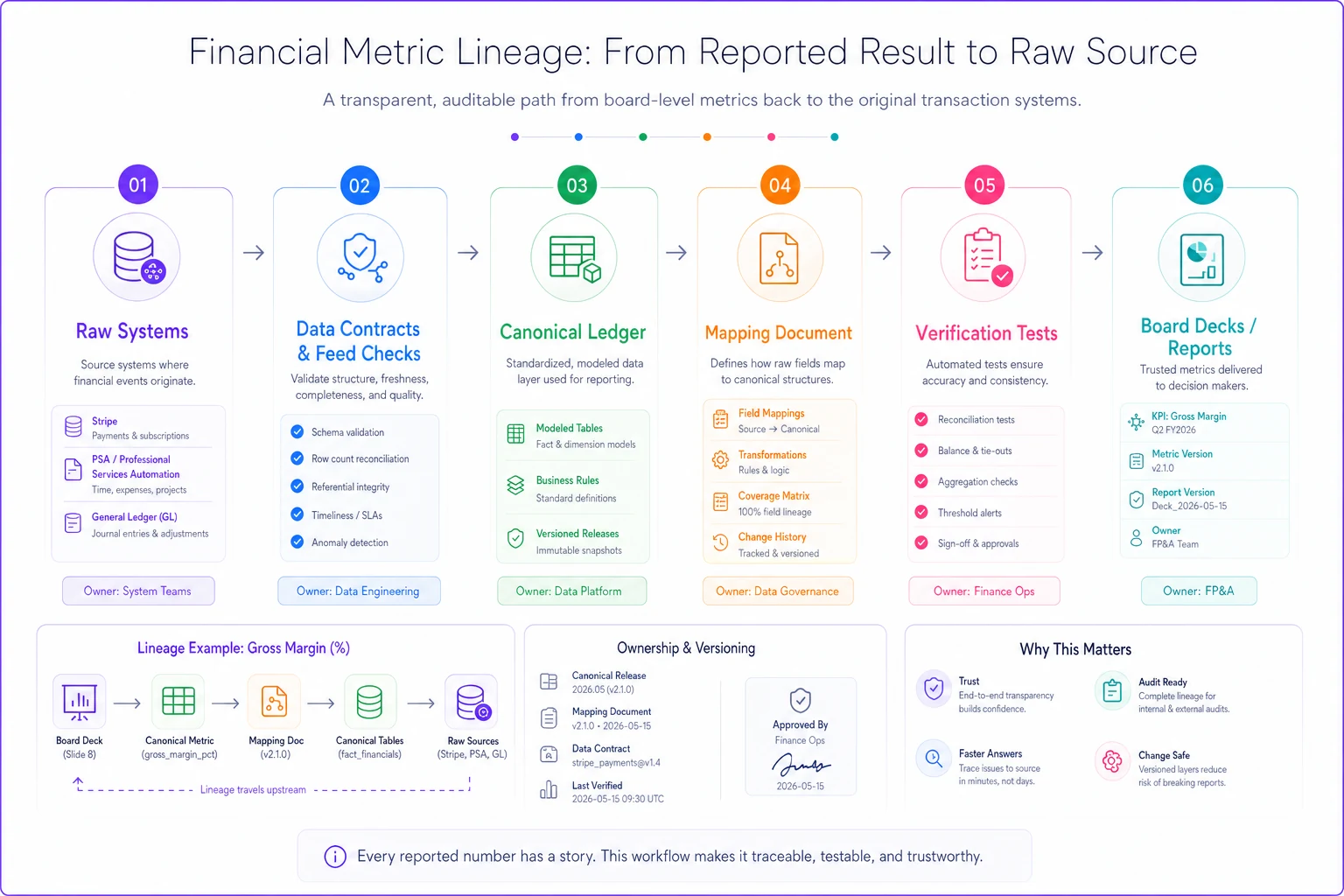
The image highlights who owns each handoff and where version stamps appear, making an auditor-friendly view of the path from source to report.
Versioning rules: changing definitions without breaking history
Definitions change. You'll switch from cash to accrual, redefine "active customer," or start excluding trials from revenue. The mistake is changing the definition in place, which silently rewrites history and makes last year's board deck impossible to reproduce.
-
Every metric definition gets a version number and an effective date (
recognized_revenue v2, effective 2025-01-01). -
Breaking changes bump the major version. Changing what's included in a metric is breaking. Fixing a bug that made the number wrong is a patch.
-
You keep the old logic runnable. If someone asks about Q3 last year, you reproduce it with the definition that was live then, not the current one.
-
Every report stamps which version it used. A board deck footnote reading "revenue per definition v2" saves enormous confusion later.
-
Changes get announced before they land, not discovered after.
The pattern that burns people: a founder tweaks the "active customer" definition mid-year to make a metric look better for a fundraise, doesn't version it, and then can't explain to the new CFO why the trend line has an unexplained kink. Versioning turns definition changes from a credibility risk into a documented, defensible decision.
Light verification tests you can actually maintain
You don't need a data-quality platform. You need a handful of tests that run on a schedule and make noise when something's off. The trick is keeping them light enough that a small team actually maintains them instead of letting them rot.
-
- Uniqueness
charge_idis unique. Duplicates mean double-counted revenue. -
- Not-null
required contract fields are never empty. Nulls mean unallocated revenue.
-
- Referential
every charge maps to a customer that exists in the customer dimension. Orphans mean revenue with no owner.
-
- Reconciliation
canonical revenue total matches the GL total within a tolerance (say, $50 or 0.1%). Divergence means the layers drifted.
-
- Range/sanity
no single charge exceeds a plausible ceiling; refund totals never exceed charge totals for a period.
-
- Row-count stability
today's transaction count isn't wildly different from the trailing average without explanation.
This kind of continuous checking is the backbone of a reliable close. We go deeper on the reconciliation side in the continuous reconciliation and data-governance playbook—the tests here feed that same discipline.
| Check | Tolerance | Action if breached |
|---|---|---|
| Canonical rev vs GL | ±$50 or 0.1% | Block close, investigate |
| Refunds vs charges | Refunds ≤ charges | Alert steward same day |
| Row-count vs 30-day avg | ±25% | Warning, review before close |
| Feed freshness | > 4 hrs stale | Alert producer immediately |
A realistic tolerance table for reconciliation checks is shown above and gives clear actions for the team when thresholds are breached.
Drift-detection: catching the slow leaks
Hard breaks are easy—the feed dies, the test fails, someone gets paged. The dangerous problems are the slow ones. A definition subtly shifts, a source starts including a new transaction type, an average creeps up 2% a month until six months later your margin is off by double digits and nobody can pinpoint when it started.
Drift detection is about watching distributions and relationships over time, not just single-point failures.
-
- Ratio monitoring
track refund rate, average charge size, and revenue-per-customer month over month. Sudden shifts flag a definition or source change even when no individual test technically fails.
-
- Schema drift
alert when a source adds, removes, or retypes a field. New fields are often the quiet culprit—someone adds a "surcharge" line and it starts flowing into revenue unnoticed.
-
- Mapping coverage
what percentage of raw transactions successfully map to a canonical category? If that drops from 99% to 94%, something new appeared that your mapping doesn't handle, and those transactions are falling into an "other" bucket nobody looks at.
-
- Reconciliation gap trend
don't just check if the GL-vs-canonical gap is within tolerance today. Chart it over time. A gap that's within tolerance but growing every month is drift you want to catch before it breaks something.
The mapping-coverage check is the one most teams don't run and most need. Unmapped transactions don't throw errors. They just quietly accumulate in a default bucket, and by the time someone notices, months of numbers are subtly wrong.
Consumer SLAs: setting expectations both ways
The canonical layer only works if the people building reports agree to use it and the people maintaining it agree to support it. That two-way agreement is your consumer SLA.
-
- Freshness
canonical tables are refreshed and reconciled by, say, business day 3 of close.
-
- Availability
if the layer is broken, consumers are told before they build reports—not after.
-
- Definition stability
consumers can rely on definitions not changing mid-period without notice.
-
- Change requests
a defined path for a consumer to request a new metric or flag a wrong one, with an expected turnaround.
-
- What consumers owe back
they build from the canonical layer, not raw sources or side spreadsheets, and they report anomalies instead of quietly working around them.
The clause that matters most: consumers agree not to fork the logic. The moment FP&A decides the canonical revenue number is "close enough" and rebuilds their own version in a spreadsheet, you've lost the single source of truth. The SLA exists to make that a violation, not a convenience.
A real scenario
A managed-services firm, roughly 30 people, was closing books around business day 12 every month—and the founder had stopped trusting the revenue number entirely. Three systems (a PSA tool, Stripe, and QuickBooks) each reported different monthly revenue, and reconciling them was a two-day manual slog the controller did from memory.
They didn't buy new software. They built a canonical layer: one steward (the controller), written data contracts for each source, a mapping doc for the six metrics that mattered, and about a dozen light verification tests plus a monthly drift check on refund rate and mapping coverage.
The first real win came in month two. The mapping-coverage check flagged that roughly 4% of PSA transactions—a newly added "reimbursable expense" type—were falling into an unmapped bucket and not hitting revenue. That was somewhere around $6k–$8k a month of billed work quietly going unrecognized. Nobody had noticed because no error ever fired.
Within about four months, close moved from business day 12 to day 6, the three-way revenue disagreement disappeared because everything now pulled from one defined layer, and when they raised a round later that year, the diligence data request that used to trigger a week of scrambling took an afternoon. The lineage doc answered most of the auditor's "where did this come from" questions on its own.
When this makes sense—and when it doesn't
When it's worth building:
-
- You have more than one system feeding financial reports (nearly everyone past bookkeeping-only).
-
- Numbers regularly disagree between tools and reconciliation is manual and tribal.
-
- You're approaching a fundraise, audit, or lender relationship where reproducibility matters.
-
- Key financial logic lives in one person's head.
When it's premature:
-
- You're a solo operator with one system and 30 transactions a month. A clean chart of accounts does the job; a canonical layer is overhead you don't need yet.
-
- You haven't fixed master-data basics. If customer and vendor records are a mess at the source, build governance there first—canonical modeling on top of dirty data just documents the dirt.
Who should not start here:
Teams still fighting fires on basic reconciliation. If you can't currently tie your bank to your GL, that's the prerequisite. Canonical design assumes your fundamentals hold; it's the layer that makes them scale, not a substitute for having them.
Where automation fits (without pretending it's magic)
Most of this blueprint is discipline, not tooling. But the maintenance load is real, and it's where small teams give up. Running verification tests every close, watching for schema drift, checking mapping coverage, re-reconciling the GL against canonical totals—doing that by hand is exactly the kind of repetitive work that gets skipped the month everyone's busy, which is usually the month it matters most.
This is where AI-assisted operational tooling earns its place: not by defining your truth for you, but by continuously running the checks, surfacing drift before it compounds, and flagging when a source silently changed. The definitions and ownership stay human—those are judgment calls. The tireless monitoring, the "this ratio moved 8% and nobody logged a reason" alerts, the reconciliation that reruns every night—that's what automation should carry so your controller isn't the single point of failure for financial truth.
The teams that get this right treat automation as the thing that enforces the blueprint consistently, not the thing that replaces the thinking behind it.
A canonical ledger isn't a bigger reporting project. It's the decision to make financial truth explicit—owned, defined, versioned, and traceable—instead of leaving it scattered across systems and someone's memory. Data contracts stop silent breakage. Lineage makes every number answerable. Versioning protects your history. Light tests and drift checks catch the leaks before they compound.
The payoff isn't just faster closes or cleaner diligence, though you'll get both. It's that when someone asks what a number means and where it came from, there's one answer—and you can prove it. For a growing SMB, that's the difference between finance that scales with you and finance that quietly becomes the bottleneck nobody can untangle.
Ready to take control of your finances?
Join over 2,000 businesses using Acctaly to simplify accounting, accelerate cash flow, and ensure tax readiness.