


Most SMB owners fund finance the way they fix a leaky roof: something breaks, money goes out, and nobody asks whether that was the best place to spend it. Then six months later something else breaks. What you end up with is a pile of half-finished capabilities — a decent close process, a shaky forecast, controls that live entirely in one person's head — none of it sequenced against where the business actually is.
The way out isn't a bigger budget. It's treating your finance function like a portfolio of capabilities that each have a stage, an owner, a success metric, and an investment gate. That's what finance capability portfolio governance actually means for an SMB: a shared map that a founder, a fractional CFO, and a board member can all look at and agree on what gets funded next and what "done" looks like.
This post is less about any single mechanic and more about how the pieces connect — and where the coordination breaks as headcount and revenue climb.
Why finance investment goes sideways in SMBs
Finance capabilities don't fail loudly. A weak reconciliation process doesn't crash the way a website does. It just quietly produces numbers that are 4% off, and you don't find out until a diligence process or a bad month forces someone to actually trace the ledger. Because the failure stays invisible until it's expensive, funding decisions end up made emotionally rather than by stage.
A second pattern shows up almost everywhere: capabilities get funded out of order. A ten-person company will buy a fancy FP&A tool before it has a chart of accounts that produces trustworthy inputs. Now you've got beautiful dashboards built on numbers nobody believes. The dashboard isn't the problem — the sequencing is. Capability B was funded before capability A that feeds it.
Then there's ownership drift. In a solo shop, the founder owns everything by default. Somewhere around four to ten people, "everyone owns it" becomes "nobody owns it," and things like access reviews, close checklists, and forecast updates fall between the chairs. The capability technically exists but has no accountable owner, so it degrades quietly.
Governance fixes all three by forcing three questions before any dollar moves:
-
What stage is this capability supposed to be at, given our size?
-
Who owns it, and how do we measure whether it's working?
-
What's the minimum viable version we can ship before over-investing?
Governance fixes all three by forcing three questions before any dollar moves:
The capability map: what belongs at each stage
Think in three rough growth bands most SMBs pass through. The bands aren't about revenue alone — they track the complexity of transactions, the number of people touching money, and how much external scrutiny you're under.
Stop letting accounting slow your business down.
Acctaly automates your financial operations so you can focus on growth and compliance.
- Automated bookkeeping
- Real-time financial reporting
- Integrated tax management
No credit card required
The staged finance-ops maturity model goes deep on the sequencing logic. Here's the portfolio-level view a board would actually use:
| Capability area | Stage 1 (1–3 finance-adjacent) | Stage 2 (4–10) | Stage 3 (10–50) |
|---|---|---|---|
| Ledger & close | Clean COA, monthly close in ~10 days | Close in 5 days, documented checklist | Continuous close, sub-issues tracked |
| Cash & liquidity | Bank recs, basic runway view | 13-week rolling forecast | Forecast gates AR/AP and CapEx |
| Controls | Owner reviews high-value items | Segregation on payments, access reviews | Continuous control monitoring |
| FP&A | Simple budget vs actual | Driver-based model, unit economics | Scenario planning tied to decisions |
| Data & reconciliation | Manual but consistent | Automated recs on key accounts | Data contracts, lineage, exception handling |
| Reporting | P&L a founder trusts | KPI pack mapped to the business model | Board-ready, self-serve reporting |
The point of this table isn't to check every box top-to-bottom. Each row advances as you grow, and trying to jump two stages ahead usually just wastes money. A 12-person services firm running scenario planning while its close still takes 14 days has invested in the wrong row.
Success metrics that actually gate funding
A capability without a metric is a hobby. But most finance metrics on a board deck are vanity — "we implemented X." That tells you nothing about whether X works. You want metrics that would visibly move if the capability degraded.
A few that hold up across different business types:
-
Close cycle time and its variance. A close that takes 6 days one month and 13 the next is worse than a steady 9. Variance signals a fragile process dependent on one person.
-
Reconciliation coverage. What percentage of cash and revenue accounts are reconciled with a documented, repeatable process versus "someone eyeballs it." Coverage below roughly 70% at Stage 2 is a red flag.
-
Forecast error. Compare your 13-week forecast to actuals at week 4 and week 13. Routinely off by more than 10–15% at week 4 means the forecast isn't yet a decision tool.
-
Control exception rate. How many payments, journal entries, or access grants bypassed the intended approval path last quarter.
Attach each metric to an investment gate. Don't fund the next stage of a capability until the current stage's metric is stable. Forecast error above 20%? Don't buy scenario-planning software — fix the inputs first. This is exactly the discipline behind a portfolio scoring framework for automation spend: score before you fund, and don't let a shiny tool jump the queue.
Investment gates and minimum viable deliverables
Run this sequence whenever someone proposes spending real money — headcount, software, or an outside firm — on a finance capability.
-
Name the capability and its target stage. Not "better reporting." Instead: "move close from Stage 1 to Stage 2 — a documented 5-day close."
-
Define the minimum viable deliverable. The smallest version that produces the target metric. For a 13-week forecast, that's a spreadsheet with real bank data and weekly updates — not a six-figure planning platform.
-
Set the success metric and a review date. "Forecast error under 15% at week 4, reviewed in 90 days."
-
Confirm the upstream dependency is stable. Is the capability that feeds this one already at the right stage? If reconciliation is shaky, don't fund forecasting yet.
-
Assign an accountable owner. One name. Not a committee.
-
Approve the minimum version only. Fund the MVP, prove the metric, then decide on the next increment at the review date.
Use this quick workflow when evaluating a proposed spend.
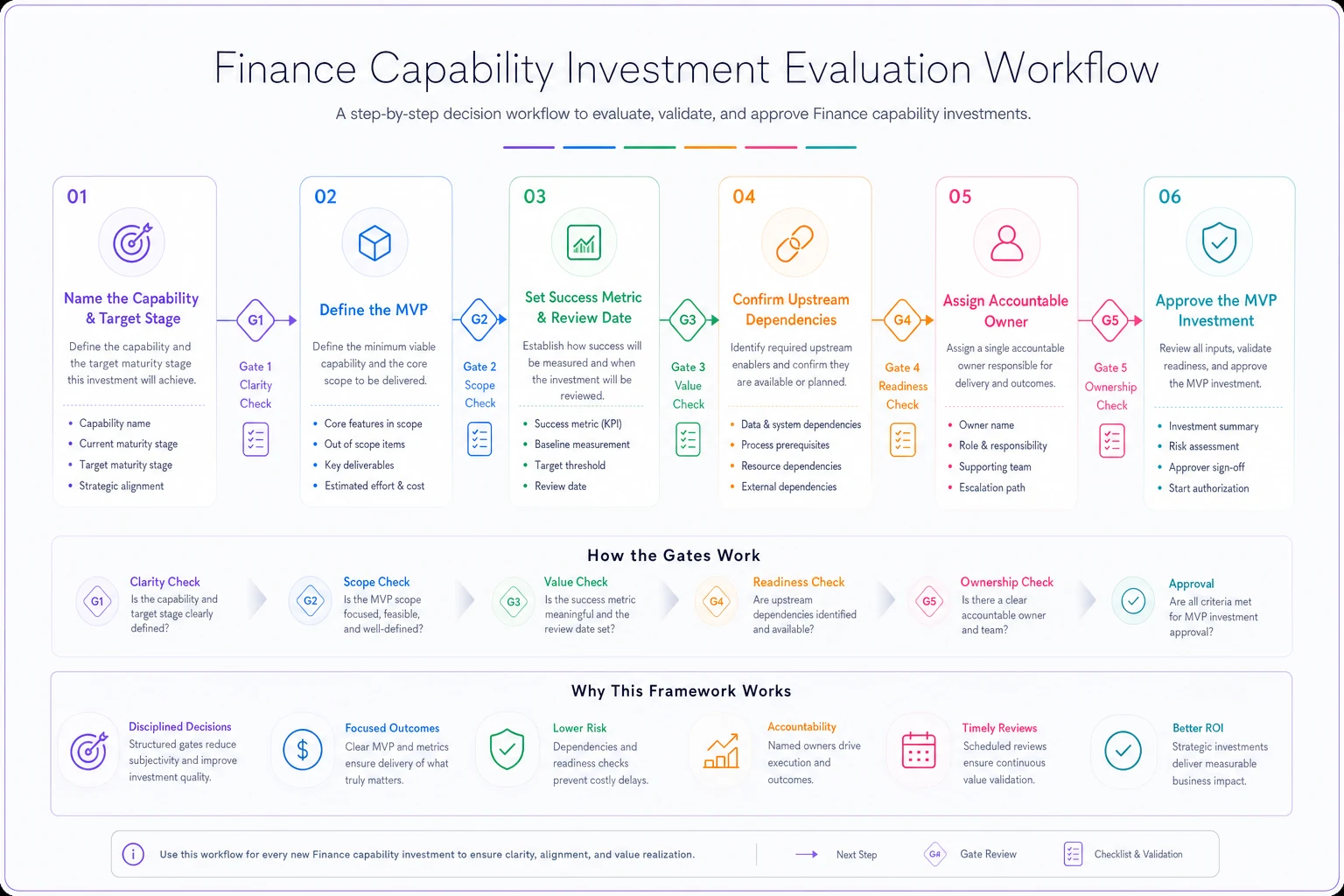
That last point is where most SMBs leak money. They approve the full platform when the MVP would have told them whether the capability even mattered. The MVP mindset is what keeps a portfolio affordable — you buy proof before you buy scale.
Lightweight monthly and quarterly templates
Governance dies when it's heavy. If reviewing the finance portfolio takes a half-day workshop, it won't happen. Two rhythms are enough.
Monthly (15–20 minutes, owner + founder or fractional CFO):
-
Which capabilities hit their metric this month, which slipped?
-
Any capability now blocking another (e.g., recon delays holding up close)?
-
One thing to fix before next month. Just one.
Keep the monthly check to one fix to maintain momentum and avoid turning the meeting into a project plan.
Quarterly (board- or exec-facing, one page):
-
The capability map with each row marked green / amber / red against its target stage.
-
Any capability proposed for the next investment gate, with its MVP and metric.
-
Funding sequenced for the next two quarters — what's next, and what's explicitly not being funded yet.
The quarterly one-pager is what a board actually wants. It answers "are we investing in the right finance things in the right order?" without drowning anyone in detail. When the FP&A layer matures, this connects naturally to an FP&A operating system that triggers decisions — the same metrics that gate funding also drive the operating cadence.
Funding sequencing: what to buy before what
Fund first (foundations): chart of accounts, clean close, bank reconciliation. Everything downstream reads from these. Under-invest here and you guarantee garbage in every report you build later.
Fund second (visibility): the rolling cash forecast and a KPI pack mapped to how you actually make money. You can't govern spend on capabilities you can't see the impact of.
Fund third (control and automation): approval routing, access reviews, automated reconciliation on high-volume accounts. This is where AI-assisted operational tooling starts earning its keep — not by replacing judgment, but by handling the repetitive matching, flagging, and routing that eats a bookkeeper's week. When exceptions get surfaced automatically instead of hunted for manually, a small team can handle a much larger transaction volume without the error rate climbing.
Fund last (sophistication): scenario planning, driver-based modeling, self-serve board reporting. Genuinely valuable — but worthless sitting on shaky foundations.
The most common sequencing mistake is buying automation before the underlying process is stable. Automating a broken reconciliation process just produces wrong answers faster. Stabilize the workflow first, then let automation carry the volume.
A real scenario
A regional field-services company — around 30 staff, maybe four people touching finance — had funded finance reactively for years. They'd bought a mid-tier planning tool but were still closing the books in 12–14 days, and the runway forecast was basically the founder's gut updated "whenever."
When they mapped capabilities against stages, the picture was obvious: they'd funded Stage 3 sophistication on a Stage 1 foundation — an inconsistent close, almost no real reconciliation coverage. The dashboards looked fine. Nobody trusted them.
They reversed the sequence. The first quarter went entirely to close discipline and reconciliation — a documented checklist, one accountable owner, automated matching on their two highest-volume bank accounts. Close dropped to around 6 days and, more importantly, stopped swinging wildly month to month. Only then did they turn the planning tool back on, feeding it numbers people actually believed. Forecast error at week four went from routinely above 25% to the low teens. Nothing about the spend was dramatic — they mostly re-sequenced money they were already spending.
When this governance approach is overkill
If you're a two-person shop closing books over a weekend with no external scrutiny, a full portfolio map is more overhead than it's worth. Run one monthly question — "what's the one finance thing to fix this month?" — and skip the rest until you hit four or five people.
It's also a bad fit if leadership won't actually enforce the gates. Governance that gets overridden every time someone wants a new tool creates paperwork and false comfort. If the founder is going to buy whatever they want regardless of sequence, don't pretend there's a portfolio process.
Where it genuinely earns its keep is the messy middle — roughly 10 to 50 people, transactions getting complex, maybe a first outside investor or lender asking real questions. That's the range where uncoordinated finance spending quietly compounds into a function nobody trusts.
Bringing it together
The value of treating finance as a governed portfolio isn't control for its own sake. It forces every dollar to answer for its place in a sequence — foundations before visibility, visibility before control, control before sophistication. Capabilities stop getting funded out of order. Metrics tell you whether something's working before you scale it. A founder, a fractional CFO, and a board member can look at one page and actually agree on what happens next.
Start small. Draw the capability map, mark each row green, amber, or red against your stage, and pick the single most out-of-sequence investment to correct first. That one decision — funding the foundation you skipped instead of the sophistication you were tempted by — is usually worth more than the entire budget you were about to spend.
Start small. Draw the capability map, mark each row green, amber, or red against your stage, and pick the single most out-of-sequence investment to correct first. That one decision — funding the foundation you skipped instead of the sophistication you were tempted by — is usually worth more than the entire budget you were about to spend.
Ready to take control of your finances?
Join over 2,000 businesses using Acctaly to simplify accounting, accelerate cash flow, and ensure tax readiness.