


Most finance problems in small businesses aren't caused by doing the wrong things. They're caused by doing the right things at the wrong time. A four-person company running a formal three-way match process is wasting energy. A forty-person company still reconciling in a shared spreadsheet is quietly bleeding money and doesn't realize it yet.
Finance capability doesn't scale linearly with headcount or revenue — it scales in jumps. You'll cruise along fine for months, then hit a wall where the way you've always done things suddenly stops working. And it usually breaks during a bad week. A fundraise, an audit, a cash crunch.
This is a map for sequencing those jumps. Not a checklist of best practices, but a staged view of which capabilities actually earn their keep at each phase, roughly what they cost, and how much risk you can tolerate leaving on the table before it bites you.
The four stages, and what actually defines them
People instinctively want to map finance maturity to revenue or headcount. That's part of it, but the real trigger is decision complexity — how many people are making financial decisions, and how far those decisions are from whoever's watching the bank balance.
| Stage | Rough profile | The core question you're solving | Biggest risk if you over-invest |
|---|---|---|---|
| Founder | Solo or founder-led finance, <$1M–$2M rev | "Do we have money, and where did it go?" | Building process nobody follows |
| Foundation | First finance hire/bookkeeper, ~$2M–$8M | "Can we trust the numbers without checking them by hand?" | Buying enterprise tools you can't staff |
| Scale | Small finance team (3–6), ~$8M–$25M | "Can we make decisions fast without breaking controls?" | Adding headcount instead of systems |
| Expand | Finance function with specialization, $25M+ | "Can each business line be measured and managed independently?" | Centralizing things that should stay flexible |
Worth noting: the dangers at each stage are just as much about over-building as under-building. A Founder-stage company that installs a rigid approval matrix creates friction that slows the business without protecting anything real — there's nothing yet to protect, and no one to enforce it consistently anyway.
Founder stage: visibility before control
At this stage the entire finance operation lives inside one or two people's heads, and honestly, that's fine. The mistake founders make isn't a lack of controls — it's a lack of visibility. They can tell you last month's revenue but not whether next month's payroll clears.
Stop letting accounting slow your business down.
Acctaly automates your financial operations so you can focus on growth and compliance.
- Automated bookkeeping
- Real-time financial reporting
- Integrated tax management
No credit card required
What actually matters here:
-
A clean separation between business and personal spending (sounds obvious, gets violated constantly)
-
A chart of accounts that won't need to be torn apart in eighteen months
-
A running view of cash — even a manual one — that looks forward, not backward
-
Basic categorization discipline so the books mean something later
The single highest-leverage investment at Founder stage is a chart of accounts built to grow. Almost every painful cleanup project down the road traces back to an account structure that was slapped together to get through the first tax filing. A reporting-first chart of accounts that scales is far cheaper to build now than to retrofit after three years of miscoded transactions.
Rough investment: Bookkeeping software plus a few hours a month. Maybe $200–$600/month all-in if you're outsourcing the books.
Risk tolerance: High. Messy processes, occasional miscategorization, some manual work — all fine. What you cannot tolerate is not knowing your cash position. A founder who's surprised by a low balance is the real failure mode here.
When to move on: The moment someone other than the founder starts making spending decisions, or when checking the books manually every week stops being feasible.
Foundation stage: making the numbers trustworthy
This is where most SMBs get stuck for years, and it's the stage that determines whether growth is going to be painful or manageable.
The defining problem shifts from "do we have money" to "can I trust this report without re-verifying it." You've hired a bookkeeper or a controller, transactions are flowing from multiple sources, and the founder is no longer touching every entry. That's exactly when errors start hiding.
A typical example: a services company around $4M in revenue, one full-time bookkeeper, revenue coming through Stripe, a POS, and a couple of manual invoices. Month-end close takes eleven business days, mostly because reconciling the payment processors against the bank against the accounting system is a manual detective exercise every single time. Nobody trusts the mid-month numbers, so decisions wait for close — which means decisions are always three weeks stale.
What you're building at Foundation stage is reliability:
-
A repeatable monthly close with a defined cutoff and a clear owner
-
Reconciliation that happens continuously, not in a panic at month-end
-
Basic segregation — the person who approves spend isn't the person who cuts the check
-
A short-horizon cash forecast that people actually look at
The close is the keystone. When it's predictable, everything downstream gets easier — reporting, forecasting, tax prep, diligence. A predictable monthly close system pays for itself faster than almost any other investment at this stage, because a shorter close directly means fresher decisions.
Rough investment: Accounting platform plus reconciliation and close tooling, roughly $500–$2,000/month, plus the bookkeeper or controller salary. This is where automation starts earning real returns — not by replacing your bookkeeper, but by killing the repetitive matching work that eats half their week.
Risk tolerance: Moderate. Some manual processes are fine. Numbers you don't trust are not. A simple threshold: if you'd hesitate to send a report to a bank or investor without re-checking it yourself, you're not done here.
When Foundation-stage investment is a bad idea
Don't build formal audit trails, complex approval hierarchies, or department-level P&Ls yet. There aren't enough people or transactions to justify the overhead, and you'll spend more time maintaining the process than the process saves you. A common pattern is a founder reading about "controls" and installing a multi-tier approval chain in a nine-person company — everything grinds, and people route around it anyway.
Scale stage: speed without breaking things
Something specific happens around the 3–6 person finance team mark. The workarounds that got you here — the one person who "just knows" how the marketplace payouts reconcile, the tribal knowledge about which vendor invoices always come in late — start becoming liabilities. When that person is out for a week, the close slips.
The core tension at Scale is speed versus control. The business is making decisions fast enough that waiting for month-end isn't acceptable, but you've got enough people spending money that loose controls get expensive quietly.
In practice, this usually shows up as a coordination problem more than a technical one. Picture a company where:
-
Sales is committing to custom deal terms that finance finds out about at invoicing
-
Multiple people have company cards with no consistent coding
-
AP is piling up because approvals bounce around email
-
A forecast exists but operations ignores it
Each of these is manageable in isolation. Together, they mean the finance team spends its days chasing information instead of producing insight. The bottleneck stops being doing the work and starts being coordinating it.
The right investments at Scale are about connective tissue:
-
Role clarity — who owns what, documented, so nothing lives in one head. Getting the finance org and role charters right as you cross this threshold prevents the "everything breaks when Dana's on vacation" problem.
-
Enforced-not-suggested controls — approval rules and card policies that live in the workflow, not in a PDF nobody reads
-
A forecast that gates decisions rather than just describing them after the fact
-
Continuous reconciliation so the close is a formality, not an event
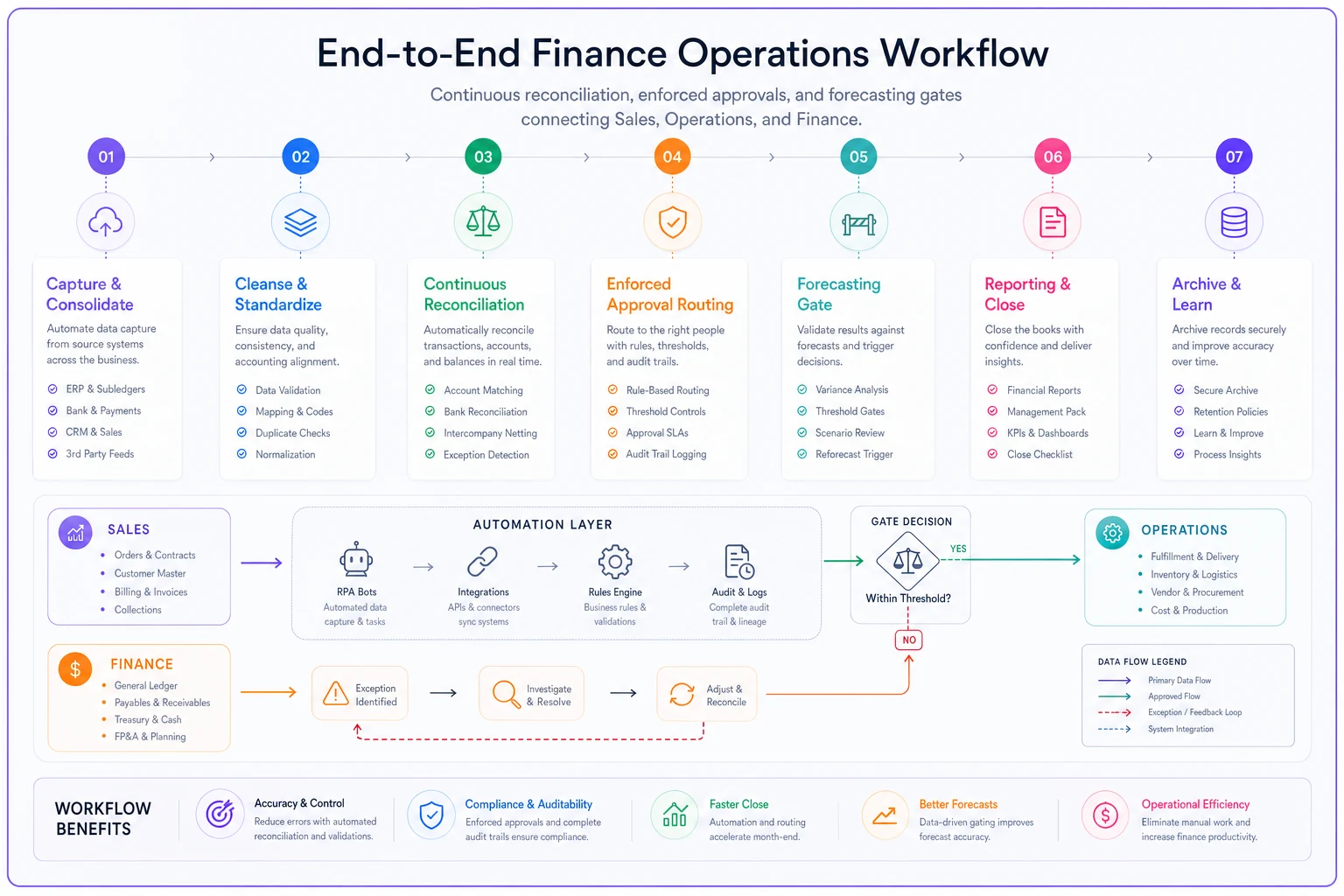
This is also the stage where finance automation shifts from "nice efficiency gain" to structurally necessary. Not because it's trendy — because the volume and number of decision-makers has outgrown what manual coordination can handle. When approval routing, transaction matching, and exception flagging happen automatically, a small team can supervise a much larger operation without adding headcount for every increment of growth. That's the actual leverage: systems absorb the coordination load that would otherwise require a fifth and sixth hire.
Here's a simple workflow visualization to keep the priorities straight:
Rough investment: Integrated finance stack — accounting, AP/AR automation, expense management, forecasting — often $2,000–$6,000/month in software, on top of the team. The number that matters more than the software cost is the headcount you don't add.
Risk tolerance: Lower. Occasional exceptions are fine. Systemic gaps aren't. A useful threshold: if a control depends entirely on one person remembering to do it, it's not a control — it's a hope.
Who should NOT invest at Scale-stage intensity
If your transaction volume is still low even though revenue looks big — say, a handful of large enterprise contracts per month — you may not need heavy AP automation or expense tooling at all. Stage isn't purely about revenue. A company with twelve invoices a month and eight employees can stay lighter than the framework suggests. Match the investment to transaction complexity, not the top-line number.
Expand stage: measuring the business as its parts
By Expand stage the question changes again. It's no longer "can we trust the numbers" or "can we move fast" — it's "can we understand and manage each part of the business independently."
This is where multi-entity structures, multiple product lines, or distinct customer segments make the consolidated P&L nearly useless for decisions. The company might be profitable overall while one business line quietly loses money and another subsidizes it. At Founder or Foundation stage that's invisible and doesn't really matter. At Expand stage it's the whole game.
What breaks here is attribution. Costs that were fine to lump together — shared infrastructure, a sales team selling multiple products, overhead — now need to be allocated to understand real unit economics. The finance team's job becomes less about accuracy of the total and more about the honesty of the breakdown.
-
Segment-level or entity-level reporting with real cost allocation
-
Specialized roles — someone owns FP&A, someone owns controllership, and they're no longer the same person
-
Governance over how allocations and definitions are made, so "gross margin" means the same thing across every deck
-
Scenario planning that models each business line separately
Rough investment: This is where you might genuinely need a more capable ERP or a proper FP&A platform, plus specialized hires. Software can run $6,000–$15,000+/month, and the team cost dwarfs it.
Risk tolerance: Low on definitions and allocations — but deliberately higher on precision, which sounds backwards. A perfect allocation that takes three weeks is worse than a defensible one that takes three days, because the point is timely decisions per business line, not a perfect number nobody can act on.
A short real scenario
A specialty e-commerce business at roughly $11M in revenue had grown to a three-person finance team but was still operating with Foundation-stage habits. Close took around ten days. Reconciliation across their payment processors and 3PL was manual. Nobody could say with confidence which of their three product categories actually made money after fulfillment and ad costs.
The founder's instinct was to hire a fourth finance person. Instead they treated it as a Scale-stage problem: enforced approval routing in the AP workflow, moved reconciliation to a continuous process, and standardized cost allocations before touching headcount.
Within a couple quarters, close dropped to roughly four days. More importantly, they found that one product category was running near break-even after true fulfillment costs — something the consolidated numbers had completely hidden. They shifted ad spend accordingly. No fourth hire, and the team stopped working weekends around close.
The lesson wasn't that automation is magic. It was that they correctly identified their stage and invested in the right capability instead of throwing a person at a systems problem.
How to actually use this map
The most common way businesses get this wrong is treating maturity as a straight climb — assuming they need everything at the top eventually, so they might as well build ahead. That's how you end up with an ERP that takes eighteen months to implement in a company that needed a better close and a cash forecast.
Work it the other way. Diagnose honestly:
-
Founder Do you know your forward cash position without doing manual math each time?
-
Foundation Do you trust your reports without re-checking them?
-
Scale Do your controls survive a key person being out for a week?
-
Expand Can you measure each business line as if it were its own company?
Find the first question you can't answer with a confident yes. That's your stage. Invest there. Resist the pull to build capabilities two stages ahead — they'll cost more, break more, and sit unused until the business actually needs them.
Finance operations mature in steps, not slopes. The businesses that stay healthy through growth aren't the ones with the most sophisticated stack — they're the ones whose capabilities match their actual stage, built just slightly ahead of the wall they're about to hit, and no further.
Ready to take control of your finances?
Join over 2,000 businesses using Acctaly to simplify accounting, accelerate cash flow, and ensure tax readiness.