


Most FP&A setups in small companies aren't broken because the math is wrong. They're broken because nothing happens after the model updates. You refresh the forecast, the numbers shift a little, someone nods on the call, and then everyone goes back to running the business exactly like they did before. The forecast becomes a report card instead of a control system.
That gap — between "the model says something changed" and "we did something about it" — is the real problem. Not a fancier spreadsheet. A set of connected rules that turn financial signals into specific actions, owned by specific people, at predictable times.
Almost nobody sets this up on purpose. It just evolves badly until the company is 30 people deep and the finance lead is manually stitching together numbers every month with no clear link between what the forecast shows and what the team actually does next.
Why the forecast rarely changes behavior
The pattern you see over and over in companies between 5 and 50 people: forecasting improves faster than the decision-making around it.
Someone gets good at building models. The revenue projection gets more sophisticated, the cash view gets tighter, the assumptions get documented. But the operating side — who acts, when, and based on what threshold — stays completely informal. A founder still decides on a new hire based on gut feel. A marketing spend increase gets approved because Q3 "felt strong." The model exists in one universe and the decisions live in another.
The core issue is that a forecast is a description, and a description doesn't force anyone to do anything. What forces action is a trigger — a pre-agreed line that, when crossed, requires a specific response. Without triggers, every financial decision becomes a fresh negotiation. That gets exhausting fast, and it gets worse as more people join.
A related trap: teams treat the forecast as a single scenario. One line of "here's what we think will happen." When reality diverges — and it always does — there's no pre-built version of the plan for that reality, so the whole exercise starts from scratch under pressure. That's the worst time to be building your response.
If you've already tackled the cash side of this, some of what follows will feel familiar. Building a system that actually gates AR/AP and CapEx decisions off your cash position is the sibling problem to what we're covering here. This article is the layer above it — the planning system that decides which levers to pull before the cash operations system enforces them.
The four parts of an FP&A operating system
An operating system that holds up at scale has four pieces that work together. Skip any one and the other three degrade.
Stop letting accounting slow your business down.
Acctaly automates your financial operations so you can focus on growth and compliance.
- Automated bookkeeping
- Real-time financial reporting
- Integrated tax management
No credit card required
| Component | What it does | What breaks without it |
|---|---|---|
| Scenario library | Pre-built variants (base, upside, downside) so you're never modeling from zero | Every surprise triggers a fire drill and ad-hoc rebuild |
| Decision-trigger thresholds | Explicit numeric lines that require a defined action | Forecasts describe reality but never change it |
| Model-version governance | Control over which model is "current" and who changed what | Three versions float around, nobody trusts the numbers |
| Monthly reforecast ritual | A lightweight recurring rhythm sized to team size | The forecast rots between quarters and stops matching reality |
The mistake most teams make is investing heavily in the first component — building elaborate scenarios — while completely ignoring the other three. A gorgeous downside model does nothing if there's no threshold that activates it, no version discipline to keep it current, and no ritual to refresh it.
Scenario libraries: build the variants before you need them
The point of a scenario library isn't prediction. It's preparation. You're not trying to guess which future happens. You're building the plans in advance so that when one of them starts materializing, you can switch to it in an afternoon instead of a week.
For a small company, you don't need twelve scenarios. Three or four that are genuinely different from each other — not the base case with slightly different growth percentages.
-
Base case — your honest expectation, updated monthly
-
Downside — a revenue miss of roughly 20–30% against plan, or a specific customer concentration risk playing out
-
Upside — demand runs ahead and you have to decide whether to spend into it
-
Shock — a single-event scenario
losing your largest account, a funding delay, a major cost spike
What makes these useful is that each one comes with its own action set baked in, not just its own numbers. The downside scenario doesn't only show lower revenue — it shows which costs get cut, in what order, and who signs off. The upside scenario shows what hiring gets unlocked and at what confidence level.
A services firm doing around $4M in revenue built a downside scenario assuming their two biggest clients — about 40% of revenue combined — both churned in the same quarter. They didn't just model the hole. They pre-decided that if it happened, contractor spend gets frozen first, the two open roles get paused, and the founder's discretionary marketing budget drops by half. When one of those clients actually left months later, the response took a single meeting instead of three weeks of arguing.
That's the whole value. The library turns a crisis into a lookup.
Decision-trigger thresholds: the part everyone skips
This is where an FP&A operating system stops being a reporting exercise and starts being an actual control system.
A decision trigger is a specific, numeric, pre-agreed line paired with a specific action and a specific owner. The format that works:
> When [metric] crosses [threshold], then [action] happens, owned by [person], reviewed [when].
Vague triggers are useless. "If cash gets tight, we'll be careful" is not a trigger. "When runway drops below 6 months, all new hires require founder + finance sign-off and the hiring plan is re-ranked" — that's a trigger.
-
Runway threshold — below X months, hiring and non-essential CapEx move to a stricter approval path
-
Gross margin drift — if margin falls more than a few points below plan for two consecutive months, pricing and vendor costs get reviewed
-
Revenue variance — if actuals miss forecast by more than ~15% in a month, the downside scenario gets activated as the working plan
-
Customer concentration — if any single client exceeds a set percentage of revenue, a de-risking action gets queued
-
AR aging — if overdue receivables cross a threshold, collections escalate and new work for that client pauses
Most teams miss this distinction: thresholds should trigger a decision process, not always a decision. The trigger doesn't say "fire someone." It says "this now requires a specific review with specific people." That keeps the system from overreacting to noise, while still making sure nothing important gets quietly ignored.
| Signal | Threshold | Action triggered | Owner |
|---|---|---|---|
| Runway | < 6 months | Freeze non-critical hires, re-rank hiring plan | Founder + Finance |
| Gross margin | > 3pts below plan, 2 months | Vendor + pricing review | Finance lead |
| Monthly revenue | Miss > 15% | Switch working plan to downside scenario | Finance lead |
| Single-customer share | > 25% of revenue | Queue diversification plan | Founder |
| AR overdue | > $X or > 60 days | Escalate collections, pause new work | AR owner |
The matrix is the operating system in its most compressed form. Everything else — the scenarios, the models, the ritual — feeds into keeping this table honest and current.
Model-version governance: boring, and the reason people trust the numbers
Nothing kills a forecasting system faster than three versions of the model floating around with slightly different assumptions and nobody sure which one is real. It happens quietly. Someone downloads a copy to test an idea. Someone else emails a version to an investor. A third person updates the "real" one. Two weeks later, four different numbers exist for the same metric.
-
One canonical model. Exactly one file or workspace is "current." Everything else is a copy, clearly labeled as a copy.
-
A change log. Every material assumption change gets a one-line note: what changed, why, who, when. Takes seconds, saves hours in every future argument.
-
Locked assumptions. Core assumptions live in one clearly marked place, not scattered across forty cells nobody can find.
-
A named owner. One person is accountable for the canonical version being right and current.
The failure mode at scale is subtle. As the team grows, more people need to see the forecast and some need to change it — and those are very different permissions. The moment someone who shouldn't be editing assumptions edits them "just to check something," trust in the whole system starts leaking.
Lightweight FP&A platforms help here — they enforce a single source of truth and keep an automatic history of who changed what, so version discipline doesn't depend on everyone remembering to be careful. AI-powered operational software takes this further by flagging assumption drift automatically, so the finance lead isn't hunting for what changed between versions. But you can start with disciplined file naming and a shared change log. The habit matters more than the tooling.
The monthly reforecast ritual, sized to your headcount
A reforecast is only useful if it actually happens on a predictable rhythm. The biggest mistake is running a process that's too heavy for the team you have. A 6-person company trying to run a 50-person company's reforecast will stop doing it after two months.
Solo / very small (1–5 people): A 45-minute monthly session. Update actuals, refresh the base case, check the trigger matrix, note any breaches. No committee, no deck.
Small (5–20 people): A 90-minute monthly reforecast with the founder, finance lead, and one operational owner. Update actuals, review variance against last month's forecast, check every trigger threshold, decide on any that got breached, log assumption changes.
Mid (20–50 people): A structured monthly cycle. Finance prepares actuals and variance in advance, department owners submit updated inputs, the reforecast meeting focuses only on decisions and threshold breaches — not on reviewing numbers line by line.
-
Close enough to reforecast — you need actuals current enough to be worth comparing against
-
Compare actuals to last forecast — where did reality diverge, and by how much
-
Check every trigger threshold — did anything cross a line
-
Act on breaches — run the action from the matrix, don't debate whether to act
-
Update the base case — roll assumptions forward
-
Log changes — one line per material change
-
Confirm the working scenario — is base still the working plan, or did a trigger switch you to downside
Here's a simple workflow you can visualize before you run the meeting.
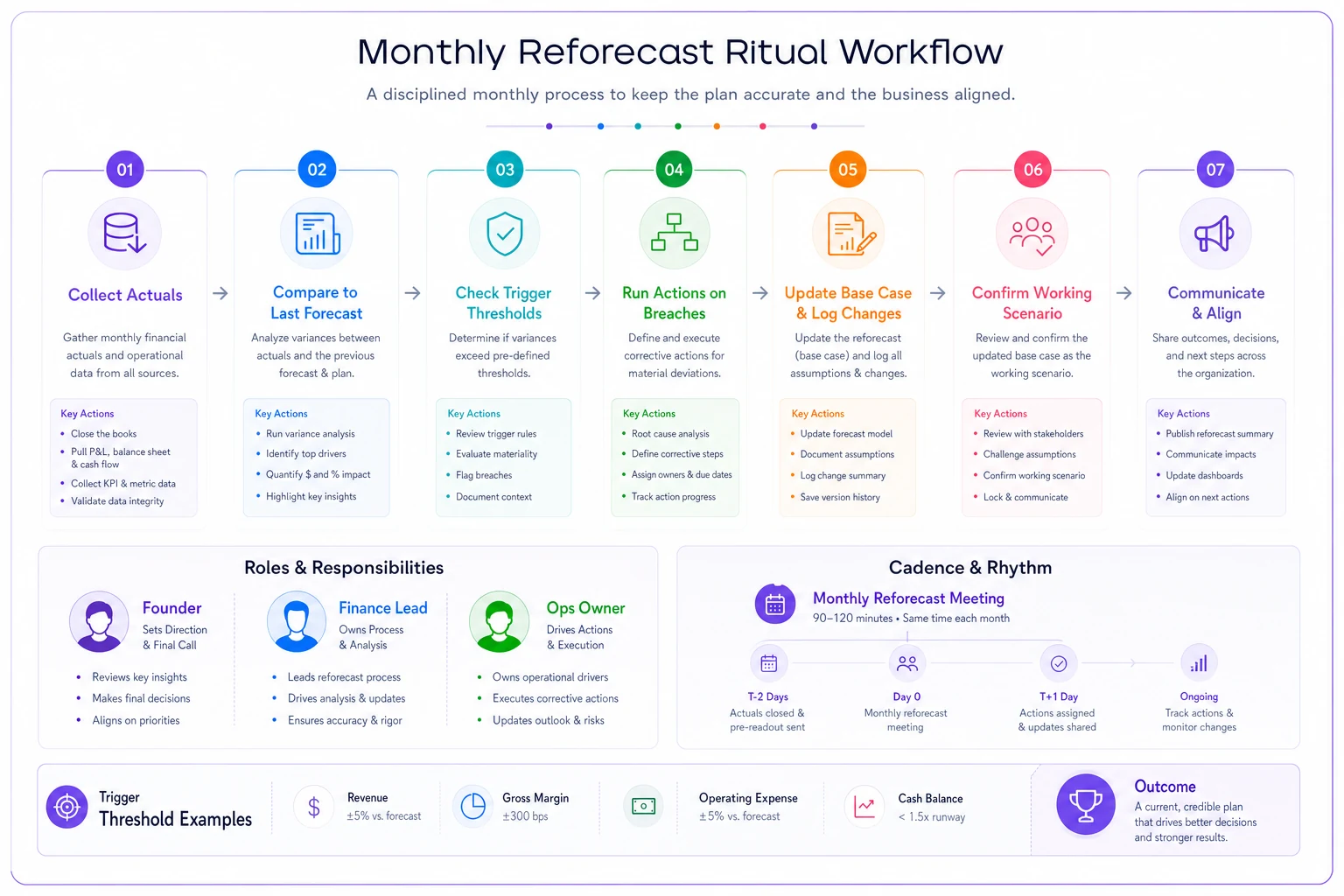
What makes this a ritual rather than a chore is steps 3 and 4. If every month you check the thresholds and act mechanically on breaches, the forecast becomes load-bearing. People start believing it because it actually changes what happens.
This pairs naturally with a short-cycle cash view. Many teams run their monthly strategic reforecast alongside a 13-week rolling cash forecast — the 13-week gives you the near-term liquidity picture, the monthly reforecast handles the strategic layer where hiring and investment decisions live. They answer different questions and both feed the same trigger matrix.
A real scenario
A subscription software company, roughly 18 people, around $2.6M ARR, kept getting blindsided by its own quarters. Their models weren't bad — they forecasted well enough — but every time something moved, the founder relitigated the same decisions from scratch. Should we hire? Should we cut spend? Nobody could answer quickly because there was no pre-agreed logic.
Over about six weeks they set up three things: a three-scenario library (base, downside at roughly a 25% miss, upside), a trigger matrix with five thresholds, and a 90-minute monthly reforecast ritual with the founder, finance lead, and head of ops.
The change wasn't dramatic in the numbers. This isn't a story about revenue tripling. It was operational. When a large customer downgraded and knocked a real hole in the plan, the finance lead flagged it as crossing the revenue-variance threshold, the team switched the working plan to the pre-built downside scenario, and the pre-decided cost actions — pausing two contractor engagements, delaying one hire — executed within a week instead of after a month of back-and-forth. The founder later said the biggest win was that decisions stopped feeling like emergencies. They felt like following a plan the team had already agreed to when everyone was calm.
That's the outcome to aim for. Not perfect prediction — faster, calmer, more consistent reaction.
When this makes sense — and when it doesn't
When it's worth building: You're past the point where the founder can hold the whole business in their head. Usually somewhere north of 5–8 people, or once you have real fixed costs — payroll, contracts, a lease — that make bad timing expensive. If a wrong hiring or spending decision would genuinely hurt, you need triggers.
When it's overkill: If you're 2 people, pre-revenue or barely past it, with almost no fixed commitments, a full scenario library is premature. Run a simple base case and one downside, check your runway monthly, and move on. Building an elaborate trigger matrix for a business that changes shape every month is wasted effort.
Who should not do this yet: Founders who haven't nailed down basic actuals. If your books close weeks late or your revenue recognition is a mess, fix that first. A forecasting operating system built on unreliable actuals just produces confident wrong answers faster. Get the inputs trustworthy, then build the decision layer on top.
Bringing it together
FP&A fails to move the business in most small companies not because of a modeling failure, but a systems failure — the forecast and the decisions live in separate worlds and never connect. The fix is to build the connective tissue on purpose: scenarios ready before you need them, thresholds that turn signals into defined actions, version discipline so people trust the numbers, and a reforecast rhythm sized so it actually happens every month.
Start small. Three scenarios, five triggers, a monthly session that fits your team. The elaborate version can come later. What matters now is closing the gap between what the forecast shows and what the company does about it — because that gap is where small businesses quietly lose the ability to react in time.
FP&A fails to move the business in most small companies not because of a modeling failure, but a systems failure — the forecast and the decisions live in separate worlds and never connect. The fix is to build the connective tissue on purpose: scenarios ready before you need them, thresholds that turn signals into defined actions, version discipline so people trust the numbers, and a reforecast rhythm sized so it actually happens every month.
Start small. Three scenarios, five triggers, a monthly session that fits your team. The elaborate version can come later. What matters now is closing the gap between what the forecast shows and what the company does about it — because that gap is where small businesses quietly lose the ability to react in time.
Ready to take control of your finances?
Join over 2,000 businesses using Acctaly to simplify accounting, accelerate cash flow, and ensure tax readiness.