


Most SMB control programs die the same way. Not from neglect, but from ambition. Someone builds a beautiful controls matrix with 47 controls, assigns monthly testing to all of them, and by month three the whole thing has quietly collapsed because there's one person doing close, AR, AP, and now supposedly testing controls on top of it.
The problem isn't that continuous controls monitoring for SMB finance is hard in theory. It's that almost every framework you'll find online was written for a 200-person internal audit function. When you try to shrink that down to a 3-person finance team, you don't get a smaller version of the same thing — you get something that breaks.
So this is about the opposite approach. Start from the capacity you actually have, and design monitoring frequencies, sampling, and escalation around that ceiling. Not the other way around.
The core mistake: testing everything at the same frequency
A pattern that shows up constantly: a finance lead reads about continuous controls monitoring, gets excited, and builds a spreadsheet where every control gets tested "monthly." Bank rec review, monthly. Approval limits, monthly. New vendor setup, monthly. Journal entry review, monthly.
That word "monthly" is doing a lot of quiet damage.
Because in reality, those controls carry wildly different risk. A duplicate-vendor payment can walk out the door the same week the vendor is created. Waiting 30 days to catch it means the money's already gone. Meanwhile, reviewing your chart-of-accounts mapping monthly is overkill — that stuff barely changes.
-
High-velocity risks get monitored too slowly (fraud, duplicate payments, unauthorized approvals)
-
Low-velocity, stable controls eat capacity that should've gone somewhere else
The fix is boring but it's the whole game: frequency should follow how fast the risk can actually hurt you, not how important the control sounds on paper.
Match monitoring frequency to risk velocity, not risk importance
Think about how quickly a broken control turns into real money leaving the building. That's "risk velocity." It's different from severity.
Stop letting accounting slow your business down.
Acctaly automates your financial operations so you can focus on growth and compliance.
- Automated bookkeeping
- Real-time financial reporting
- Integrated tax management
No credit card required
A misstated deferred revenue balance is severe but slow — it won't cost you cash tomorrow, and you'll catch it at close. A missing approval on a $9k wire is fast — the money's gone in hours.
Here's a practical way to map it:
| Control area | Risk velocity | Suggested monitoring frequency | Why |
|---|---|---|---|
| Outbound payments / wires above threshold | Very fast | Daily (automated flag) | Money leaves immediately; recovery is hard |
| New vendor / vendor bank detail changes | Fast | Real-time or same-day | Classic vector for redirect fraud |
| Approval-limit overrides | Fast | Weekly review | Overrides cluster right before quarter-end |
| Journal entries above $ threshold | Medium | Weekly sample | Errors and manual adjustments hide here |
| Bank & clearing account reconciliation | Medium | Weekly | Drift compounds if left to month-end |
| Access / permission changes in accounting system | Medium | Monthly | Slow to change, high impact when it does |
| Chart-of-accounts mapping integrity | Slow | Quarterly | Rarely changes; low velocity |
| Expense-policy compliance | Slow | Monthly sample | Small dollar, high volume |
The insight most people miss: you don't need to monitor everything continuously to have continuous assurance. You need to monitor the fast stuff continuously and let the slow stuff ride on a longer cadence. That's what makes the program survivable for a small team.
Sampling: stop testing 100% of everything
The second capacity killer is testing full populations. A 4-person team cannot review every journal entry, every expense report, every vendor change. So they either don't do it, or they burn out trying.
Sampling fixes this, but SMBs usually do it wrong. They either sample randomly (which misses the risky stuff) or they sample too small to catch anything.
A better approach mixes two methods:
1. Threshold-based full coverage for the tail. Every transaction above a dollar line gets reviewed, no exceptions. For a business doing roughly $3M–$5M in annual spend, that line often lands somewhere around $5k. Above it, you look at 100%. That's usually only a handful of items a week.
2. Risk-weighted sampling for the middle. For the high-volume, lower-dollar stuff, you sample — but weight the sample toward risk signals. New vendors, round-dollar amounts, entries posted outside business hours, anything touching a manual clearing account.
A workable weekly sampling rule for a small team:
-
Pull all transactions above your dollar threshold (e.g. > $5k).
-
Pull all new-vendor payments regardless of amount (first payment to any vendor added in the last 30 days).
-
Pull a random 5–10% of everything else, weighted 3x toward flagged patterns (round numbers, weekend postings, duplicate-adjacent amounts).
-
Cap the total sample at whatever the reviewer can actually clear in the time budgeted — usually 20–40 items per week for one part-time reviewer.
Cap the sample to the reviewer's real capacity and tune thresholds to hit that volume.
That cap in step 4 matters more than it looks. If your sampling rule generates 200 items and your reviewer has two hours, the rule is fiction. Design the sample to fit the hours, then tune the thresholds until the volume lands where a real person can finish it.
Alert thresholds: the difference between signal and noise
Thresholds are where most monitoring programs quietly get switched off. Someone sets an alert for "any duplicate vendor name" and gets 60 alerts a week, 58 of which are legitimate. Within a month, everyone ignores the alerts entirely. Now you have worse-than-nothing — a control that looks active but nobody reads.
The general rule from real operations: an alert channel that fires more than a handful of times a week for a small team will get ignored. Thresholds have to be tuned for a low, actionable volume — not for catching every theoretical anomaly.
-
Fuzzy-match duplicates, not exact-match. Exact-match on invoice numbers misses the real duplicates (same invoice, different formatting) and floods you with false ones. Match on vendor + amount + date-proximity instead.
-
Deviation-based, not absolute. Instead of "alert on any payment over $10k," use "alert on any payment more than 2x this vendor's trailing average." A $12k payment to a vendor you always pay $12k isn't news. A $12k payment to a vendor you usually pay $800 is.
-
Velocity thresholds. Three or more payments to the same vendor inside 48 hours. That pattern catches split transactions designed to slide under approval limits.
If you've already built out weekly detection queries — the kind used in fraud-detection and reconciliation work — this is where they plug in. The point isn't the queries themselves, it's tuning them so the volume of alerts stays inside what your team can actually act on.
The escalation plan people forget to write down
A gap that shows up over and over: the monitoring works, an alert fires, and then… nothing happens. Because nobody decided in advance who owns the response, how fast, and what "resolved" means.
An alert with no escalation path is just a notification nobody's accountable for.
A lightweight escalation plan needs four things written down:
-
Owner — one named person per alert type (not "the finance team")
-
Response window — how long they have before it escalates up
-
Escalation target — who it goes to if it's not cleared in time
-
Resolution definition — what evidence closes it out
For a small team it can be as simple as this:
| Alert severity | Example | Owner | Response window | Escalates to |
|---|---|---|---|---|
| Critical | Vendor bank detail change + immediate payment | Finance lead | Same day | Owner / CFO |
| High | Payment > threshold, no approval on file | Bookkeeper | 2 business days | Finance lead |
| Medium | Sampled JE with missing support | Bookkeeper | Weekly batch | Finance lead |
| Low | Expense policy exception, small dollar | Bookkeeper | Monthly batch | — |
What makes this work is the batching on medium and low. You don't want a critical-alert response process running for a $40 policy exception. Batch the small stuff into a weekly or monthly sweep so it doesn't compete for attention with the genuinely urgent items.
Audit-evidence capture: do it as you go, not at year-end
The most avoidable pain in this whole area is scrambling to reconstruct evidence months later. Auditor asks "show me you reviewed high-value payments in Q2," and now someone's digging through emails trying to prove a control that actually did happen but was never documented.
The fix is to make evidence capture a byproduct of the review, not a separate task. When a reviewer clears a sampled item, that same action should leave a trail:
-
What was reviewed (the transaction / control)
-
Who reviewed it
-
When
-
What they concluded (pass / exception / escalated)
-
Link to support (the invoice, approval, screenshot)
If capturing that takes more than a few seconds per item, people skip it under deadline pressure. The format has to be dead simple — a logged decision with a timestamp beats a beautifully formatted memo written three weeks later. Consistent, boring, contemporaneous evidence is what actually holds up.
This is also where a proper control matrix earns its keep. If you've already sized your controls to team headcount — the way the internal-controls recipes for different team sizes lay out — then evidence capture just hangs off controls that already exist, instead of being invented from scratch.
Where the pipeline has to be solid first
None of this monitoring is worth much if the underlying data is unreliable. If your bank feeds break silently, or transactions post twice, or a sync fails and nobody notices, then your alerts are firing on garbage and your samples are pulling from an incomplete population.
Continuous monitoring assumes the data underneath it is trustworthy. That's a real assumption, and for a lot of SMBs it's not yet true. Getting the continuous reconciliation and data-governance foundations in place first is what makes the monitoring layer meaningful instead of theater. Monitor bad data and you get confident-looking false assurance, which is arguably worse than admitting you don't know.
A real scenario
A regional e-commerce distributor, about 22 people, two in finance. Roughly $6M in annual spend across a few hundred vendors. Their "controls" were basically the owner eyeballing the bank feed once a week and hoping.
The breaking point wasn't fraud — it was a supplier whose bank details got changed through a compromised email thread, and two payments totaling around $18k went to the wrong account before anyone noticed. They recovered part of it, not all.
What they put in place afterward wasn't heavy. A same-day flag on any vendor bank-detail change, full review on payments over $5k (about 15–20 items a week), a weekly 8% sample of everything else, and a one-page escalation table taped to the wall. Total added workload landed around 3–4 hours a week for the bookkeeper.
Six months in, they'd caught two duplicate payments (roughly $2,600 combined), one unauthorized override, and — the part that mattered most to the owner — they could actually show the review had happened when their lender asked. The program didn't make them audit-perfect. It just moved them from "we hope nothing's wrong" to "we'd know within a day or two."
When a lightweight CCM program makes sense — and when it doesn't
When it makes sense:
-
You're doing enough transaction volume that manual eyeballing misses things (usually somewhere past a few hundred payments a month)
-
A lender, investor, or acquirer is starting to ask about controls
-
You've had at least one near-miss you'd rather not repeat
-
You have at least a few hours a week of finance capacity to dedicate to review
When it's a bad idea, or premature:
-
Your data pipeline is still unreliable — fix that first, or you're monitoring noise
-
You genuinely have zero spare capacity; a program nobody runs is worse than an honest gap
-
You're pre-revenue with a handful of transactions a month — just review everything, you don't need sampling logic yet
Who should not do this: anyone tempted to build the 47-control matrix. If your first draft has more than about 10–12 monitored controls, you've already designed something your team won't sustain. Cut it down. The controls you actually run beat the controls you documented and abandoned.
Pulling it together
The whole trick with continuous controls monitoring for SMB finance is refusing to copy the enterprise playbook. You're not trying to monitor everything. You're trying to monitor the fast-moving, money-out-the-door stuff continuously, sample the middle intelligently, let the slow stuff ride on a long cadence, and capture evidence as a byproduct instead of a separate project.
A simple workflow helps tie monitoring, sampling, escalation and evidence capture together.
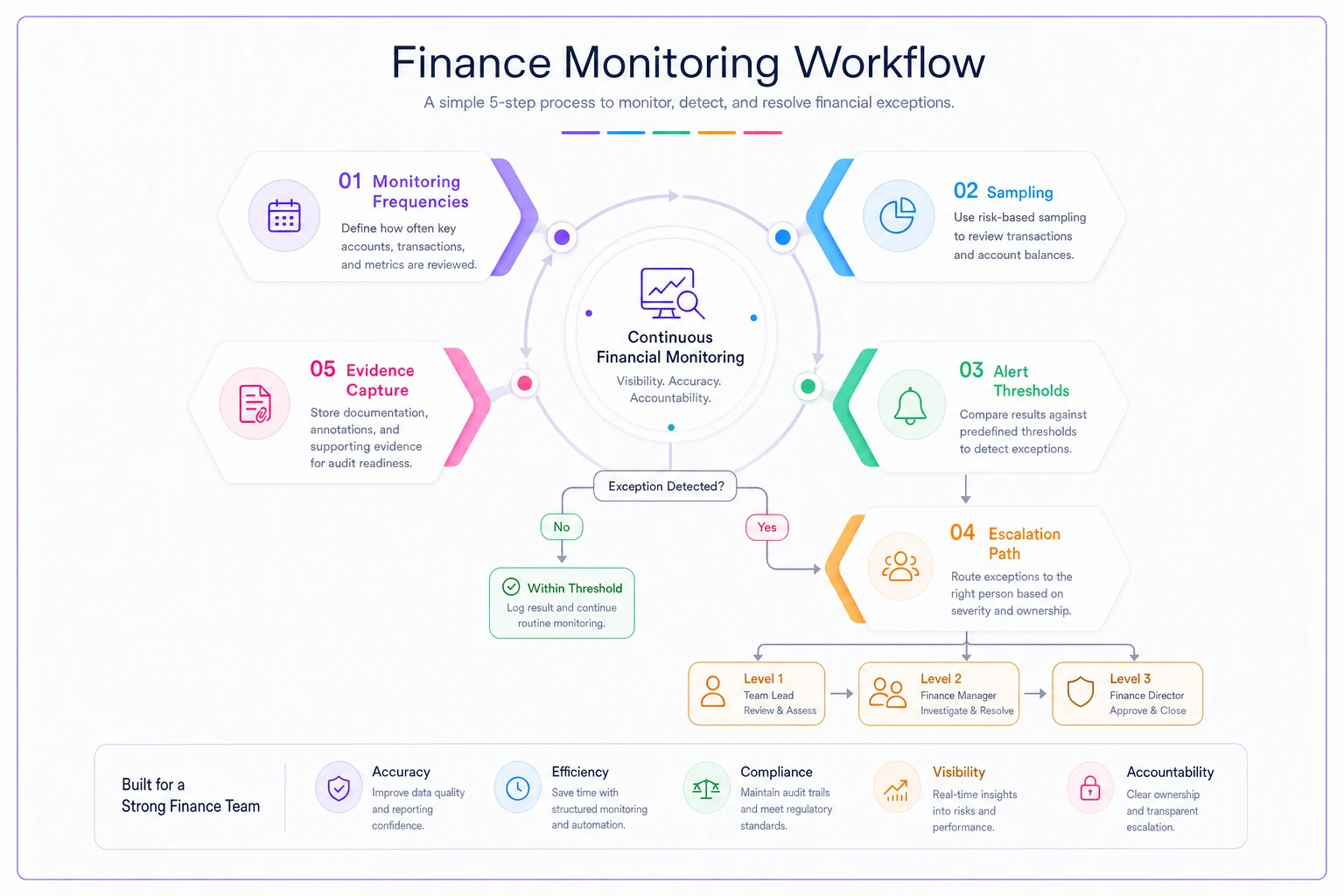
This flow highlights the sequence: detect, sample, escalate, and log evidence so handoffs are clear and the team knows who does what when.
Design the sample to fit the hours you have. Tune thresholds so alerts stay rare enough to be read. Write down who responds and how fast. Do those four things and you've got real, defensible assurance from a program a two-person team can actually keep running — which, in the end, is the only kind that counts.
Ready to take control of your finances?
Join over 2,000 businesses using Acctaly to simplify accounting, accelerate cash flow, and ensure tax readiness.