



Every month, same story. Day 12 rolls around and the finance person at a 30-person marketing agency is still waiting on expense reports from last month. The controller messages the founder: "We're running behind again." The founder, who's been in client meetings all week, responds with "Do we really need all this detail?" Meanwhile, the sales team wants their commission numbers, operations needs their project margins, and the bank wants updated financials for that line of credit review.
The monthly close drags into week three. Numbers finally get published around day 18. By then, half the decisions that needed those numbers have already been made on gut feel. The next month, everyone promises it'll be different. It never is.
After building operational software for businesses ranging from 3-person consulting shops to 50-person manufacturing operations, one pattern keeps emerging: the monthly close falls apart not because people don't care, but because nobody owns the system. Finance teams treat it like an accounting exercise when it's actually an operational workflow that touches every corner of the business.
Why month-end becomes a scramble at 15+ people
Below 10 people, monthly close happens almost accidentally. The founder reviews bank statements, the bookkeeper categorizes transactions, maybe there's a spreadsheet tracking major expenses. Takes a day or two, tops. The business runs lean enough that everyone knows what's happening anyway.
Then somewhere between person 12 and person 20, the wheels start coming off. Not dramatically at first — just small delays that compound. The operations manager forgets to submit their vendor invoices. The sales lead doesn't update the CRM with final contract values. The project manager has receipts scattered across three expense apps. Each delay pushes the close back another day.
By 25 people, you've got department heads who each run their area differently. Sales tracks everything in their CRM. Operations uses project management software. Marketing has their own attribution tools. Finance spends the first week of every month playing detective, trying to piece together what actually happened last month.
The breaking point usually hits around 30-35 people. That's when the founder realizes they haven't seen accurate monthly numbers in the first half of the month for the past quarter. They're making hiring decisions on three-week-old data. They're negotiating vendor contracts without knowing current cash position. The business is essentially flying blind for 40% of each month.
What makes this worse is that everyone thinks it's someone else's problem to fix. Finance thinks operations should submit things faster. Operations thinks finance should simplify the process. The founder just wants numbers that make sense without having to referee between departments.
The three workflows that actually matter
Most businesses try to fix their monthly close by adding more checkpoints, more approvals, more spreadsheets. That's backwards. Successful businesses focus on three core workflows, and they run them in parallel, not sequentially.
Stop letting accounting slow your business down.
Acctaly automates your financial operations so you can focus on growth and compliance.
- Automated bookkeeping
- Real-time financial reporting
- Integrated tax management
No credit card required
Transaction reconciliation (days 1-3) This is pure mechanics — matching bank transactions to internal records. But the challenge changes as you scale: at 10 people, one person owns all the accounts. At 30 people, you've got credit cards distributed across departments, multiple bank accounts, maybe some international wires. The reconciliation workflow needs clear ownership for each account, not just "finance handles it."
Accrual calculations (days 2-5) The stuff that hasn't hit the bank yet but needs to be in the numbers. Unbilled revenue from projects in progress. Expenses incurred but not yet paid. Commission calculations based on deals closed. This is where small businesses usually punt and just go with cash basis, then wonder why their numbers swing wildly month to month.
Departmental validation (days 4-6) This is where most monthly closes die. Finance produces numbers, sends them to department heads, and then waits. And waits. The sales head is traveling. The operations lead is in back-to-back meetings. By the time feedback comes back, it's day 10 and finance has moved on to other work.
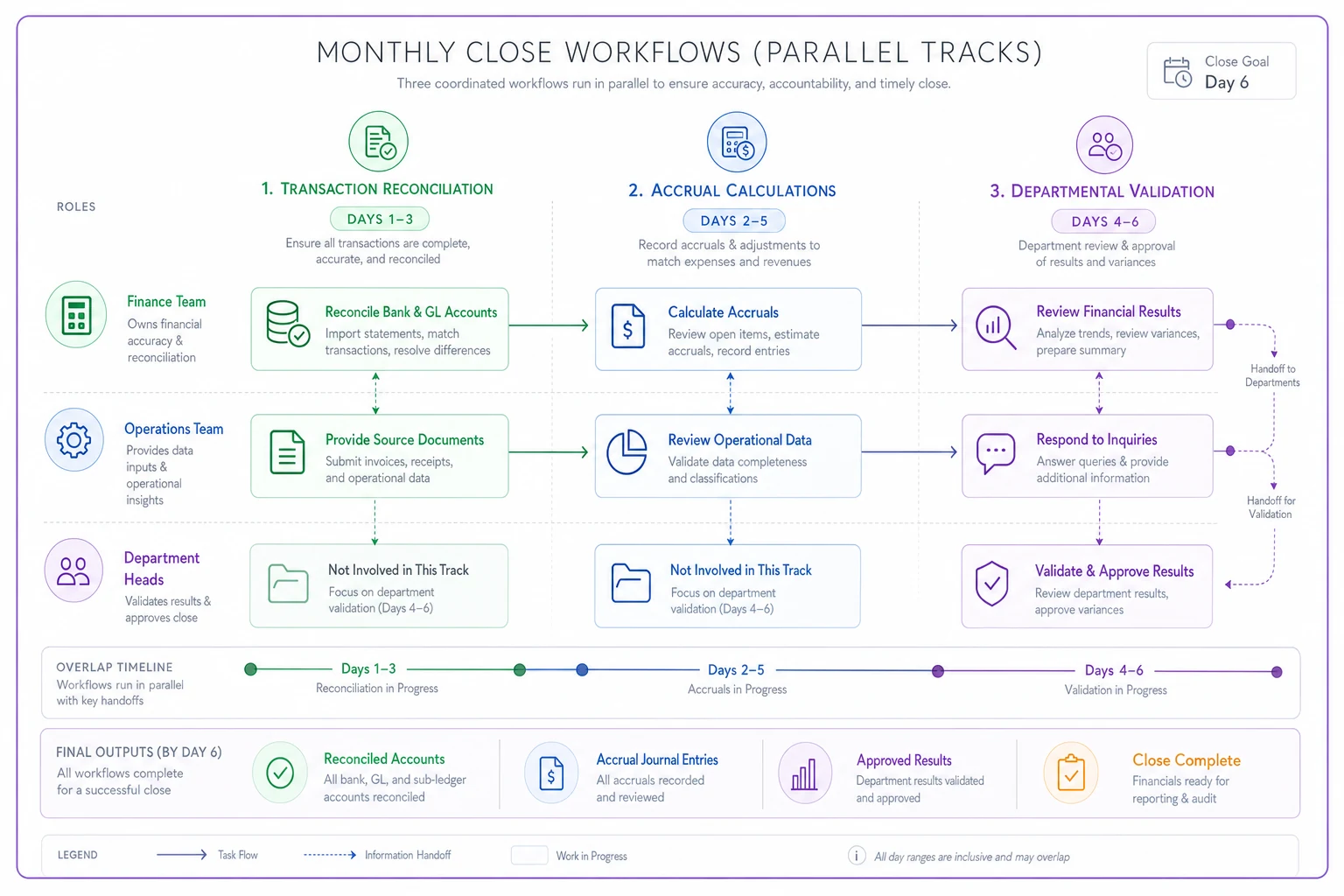
Here's a simple workflow diagram to visualize these parallel threads.
The fix isn't faster review — it's pre-validation. Department heads shouldn't see numbers for the first time during close. They should be validating inputs throughout the process. Sales confirms deal values on day 2. Operations validates project costs on day 3. Marketing verifies campaign spend on day 4. By day 6, the review is just confirming what they've already seen.
Time budgets and role clarity that scales
Here's a realistic time allocation for a monthly close system:
| Role | Days 1-3 | Days 4-6 | Days 7+ | Total Hours |
|---|---|---|---|---|
| Finance Lead | 6 hrs/day | 4 hrs/day | 2 hrs/day | ~35 hours |
| Bookkeeper | 8 hrs/day | 3 hrs/day | 1 hr/day | ~35 hours |
| Department Heads | 1 hr/day | 2 hrs/day | 0.5 hrs/day | ~10 hours |
| Founder/CEO | 0 hrs | 1 hr total | 2 hrs review | ~3 hours |
Block calendar time for department heads on the days you need their validation and treat those blocks as non-negotiable.
The critical insight: department heads need scheduled, non-negotiable time blocks during close. Not "whenever you can get to it" but actual calendar holds. A 35-person SaaS company started blocking 9-11am for all department heads on days 2, 4, and 6 of each month. Just for close activities. No client calls, no team meetings. Close only. Their on-time close rate went from 30% to 85% in three months.
For the finance team, the allocation shifts as the business grows. At 15 people, one person might handle the entire close in 20 hours. At 30 people, you need two people putting in 35 hours each. At 50 people, you're looking at a three-person effort with specialized roles.
Building task ownership without the politics
The biggest source of month-end delays isn't technical — it's unclear ownership. "Someone in sales" needs to validate commission calculations. "The operations team" should review project costs. This vagueness kills momentum.
What works is a task-owner matrix that's painfully specific:
Revenue recognition tasks:
-
Contract value confirmation
Sales Operations Manager (not "sales team")
-
Billing reconciliation
AR Specialist (not "accounting")
-
Revenue recognition calculation
Controller (not "finance")
Expense validation tasks:
-
Credit card coding
Cardholder's direct manager (not the cardholder)
-
Vendor invoice approval
Department head who approved the purchase
-
Payroll allocation
HR Manager for headcount, Controller for calculations
Accrual ownership:
-
Project WIP
Project Manager who owns the project
-
Prepaid expenses
AP Specialist who processed the original payment
-
Deferred revenue
Customer Success lead for that account
One pattern that emerges repeatedly: businesses assign tasks based on who has the information rather than who has the time. The salesperson might know the deal details, but they're not going to prioritize month-end close over closing new deals. Better to have sales operations own the task with a clear escalation path to the salesperson if needed.
The matrix should also specify what "done" looks like. Not "review expenses" but "code all transactions in QuickBooks and mark as reviewed." Not "validate revenue" but "confirm all contracts in CRM match billing records and flag any discrepancies over $500."
Where automation actually moves the needle
Everyone wants to automate their entire close, but that's not where you start. The highest-impact automation points for small finance teams are surprisingly mundane.
Transaction import and initial coding saves roughly 8-12 hours per close once you hit 20+ people. Not fancy AI categorization — just reliable daily imports from banks and credit cards with basic rules-based coding. If Marketing always uses the company Amex for ad spend, auto-code those transactions. If the weekly Slack charge always hits on Tuesday, auto-categorize it. This isn't about perfection; it's about reducing the pile of completely unknown transactions from 400 to maybe 50.
Accrual templates cut calculation time by 60-70% once built properly. Instead of calculating project WIP from scratch each month, pull project completion percentages from your project management tool and apply standard formulas. A 45-person consulting firm automated their WIP calculations by connecting their project tool directly to their close checklist. What took 6 hours of manual calculation now takes 30 minutes of validation.
Report generation and distribution seems obvious but gets overlooked. Once numbers are locked, generating the standard reports should take minutes, not hours. The same consulting firm automated their entire reporting package — P&L by department, margin analysis, cash flow summary — to generate and email to stakeholders automatically once the controller marks close as complete. Saves 4-5 hours and ensures everyone gets the same numbers at the same time.
Approval workflows matter more as you scale. At 30+ people, chasing approvals becomes a full-time job during close. Simple automation that routes expense reports, flags missing receipts, and escalates overdue approvals can cut 2-3 days off your close timeline. Not because the approvals happen faster, but because nothing gets lost in someone's inbox.
The automation that doesn't work? Trying to eliminate human validation entirely. AI-powered operational software can handle most routine tasks, but you still need 2-3 hours of human review to catch the weird stuff. The client lunch that got coded as software. The duplicate vendor payment. The contract that renewed at a different rate. Automation handles the routine; humans handle the exceptions.
Fixing the December disaster
December close is where good systems go to die. Holidays, vacation schedules, year-end adjustments, and everyone trying to squeeze in last-minute purchases before budget resets. Most small businesses just accept that December will close late and January's numbers won't be ready until February.
A few patterns from businesses that actually close December on time:
Start the close on December 26th, not January 2nd. Yes, people are on vacation, but transaction volume is usually light those days. Have one finance team member handle basic reconciliation December 26-30, even if it's just 2-3 hours per day. When everyone returns January 2nd, you're already 50% done instead of starting from scratch.
Pre-close everything possible before the holidays. Run preliminary revenue recognition on December 20th. Calculate known accruals on December 22nd. When you return, you're only updating for the last week's activity, not starting from zero.
Set different standards for December. Maybe you don't need department validation for expenses under $1,000. Maybe revenue recognition can be approximate with a true-up in January. The goal is directionally correct numbers by January 10th, not perfect numbers by January 25th.
Creating predictable cadence when everything's on fire
The hardest part about establishing a monthly close rhythm is that it needs to happen when nothing else slows down. Clients still need service. Sales still need to close deals. Projects still have deadlines. The close has to fit into the operational reality, not the other way around.
What works is treating close week like a sprint. Clear priorities, defined outcomes, daily standups. A 38-person logistics company runs a 15-minute daily close standup at 8:30am for days 1-6 of each month. Finance leads, department heads dial in, everyone reports: what got done yesterday, what's blocking today, what help they need. Takes 15 minutes. Keeps everyone aligned and accountable.
Another approach: the "close captain" rotation. Each month, one department head owns ensuring their peers hit their close deadlines. Not doing the work for them, but following up, removing blockers, escalating to the CEO if needed. Rotating this role means everyone experiences both sides — being held accountable and doing the accountability.
The cadence also needs buffers for reality. If your target is day 7 close, build your process for day 5 with two days of buffer. Because someone will be sick. A system will be down. A client emergency will pull people away. The businesses that consistently close on time aren't the ones where everything goes perfectly — they're the ones with realistic timelines that account for inevitable friction.
Indicators your current system is about to break
Before a monthly close completely falls apart, there are warning signs. Recognizing these helps you fix the system before it's fully broken.
The first sign is usually creeping delays. Month 1 closes on day 8. Month 2 on day 10. Month 3 on day 12. Each delay gets normalized, becoming the new baseline. By month 6, you're closing on day 20 and nobody remembers when you used to have numbers by day 7.
Department pushback intensifies. "Why do we need all this detail?" "Can't we just use the bank balance?" "The numbers are never right anyway." When stakeholders start questioning the value of the close process, it's usually because they're not getting timely, accurate information that helps them run their area better.
Shadow accounting emerges across the organization. Sales keeps their own commission calculations. Operations maintains separate project profitability reports. Marketing tracks their own ROI metrics. When departments stop trusting the official numbers, they create their own, leading to multiple versions of truth and decisions based on conflicting data.
The "heroic effort" pattern takes hold. Every month, someone in finance has to work until midnight for three days straight to get the close done. This isn't sustainable, and it usually means the process is held together by manual workarounds rather than systematic workflows.
Exception volumes grow faster than transaction volumes. If you're doing 2x the revenue but spending 4x the time on corrections and adjustments, your process is breaking down. Healthy systems show linear or even decreasing complexity as volume grows.
Building from where you are today
The path to a predictable monthly close system depends entirely on where you're starting from. A 12-person startup needs different solutions than a 40-person company that's been limping along with a broken process for two years.
For businesses under 20 people still closing within 10 days: Focus on documentation and role clarity. Write down who does what, when, and how. Create simple checklists. Assign specific account ownership. Build the foundation before you need it. The goal is to establish patterns that will scale, not optimize for speed when you're already reasonably fast.
For businesses at 20-35 people taking 15+ days: You need workflow redesign, not incremental improvement. Parallel processing, clear ownership, carved-out time blocks. This is where investing in simple automation — bank feeds, approval workflows, report templates — pays off quickly. The focus should be on removing bottlenecks and dependencies that cause cascading delays.
For businesses approaching 50 people consistently missing deadlines: Consider dedicated close resources. At this scale, having someone whose primary job is managing the close process starts making sense. Not necessarily doing all the work, but coordinating, following up, removing blockers. This role pays for itself in faster decision-making and reduced fire drills.
You're also at the scale where proper operational software becomes necessary rather than nice-to-have. AI-powered operational platforms can orchestrate the entire close workflow — routing tasks, tracking completion, escalating delays, and generating reports automatically once all validations are complete.
The build approach matters less than consistency. Pick a system — any system — and run it the same way for three months before making major changes. Most monthly close problems come from constantly changing the process, not from the process itself being fundamentally broken.
The system compounds over time
Month one of a new close system usually goes worse than the old way. People forget their tasks. Deadlines get missed. The finance team scrambles to fill gaps while also trying to manage the new process. This is normal and temporary.
Month two gets slightly better. People remember their assignments. A few workflows actually complete on time. You identify the real bottlenecks versus the theoretical ones. The close still might not be faster, but it's more predictable.
Month three is where you see the return. Department heads block the time automatically. Task handoffs happen without reminders. The exception list shrinks. What took 15 days now takes 10, not through heroic effort but through systematic execution.
By month six, the monthly close becomes background operations. Numbers are ready by day 7. Departments trust the data. Decisions get made with current information instead of last month's best guess. The same finance team that was drowning in catch-up work now has time for actual analysis and planning.
The real payoff isn't just faster closing — it's what happens when you have reliable, timely financial data. Pricing decisions based on actual margins. Hiring plans grounded in real cash flow. Investment choices informed by accurate trend lines. The monthly close stops being a burden and becomes competitive advantage.
Moving from reactive to systematic
The difference between businesses that nail their monthly close and those that don't isn't resources or sophistication — it's whether they treat the close as an operational system rather than an accounting exercise.
The businesses still scrambling on day 15 usually have talented finance teams working incredibly hard. They just lack the systematic approach that makes hard work translate into consistent results. They solve last month's crisis, only to face a new one this month.
Building a predictable monthly close system requires accepting a few realities. First, the close is everyone's responsibility, not just finance's. Second, the system needs to
Ready to take control of your finances?
Join over 2,000 businesses using Acctaly to simplify accounting, accelerate cash flow, and ensure tax readiness.