



Most finance teams scale the wrong way. They hire when things break instead of before they break. They add tools when processes fail instead of when processes change. They create role charters after territorial disputes instead of before the first overlap happens.
Having watched a lot of small businesses grow their finance operations from one person doing everything to structured teams of 50+, the pattern becomes pretty obvious. The companies that scale finance teams successfully don't just add headcount—they trigger specific organizational changes at predictable milestones. The ones that struggle keep patching problems with bodies and software until the whole operation becomes an expensive mess.
The difference between smooth scaling and operational chaos comes down to understanding that finance team growth happens in distinct stages, each with its own organizational requirements, role definitions, and tooling needs. Miss these transitions and you end up with a 20-person team operating like five people, or worse, five people trying to handle work that needs 20.
The solo bookkeeper stage (1 person): Everything runs through one brain
At one person, your finance operation is simple but fragile. One person handles AP, AR, payroll, monthly close, tax prep, and usually doubles as office manager. This works until it doesn't—usually around $2-3M in revenue or 15-20 employees in the broader company.
-
Daily transaction entry in QuickBooks
-
Weekly invoice runs
-
Biweekly payroll processing
-
Monthly bank reconciliations
-
Quarterly tax filings
-
Annual 1099s and basic reporting
What makes this stage workable is that everything lives in one person's head. They know which vendor gets paid on what terms, which customer always pays late, what that weird $347.82 monthly charge is for. The downside? When they're sick or on vacation, finance stops. When they quit, institutional knowledge walks out the door.
Role charter at this stage
The solo bookkeeper needs a clear charter that defines boundaries, not just tasks:
Core responsibilities:
-
Transaction accuracy (not strategic analysis)
-
Compliance deadlines (not tax planning)
-
Cash position tracking (not forecasting)
-
Basic monthly reporting (not board decks)
What they DON'T own:
-
Vendor negotiations
-
Collection calls beyond first notice
-
System implementations
-
Strategic planning support
Critical handoffs:
-
Approval limits (usually $500-1,000)
-
Check signing authority (usually none)
-
System access levels (view-only for banking)
-
Escalation triggers (late payments over 30 days)
Tooling at this stage
Keep it simple. The solo bookkeeper should use:
-
One accounting system (QuickBooks or Xero)
-
One payroll platform (Gusto or ADP Run)
-
One expense tool (Expensify or corporate cards)
-
One document storage (Google Drive or Dropbox)
The mistake companies make here is adding specialized tools too early. That AR automation platform sounds great until you realize your bookkeeper now manages five systems instead of doing actual bookkeeping.
The small team transition (3 people): Specialization begins
The jump from one to three people marks the first real organizational test. This usually happens between $5-10M in revenue, when transaction volume makes specialization necessary. The three-person structure typically breaks down into:
Stop letting accounting slow your business down.
Acctaly automates your financial operations so you can focus on growth and compliance.
- Automated bookkeeping
- Real-time financial reporting
- Integrated tax management
No credit card required
-
AP/AR Specialist - handles all transactions
-
Payroll/Benefits Admin - manages people-related finance
-
Controller/Senior Bookkeeper - oversees close and reporting
This is where role boundaries matter most. Without clear ownership matrices, three people create more confusion than one person ever could.
Process ownership matrix at 3 people
| Process | Owner | Backup | Approver |
|---|---|---|---|
| Vendor setup | AP Specialist | Controller | Controller |
| Invoice processing | AP Specialist | Controller | Department heads |
| Payment runs | AP Specialist | Controller | CFO/Owner |
| Customer invoicing | AR Specialist | Controller | Sales manager |
| Collections | AR Specialist | Controller | Controller |
| Payroll processing | Payroll Admin | Controller | HR/Owner |
| Expense reports | AP Specialist | Payroll Admin | Department heads |
| Month-end close | Controller | AP Specialist | CFO/Owner |
| Financial reporting | Controller | None | CFO/Owner |
| Tax filings | Controller | Payroll Admin | External CPA |
Without this matrix, you get the classic three-person problems: duplicate vendor payments because two people processed the same invoice, missed collections because everyone thought someone else was handling it, or payroll errors because the backup person didn't know about the commission adjustment.
Onboarding checklist for new team members
When adding person #2 and #3, most companies just throw them into the deep end. Here's what actually needs to happen:
Week 1: Systems and access
-
Accounting system login with appropriate permissions
-
Expense platform access
-
Document storage structure walkthrough
-
Email distribution list additions
-
Banking portal view-only access
Week 2: Process shadowing
-
Full month-end close observation
-
Daily transaction processing observation
-
Weekly payment run participation
-
Report distribution understanding
-
Approval chain documentation
Week 3: Supervised execution
-
Process 10 invoices with review
-
Complete one payment run with oversight
-
Handle 5 customer inquiries with guidance
-
Participate in one monthly close task
Week 4: Independent work with checkpoints
-
Own one full process end-to-end
-
Complete daily tasks independently
-
Flag issues appropriately
-
Document one process improvement
Outsourcing vs hiring decisions
At three people, the outsource-versus-hire question becomes critical. The rule that actually works:
Outsource:
-
Annual tax returns (complexity without frequency)
-
401k administration (regulatory expertise required)
-
International payroll (compliance nightmare)
-
Audit support (specialized knowledge)
Keep in-house:
-
Daily transaction processing
-
Weekly payment runs
-
Monthly close activities
-
Customer communications
-
Vendor relationships
The test: if it happens weekly or more frequently, keep it internal. If it requires specialized expertise but happens quarterly or less, outsource it.
Use the Week 1 access checklist as a template to automate new hires' permissions setup.
The test: if it happens weekly or more frequently, keep it internal. If it requires specialized expertise but happens quarterly or less, outsource it.
The structured department (10 people): Middle management emerges
At 10 people, finance becomes a real department. This typically aligns with $20-30M in revenue, multiple business units, or geographic expansion. The organization usually looks like:
-
Finance Director/VP (1)
-
Accounting Manager (1)
-
Senior Accountants (2)
-
Staff Accountants (3)
-
AP/AR Clerks (2)
-
Payroll Specialist (1)
This is where finance operations either professionalize or descend into chaos. The difference comes down to whether you implement structured processes before adding bodies.
Role charters at 10 people
Finance Director/VP:
-
Strategic planning and analysis
-
Board and investor reporting
-
Banking and vendor relationships
-
Team development and hiring
-
Process optimization ownership
Accounting Manager:
-
Month-end close management
-
Technical accounting decisions
-
Staff supervision and training
-
Quality control and review
Senior Accountants:
-
Complex transaction analysis
-
Month-end journal entries
-
Account reconciliations
-
Process documentation
-
Junior staff mentoring
Staff Accountants:
-
Daily transaction processing
-
Basic reconciliations
-
Report preparation
-
Data entry and validation
-
Process execution
The manager layer problem
The biggest failure point at 10 people is the accounting manager role. Companies promote their best accountant and then seem genuinely surprised when managing turns out to require completely different skills. The person who was excellent at reconciling accounts now needs to coordinate five people, manage deadlines, handle performance issues, and still maintain technical quality.
What tends to happen: the new manager keeps doing individual contributor work because that's comfortable, while management tasks pile up. Close extends from 5 days to 10. Errors increase because no one's reviewing. Team members quit because they're not getting development.
-
60% of time on review and oversight
-
30% on process improvement and documentation
-
10% on individual contributor work (complex issues only)
Tooling transitions at 10 people
At 10 people, Excel and QuickBooks start breaking. Not technically—they still function—but operationally. Multiple people editing the same spreadsheet creates version control nightmares. QuickBooks user limits force awkward workarounds. Email chains for approvals get lost.
The tooling upgrades needed:
-
ERP transition
Move from QuickBooks to NetSuite, Sage Intacct, or similar
-
Workflow automation
Implement Bill.com or similar for AP workflows
-
Reporting platform
Add Tableau, Power BI, or a dedicated FP&A tool
-
Document management
Upgrade from shared drives to structured DMS
What kills companies is trying to implement all of these at once. The entire finance team gets pulled into implementations, daily operations suffer, month-end close goes sideways, and suddenly you're three months behind on basic reporting.
-
Implement workflow automation first (2-3 months)
-
Stabilize operations (1-2 months)
-
Begin ERP evaluation (3-4 months)
-
Implement ERP (6-9 months)
-
Add reporting tools (2-3 months)
What kills companies is trying to implement all of these at once. The entire finance team gets pulled into implementations, daily operations suffer, month-end close goes sideways, and suddenly you're three months behind on basic reporting.
The specialized organization (50 people): Functional excellence emerges
At 50 people, finance splits into specialized functions. This typically happens around $75-100M in revenue, often coinciding with series B fundraising or acquisition preparedness. The structure becomes:
-
CFO (1)
-
VP Finance (1)
-
Controller (1)
-
Accounting (15-18)
-
FP&A (8-10)
-
Treasury (3-4)
-
Tax (3-4)
-
Internal Audit (2-3)
-
Procure-to-Pay (8-10)
-
Order-to-Cash (5-7)
This is no longer one finance team—it's multiple specialized teams that need active coordination.
Functional boundaries and handoffs
The challenge at 50 people isn't individual performance—it's inter-team coordination. Each function optimizes for its own efficiency, creating gaps where work falls through.
Classic coordination failures:
-
FP&A builds forecasts without accounting's input on actuals timing
-
Treasury manages cash without AR's collection projections
-
Tax plans strategies without FP&A's business unit projections
-
Procurement approves contracts without accounting's revenue recognition review
The solution isn't more meetings—it's structured handoffs:
Daily handoffs:
-
Treasury gets cash position from accounting by 9am
-
AR provides collection updates to treasury by 10am
-
AP shares payment run to treasury by 2pm
Weekly handoffs:
-
Accounting provides actual results to FP&A
-
FP&A shares forecast updates with treasury
-
Tax receives transaction summaries from accounting
Monthly handoffs:
-
Controller delivers closed books to FP&A
-
FP&A provides variance analysis to departments
-
Treasury updates cash forecast with actuals
Process ownership at scale
| Process Category | Primary Owner | Secondary Owner | Stakeholders |
|---|---|---|---|
| Financial Close | Controller | Accounting Manager | All finance |
| Management Reporting | FP&A Director | Controller | Executives |
| Board Reporting | CFO | VP Finance | FP&A, Controller |
| Cash Management | Treasurer | AP/AR Managers | CFO |
| Budget Process | FP&A Director | Department heads | All finance |
| Audit Management | Controller | Internal Audit | All finance |
| Tax Compliance | Tax Director | Controller | Treasury |
| Vendor Management | Procurement | AP Manager | Departments |
| Customer Credit | AR Manager | Sales Ops | Treasury |
| Expense Management | AP Manager | Department heads | Employees |
The automation imperative
At 50 people, manual processes that worked at 10 people consume entire teams. A single expense report might touch six people. Invoice processing could involve eight handoffs. Month-end close could require 200 person-hours.
This is where AI-powered operational software stops being optional. The transaction volume, complexity of approvals, and coordination requirements genuinely exceed what you can manage efficiently with manual effort alone.
-
Invoice processing
OCR and AI categorization eliminates manual data entry
-
Expense management
Automated policy enforcement and approval routing
-
Revenue recognition
Rule-based calculations replace spreadsheet management
-
Intercompany eliminations
Automated matching and reconciliation
-
Report generation
Scheduled production and distribution
-
Anomaly detection
AI flags unusual transactions before month-end
The companies that successfully scale to 50 people aren't the ones with the most bodies—they're the ones running operational platforms that handle routine work, freeing their people to focus on analysis and decisions that actually move the needle.
A visual of the handoff workflow can make responsibilities clear across teams.
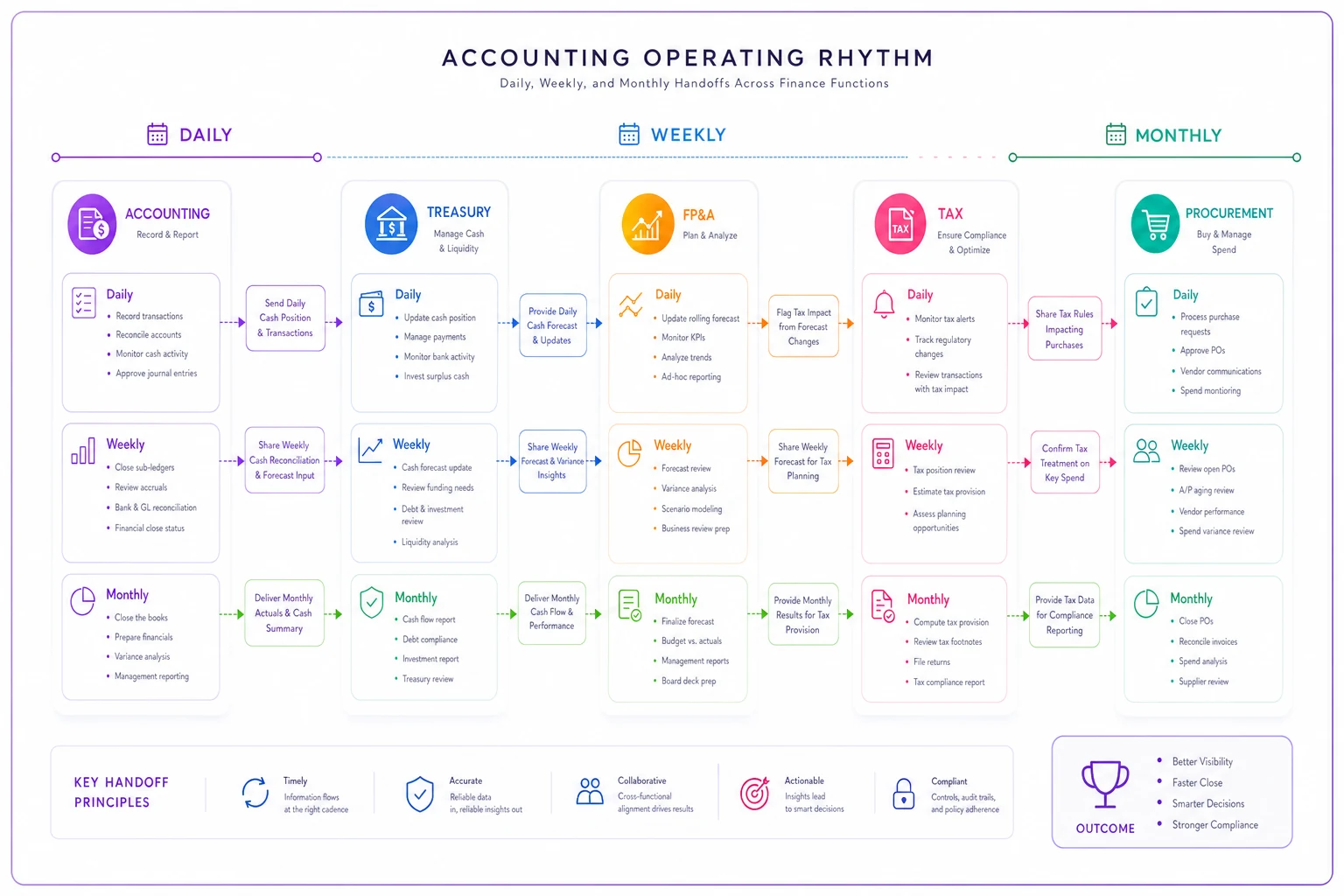
A simple diagram illustrating the daily, weekly and monthly handoffs helps teams follow the process without extra meetings.
The organizational triggers that actually matter
Successful scaling isn't really about headcount—it's about organizational readiness. Here are the triggers that should drive changes:
Add person #2 when:
-
Transaction volume exceeds 40 hours/week
-
Month-end close extends beyond 5 days
-
The solo bookkeeper takes no vacation for 6 months
-
Basic errors increase (duplicate payments, missed invoices)
Move to 3 people when:
-
Revenue exceeds $5M or employee count exceeds 50
-
Multiple revenue streams require different accounting treatment
-
Audit or due diligence is on the horizon
-
The owner stops understanding financial reports
Build to 10 people when:
-
Business units need dedicated support
-
Month-end close requires more than 5 people
-
International operations begin
-
Complex revenue recognition emerges
Scale to 50 when:
-
Public company readiness becomes a goal
-
M&A activity increases
-
Multiple entities require consolidation
-
Regulatory compliance becomes complex
The key point: trigger organizational changes based on operational signals, not calendar time or gut feeling.
The tooling progression that supports growth
Tools should precede growth, not follow it. Here's the progression that works:
1 person tools:
-
QuickBooks/Xero
-
Excel
-
Basic expense management
-
Google Workspace
3 person tools (add):
-
Bill.com or similar AP automation
-
Dedicated expense platform
-
Basic reporting tool
-
Document management system
10 person tools (upgrade):
-
Mid-market ERP (NetSuite, Sage Intacct)
-
FP&A platform
-
Advanced expense management
-
Procurement platform
50 person tools (enterprise):
-
Enterprise ERP (Oracle, SAP)
-
Treasury management system
-
Tax compliance platform
-
Consolidation software
-
AI-powered automation platform
The key point here: implement the next level's tools before you hit the headcount trigger. Implementing NetSuite with 10 people is painful. Implementing it with 15 people while trying to maintain operations is close to impossible.
Why most companies get this wrong
The fundamental mistake is treating finance team scaling as a series of hiring decisions rather than organizational transformations. Work piles up, quality drops, someone says "we need more help," and they hire. The new person gets minimal onboarding, unclear responsibilities, and inadequate tools. They either become part of the chaos or leave within six months.
The companies that scale successfully treat each transition as an organizational project:
-
Document current processes and pain points
-
Design the future organization structure
-
Create role charters and ownership matrices
-
Implement supporting technology
-
Then, and only then, hire into defined roles
This takes longer upfront. But it saves months of pain later and—more importantly—creates a finance organization that enables growth instead of constraining it.
The competitive advantage of structured scaling
Companies with well-scaled finance teams close their books in 3 days while competitors take 15. They produce board reports in hours while others scramble for weeks. They handle due diligence in days while peers need months.
The real advantage goes deeper than speed, though. A properly structured finance team becomes a strategic asset. They spot margin erosion before it hits earnings. They model scenarios that inform major decisions. They provide data that helps sales teams price effectively and operations teams manage costs.
The difference between a 50-person finance team that runs smoothly and one that struggles isn't the quality of people—it's the quality of organization. Clear role charters mean people focus on their highest-value work. Defined process ownership eliminates gaps and overlaps. Proper tooling automates routine work so humans can think rather than process.
A well-structured finance organization also scales predictably. When the business needs to grow from $100M to $200M, finance can support that growth by adding people into defined roles rather than doubling headcount and hoping for the best.
The choice is pretty straightforward: plan these transitions before you need them, or scramble through them after things break. The companies that plan ahead build finance organizations that accelerate overall business growth. The ones that don't end up with expensive, inefficient operations that become a drag on the entire company.
Ready to take control of your finances?
Join over 2,000 businesses using Acctaly to simplify accounting, accelerate cash flow, and ensure tax readiness.