


Most compliance failures in small businesses aren't dramatic. Nobody wakes up one morning and decides to skip a payroll tax deposit. What happens is quieter: the person who "used to handle that" left, the filing calendar lived in someone's head, and a sales-tax registration in a new state slipped through because nobody owned the question of when you cross the threshold.
The real issue isn't knowledge. Plenty of owners know they owe sales tax and payroll taxes. The issue is that compliance work is spread across people, tools, and months with no single operating model holding it together. It works fine at four employees and quietly collapses somewhere around twenty — usually right when you're least able to afford the distraction.
This article lays out a finance compliance operating model for SMBs that scales with you — one where provisioning, filing cadence, roles, evidence, and resourcing are all tied to your stage instead of your memory. The goal is boring, repeatable compliance that doesn't depend on heroics.
Why compliance breaks even when people are competent
Compliance is a coordination problem disguised as a knowledge problem.
Think about what a single quarterly payroll filing actually requires: accurate wage data from the payroll system, correct tax rates (which change by jurisdiction and sometimes mid-year), a funded bank account on deposit day, someone to review the return, and a place to file the confirmation so you can prove it later. That's five handoffs, and at a small company those five jobs might belong to the same overloaded person — or worse, to nobody specifically.
There's a pattern worth naming: the "default owner" trap. When no one is formally assigned a compliance task, it defaults to whoever notices it first, which is usually the founder or the most senior finance person. That works until they're tied up during a fundraise or a product launch. Then the task doesn't get reassigned — it just doesn't happen.
The second structural problem is cadence drift. Filing obligations have fixed dates. Your business doesn't. When you hire your first out-of-state remote employee, you've just created new payroll tax registrations in that state — often immediately. When your online sales cross an economic nexus threshold, your sales-tax obligations change whether or not anyone updated the calendar. The obligations move with your business activity; the calendar stays frozen unless someone explicitly updates it.
In real operations, the failure usually shows up like this: a notice arrives from a state agency, the penalty is small the first time, and it gets paid quietly. Six months later the same gap produces a larger assessment, and now you're reconstructing a year of activity to figure out what you missed.
The five pieces that actually need to connect
A functioning compliance operating model isn't a checklist — it's five moving parts that have to stay linked. When one drifts out of sync with the others, that's where the exposure lives.
Stop letting accounting slow your business down.
Acctaly automates your financial operations so you can focus on growth and compliance.
- Automated bookkeeping
- Real-time financial reporting
- Integrated tax management
No credit card required
-
Monthly provisioning — setting aside money for taxes you owe but haven't paid yet, so filing day isn't a cash crisis.
-
Filing cadence — the master calendar of every return and deposit, mapped to jurisdictions and due dates.
-
Roles and SLAs — who prepares, who reviews, who approves, and how fast each step has to happen.
-
Evidence fabric — where filed returns, confirmations, and supporting workpapers live so you can prove compliance on demand.
-
Resourcing rules — the triggers that tell you when to add a person, a tool, or an outside firm.
The connective tissue matters more than any single piece. Provisioning without a filing calendar means you have the cash but miss the date. A filing calendar without roles means everyone assumes someone else owns it. Evidence without SLAs means you have documents but can't tell if they were reviewed. The model only works when all five are wired together and refreshed on the same cadence.
What changes as you grow: the stage-trigger view
The biggest mistake owners make is building a compliance process for the company they are, then never revisiting it. The obligations compound faster than the process does.
Here's a practical breakdown of how the model should shift across stages. Treat the triggers as thresholds, not calendar dates — they fire when the business condition is met.
| Stage | Trigger that moves you here | Primary compliance risks | Who owns it | Provisioning approach |
|---|---|---|---|---|
| Solo / 1–3 | Founder-run, first employees | Missed payroll deposits, no sales-tax registration | Founder + outside bookkeeper | Manual monthly set-aside into a separate account |
| 4–10 | First real finance hire or established bookkeeper | Multi-state payroll, nexus crossings, 1099 vs W-2 misclassification | Bookkeeper prepares, founder approves | Scheduled monthly accrual with a reconciliation check |
| 10–25 | Dedicated finance lead, revenue across states | Sales-tax nexus in 3+ states, benefits/withholding complexity | Finance lead owns calendar, controller/fractional CFO reviews | Formal tax liability accrual reviewed at monthly close |
| 25–50+ | Finance team of 2–4, multiple entities or channels | Jurisdiction sprawl, audit exposure, segregation-of-duties gaps | Named owners per obligation type, documented SLAs | Automated accrual with independent review and variance checks |
The thresholds that tend to catch people off guard:
-
The first remote hire in a new state. This single event can create income tax withholding, unemployment insurance registration, and sometimes local tax obligations — often with a filing deadline measured in days or weeks, not months.
-
Crossing economic nexus for sales tax. Most states use a dollar or transaction-count threshold (commonly around $100k in sales or a few hundred transactions, though it varies). Once you cross it, you're expected to register, collect, and remit — retroactively, in some cases.
-
The second entity. The moment you add a holding company, a subsidiary, or an acquisition, inter-company transactions and separate filing obligations multiply. This is also where a clean stage-tailored investor diligence pack becomes valuable, because compliance gaps surface fast when outside eyes start reviewing.
This is also where a clean stage-tailored investor diligence pack becomes valuable, because compliance gaps surface fast when outside eyes start reviewing.
Enforceable one-page policies (and why one page matters)
Long compliance manuals don't get read. The ones that actually work are short enough to fit on a single page and specific enough that someone could follow them without asking a question.
A strong one-page policy for a given obligation — say, sales-tax filing — answers five things:
-
What is being filed and in which jurisdictions
-
When it's due (with the preparation deadline, not just the filing deadline)
-
Who prepares, reviews, and approves it
-
How it gets funded (where the money comes from and when it's set aside)
-
Where the evidence is filed afterward
Notice the preparation deadline is separate from the filing deadline. This is the single most useful detail in any filing policy. If a return is due on the 20th, the policy should say preparation is complete by the 15th and review by the 18th. That buffer absorbs the inevitable surprises — a missing report, a rate change, a bank-funding delay — without blowing the actual deadline.
The policy should be testable. Instead of "ensure sales tax is filed accurately," write "sales-tax return filed and confirmation saved to the evidence folder by the 20th of each month; monthly reconciliation of collected vs. remitted tax shows zero unexplained variance." The first version is a hope. The second is something you can audit.
Roles and SLAs: separating the work from the person
The whole point of assigning roles is to make compliance survive turnover. When the role is defined independently of the person, replacing the person doesn't break the process.
A workable role structure for a small finance team breaks every obligation into three functions:
-
Preparer — pulls the data, calculates the liability, drafts the return.
-
Reviewer — checks the numbers against source data and prior periods, confirms the rate and jurisdiction are correct.
-
Approver — authorizes payment and the filing itself.
At solo and early stages, one person may wear all three hats, and that's fine as long as it's documented and there's a compensating control — usually the outside bookkeeper or accountant doing a periodic independent look. What you can't do is leave it undefined. "Whoever gets to it" is not a role.
The SLA layer attaches time commitments to each function. A realistic payroll-tax SLA at a 10–25 person company might read: payroll data finalized by day 1 after period close, liability calculated and reviewed by day 3, deposit funded by the statutory deadline with no exceptions. The exact numbers matter less than the fact that they're written down and measurable.
For a deeper view of how these roles and the org structure around them should evolve, the headcount-triggered org and role-charter roadmap covers the staffing side in detail — this piece focuses specifically on the compliance obligations those roles have to carry.
The evidence fabric: proving it later
Compliance isn't finished when you file. It's finished when you can prove you filed, years later, to an auditor or an agency, without a frantic email search.
The evidence fabric is the connected set of records that backs up every filing. For each obligation, you want:
-
The filed return or deposit confirmation
-
The supporting calculation or report it was based on
-
A record of who reviewed and approved it
-
The date it was filed and the method
The practical failure here is scattering. Returns live in the accountant's portal, confirmations sit in email, workpapers are on someone's laptop, and approvals exist only as a vague memory that "yeah, I looked at that." When a notice arrives eighteen months later, reconstructing the trail eats days.
A simple discipline fixes most of this: one folder structure, organized by obligation type and period, where the evidence lands immediately after filing — not at year-end during a scramble. Filing evidence at the moment you file the return is what separates teams that handle audits calmly from teams that dread the mail.
A monthly workflow that holds it all together
Here's how the pieces connect in an actual monthly rhythm at a growing SMB, written as a sequence rather than a wish:
-
Close the books for the month so the data behind every liability is accurate. Compliance built on unreconciled numbers inherits every error.
-
Calculate and accrue the tax liabilities — payroll, sales tax, estimated income tax — against the closed numbers.
-
Fund the provisioning account so the cash to pay these liabilities is physically set aside, not just a line item.
-
Check the filing calendar for everything due in the coming weeks, including any new obligations triggered by the month's activity (new state, new channel, threshold crossing).
-
Prepare, review, approve, and file each obligation per its one-page policy and SLA.
-
Save evidence to the structured folder at the moment of filing.
-
Reconcile collected vs. remitted amounts (especially sales tax) and log any variance with an explanation.
Make the monthly calendar review a recurring meeting owned by the finance lead so step #4 doesn't get missed.
The step people skip is #4 — scanning for new obligations. A monthly review of business activity against nexus and registration thresholds is what catches the state you quietly started owing taxes in. Without it, you only find out when the notice arrives.
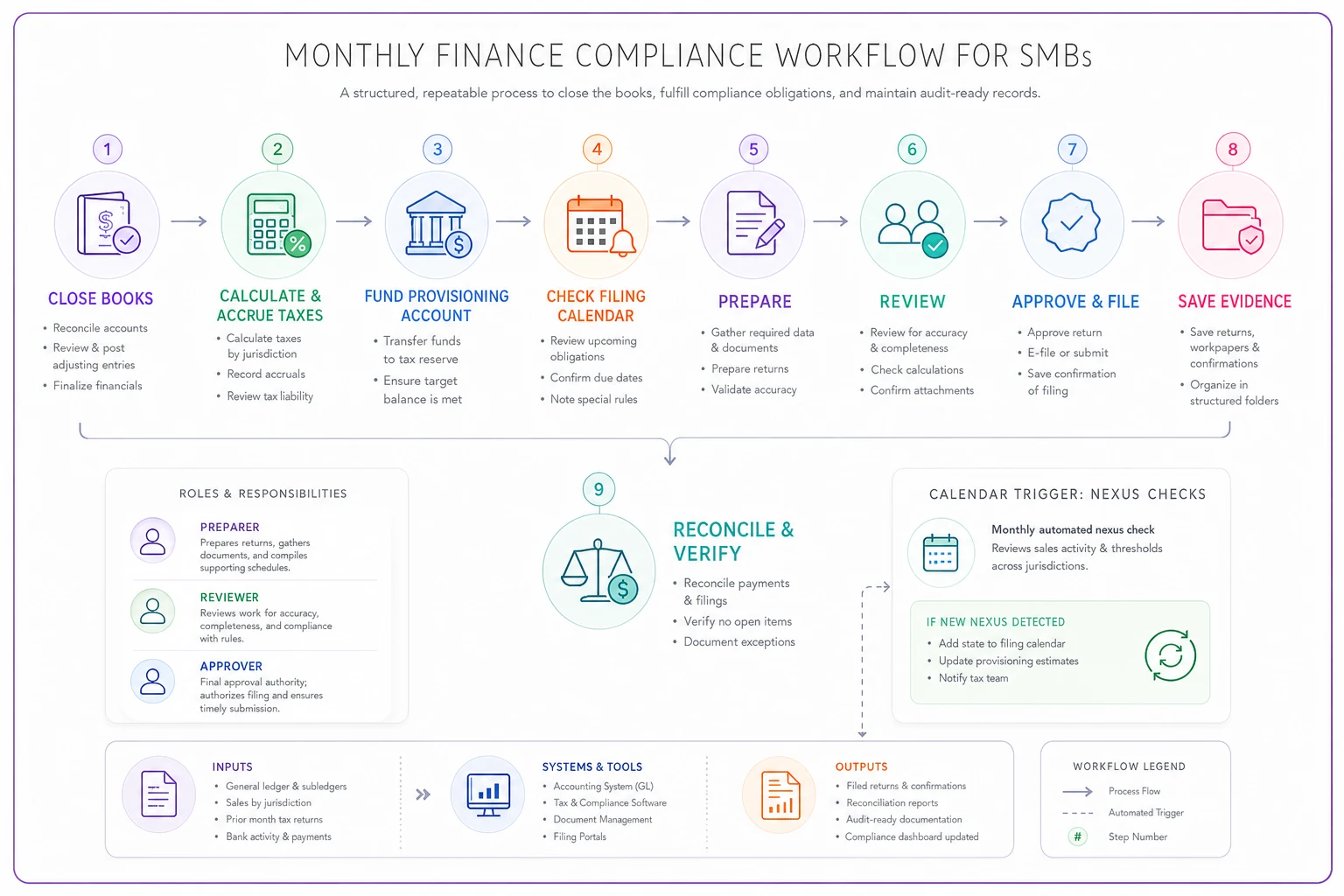
A simple visual of the monthly flow helps teams see ownership and the calendar trigger.
A real scenario: the sales-tax gap that compounded
Consider an e-commerce and wholesale business that grew from one state to selling nationwide over about two years. Revenue climbed to somewhere around $4M, with online sales spreading across most of the country.
The problem: sales-tax registration and remittance stayed set up for their home state only. Nobody owned the nexus question. As the online channel grew, they crossed economic nexus thresholds in roughly eight to ten states without registering. The books were clean, close was on time, payroll was flawless — but an entire category of obligation had no owner and no trigger watching it.
It surfaced when one state sent a notice. Back-taxes, interest, and penalties across the exposed states came to somewhere in the low tens of thousands — plus several weeks of the finance lead's time reconstructing where and when they'd crossed each threshold, and professional fees to sort out voluntary disclosure agreements.
The fix wasn't complicated, which is the frustrating part. They added one step to the monthly workflow: a review of state-by-state sales against each state's nexus threshold, with a named owner (the finance lead) and a clear SLA (register within 30 days of crossing). Provisioning started accruing sales tax for states approaching the threshold. After that, new registrations happened before notices arrived, and the compliance work became a predictable 30–45 minute monthly task instead of an emergency.
The exposure didn't come from a hard problem. It came from an obligation that nobody owned and no trigger watched.
Resourcing rules: when to add people, tools, or outside help
The resourcing question is where a lot of owners either overspend early or underspend dangerously late. A few rules of thumb that hold up across most SMBs:
-
Solo to ~5 employees An outside bookkeeper plus a good payroll provider covers most needs. Your main job is to own the filing calendar and the provisioning account personally.
-
~5 to ~20 This is where a dedicated finance hire — or a fractional controller — starts to pay for itself, specifically to own the compliance calendar and separate preparer/approver roles.
-
~20 to 50+ You need named owners per obligation type, documented SLAs, and either a capable in-house team or a hybrid with specialist outside firms for the complex areas (multi-state sales tax, R&D credits, multi-entity consolidation).
When keeping it in-house makes sense
If your obligations are concentrated — mostly one state, straightforward payroll, a single entity — in-house ownership with a part-time bookkeeper is cheaper and faster than paying firm rates for routine work.
When outside help is the better call
Multi-state complexity, multiple entities, or any area where a mistake carries real penalty exposure is usually worth specialist help. The judgment of what to keep and what to send out is covered more fully in this breakdown of when to outsource finance versus keep it in-house — the short version is to keep the routine, high-frequency work close and outsource the specialized, high-stakes work.
Who should not try to run this solo
If you're already past ~15 people and still running all compliance through the founder's head and a spreadsheet, that's not a resourcing choice — it's an accident waiting to be discovered. The volume and jurisdictional spread at that size will eventually produce a gap no single busy person can reliably catch.
A quick self-audit checklist
Run through these. Any "no" is a gap worth closing before it finds you:
-
- [ ] Every filing obligation has a named owner — not "the finance team," an actual person or role.
-
- [ ] Your filing calendar lists preparation deadlines, not just filing deadlines.
-
- [ ] You review business activity monthly for new obligations (new states, new channels, threshold crossings).
-
- [ ] Tax liabilities are provisioned into a separate, funded account before they're due.
-
- [ ] Filed returns and confirmations land in a structured folder the moment they're filed.
-
- [ ] Each filing has a documented reviewer and approver, even if that's a compensating outside review at early stages.
-
- [ ] Sales-tax collected versus remitted is reconciled monthly with variances explained.
-
- [ ] Your resourcing matches your stage — you're not running 25-person complexity on a 5-person setup.
Run through these. Any "no" is a gap worth closing before it finds you:
Bringing it together
Compliance failures at small businesses rarely come from not knowing the rules. They come from the gaps between people, between months, and between the business you were and the business you've become. Obligations compound with growth; processes don't, unless you build triggers that make them.
A stage-aware operating model closes those gaps by tying five things together — provisioning, cadence, roles, evidence, and resourcing — and refreshing all of them on the same monthly rhythm. The specific numbers and tools will vary by company. What doesn't vary is the principle: assign ownership explicitly, watch for the triggers that create new obligations, and prove everything after you file. Do that, and compliance stops being the thing that surprises you and becomes the thing you barely notice.
Ready to take control of your finances?
Join over 2,000 businesses using Acctaly to simplify accounting, accelerate cash flow, and ensure tax readiness.