


Your finance lead just got off a three-hour call with the auditors. They need documentation for seventeen different subscription scenarios, journal entry support for every revenue adjustment since inception, and proof that your deferred revenue calculations actually tie to signed contracts. The due diligence deadline is Friday.
This scenario plays out predictably. You've been recording revenue when customers pay (because that made sense at the time), your deferred revenue schedule lives in a spreadsheet that nobody really trusts, and now someone needs to rebuild two years of revenue recognition from scratch while explaining why your reported numbers don't match your bank deposits.
Most of this scramble was avoidable. Not because you should have hired a Big Four accountant at ten customers, but because subscription revenue recognition for early-stage SaaS follows predictable patterns. Annual prepays, mid-month starts, downgrades, upgrades, cancellations with credits — these scenarios repeat across every SaaS business. The journal entries stay consistent. The documentation requirements don't change.
Yet every startup rediscovers these patterns during their first real audit.
The same documentation gaps appear every time. Missing contract-to-journal-entry mapping. No clear policy for handling partial-month recognition. Deferred revenue schedules that don't reconcile to the general ledger. Recognition timing that changes depending on who entered the sale. These aren't complex accounting failures — they're process gaps that compound into audit nightmares.
Why early-stage SaaS companies fail revenue recognition audits
The core issue isn't understanding ASC 606 or knowing that you need to recognize revenue over the service period. Every SaaS founder gets that conceptually. The breakdown happens between understanding the principle and implementing repeatable processes that generate audit-ready documentation.
Consider what happens at a typical $2M ARR SaaS company. Sales closes a $24,000 annual deal on March 15th. The customer pays immediately. Finance records the full $24,000 as revenue because "we need to show growth this quarter." Three months later, someone realizes this should have been deferred. They create a manual adjustment. By audit time, nobody remembers why the original entry happened, what the adjustment was correcting, or whether the monthly recognition calculation was right.
This pattern multiplies across every edge case. A customer upgrades mid-contract — how do you handle the additional revenue? They cancel with three months remaining and want a credit — what's the journal entry? An enterprise client negotiates custom payment terms with quarterly invoicing but annual contracts — how does that map to recognition? Without clear documentation, each scenario becomes an archaeological dig during audit prep.
Your subscription revenue recognition checklist needs to solve three specific problems. First, it must map every common contract pattern to its corresponding journal entries so new scenarios don't create confusion. Second, it needs to standardize deferred revenue calculations so they're consistent regardless of who processes the sale. Third, it has to define minimum documentation requirements that satisfy auditors without creating excessive overhead for small teams.
The eight subscription patterns that cover 95% of SaaS revenue scenarios
Pattern 1: Standard annual prepay with first-of-month start This is your baseline. Customer signs December 15th for January 1st start, pays $12,000 upfront.
Stop letting accounting slow your business down.
Acctaly automates your financial operations so you can focus on growth and compliance.
- Automated bookkeeping
- Real-time financial reporting
- Integrated tax management
No credit card required
Journal entry at payment:
-
Debit
Cash $12,000
-
Credit
Deferred Revenue $12,000
Monthly recognition:
-
Debit
Deferred Revenue $1,000
-
Credit
Revenue $1,000
Evidence pack: Contract PDF, payment confirmation, start date documentation.
Pattern 2: Mid-month start with full month billing Customer starts March 15th but gets charged for full March. Many companies mess this up by recognizing the full month immediately.
Initial entry stays the same as Pattern 1. Recognition requires pro-rating the first month:
-
March recognition
$500 (half month)
-
April-February recognition
$1,000 each
-
March next year recognition
$500
Evidence pack: Contract showing start date, calculation worksheet showing pro-ration logic.
Pattern 3: Upgrade mid-contract Customer paying $1,000/month upgrades to $1,500/month plan six months into annual contract. The additional $3,000 for remaining six months gets its own deferred schedule.
Upgrade entry:
-
Debit
Cash $3,000
-
Credit
Deferred Revenue $3,000
Then recognize $500/month additional over remaining contract period.
Evidence pack: Original contract, upgrade confirmation, calculation showing remaining term.
Pattern 4: Downgrade with credit Customer moves from $2,000/month to $1,200/month plan four months into prepaid annual contract. You owe them $6,400 credit.
Adjustment entry:
-
Debit
Deferred Revenue $6,400
-
Credit
Cash (or A/R if crediting) $6,400
Then adjust monthly recognition to $1,200 going forward.
Evidence pack: Downgrade request, credit calculation, approval documentation.
Pattern 5: Cancellation with refund Customer cancels after three months of twelve-month prepaid contract, requests refund.
Reversal entry:
-
Debit
Deferred Revenue $9,000
-
Credit
Cash $9,000
Evidence pack: Cancellation request, refund calculation, payment confirmation.
Pattern 6: Multi-year contracts with annual billing Three-year contract, billed annually. Each annual payment creates its own deferred revenue schedule. Don't defer the entire contract value upfront unless you've collected it all.
Year 1 collection:
-
Debit
Cash $12,000
-
Credit
Deferred Revenue $12,000
Recognize monthly as usual. Repeat for each annual billing cycle.
Evidence pack: Multi-year contract, billing schedule, collection confirmation for each period.
Pattern 7: Usage-based with minimum commits $1,000/month minimum plus usage. Recognize the minimum ratably, usage as incurred.
Monthly entries:
-
Minimum
Debit Deferred Revenue $1,000, Credit Revenue $1,000
-
Usage
Debit A/R $[usage amount], Credit Revenue $[usage amount]
Evidence pack: Contract with minimum terms, usage reports, calculation methodology.
Pattern 8: Implementation fees with ongoing subscription $5,000 setup plus $1,000/month subscription. Unless implementation is a distinct performance obligation, amortize setup over expected customer life.
If customer life is 24 months:
-
Setup recognition
$208/month over 24 months
-
Subscription recognition
$1,000/month
Evidence pack: Contract separating fees, customer lifetime assumptions, calculation support.
Building deferred revenue schedules that actually tie to the GL
The deferred revenue schedule becomes your source of truth during audits. It needs to reconcile perfectly to your balance sheet, show clean roll-forwards month to month, and provide drill-down detail to individual contracts.
| Element | Details |
|---|---|
| Contract details | Customer name and ID; Contract start and end dates; Total contract value; Payment terms and collection status; Product/plan details |
| Recognition timeline | Monthly recognition amount; Start and end of recognition period; Pro-ration calculations for partial periods; Modifications (upgrades, downgrades, extensions) |
| Balance tracking | Beginning deferred balance; Current period collection; Current period recognition; Ending deferred balance; Cumulative recognized to date |
| Audit trail | Contract reference number; Payment reference/invoice number; Journal entry references; Modification history with dates |
| Reconciliation proof | Sum of ending balances = GL deferred revenue account; Monthly recognition total = GL revenue account; Roll-forward ties (beginning + collections - recognition = ending) |
Most companies try to maintain this in Excel, which works until around 50 active subscriptions. Beyond that, formulas break, version control disappears, and monthly updates take days instead of hours. The schedule needs systematic updates, not manual maintenance.
Tie each deferred schedule row to a contract ID and keep journal entry references in the same row to speed auditor sampling.
A simple workflow for building and reconciling a deferred revenue schedule:
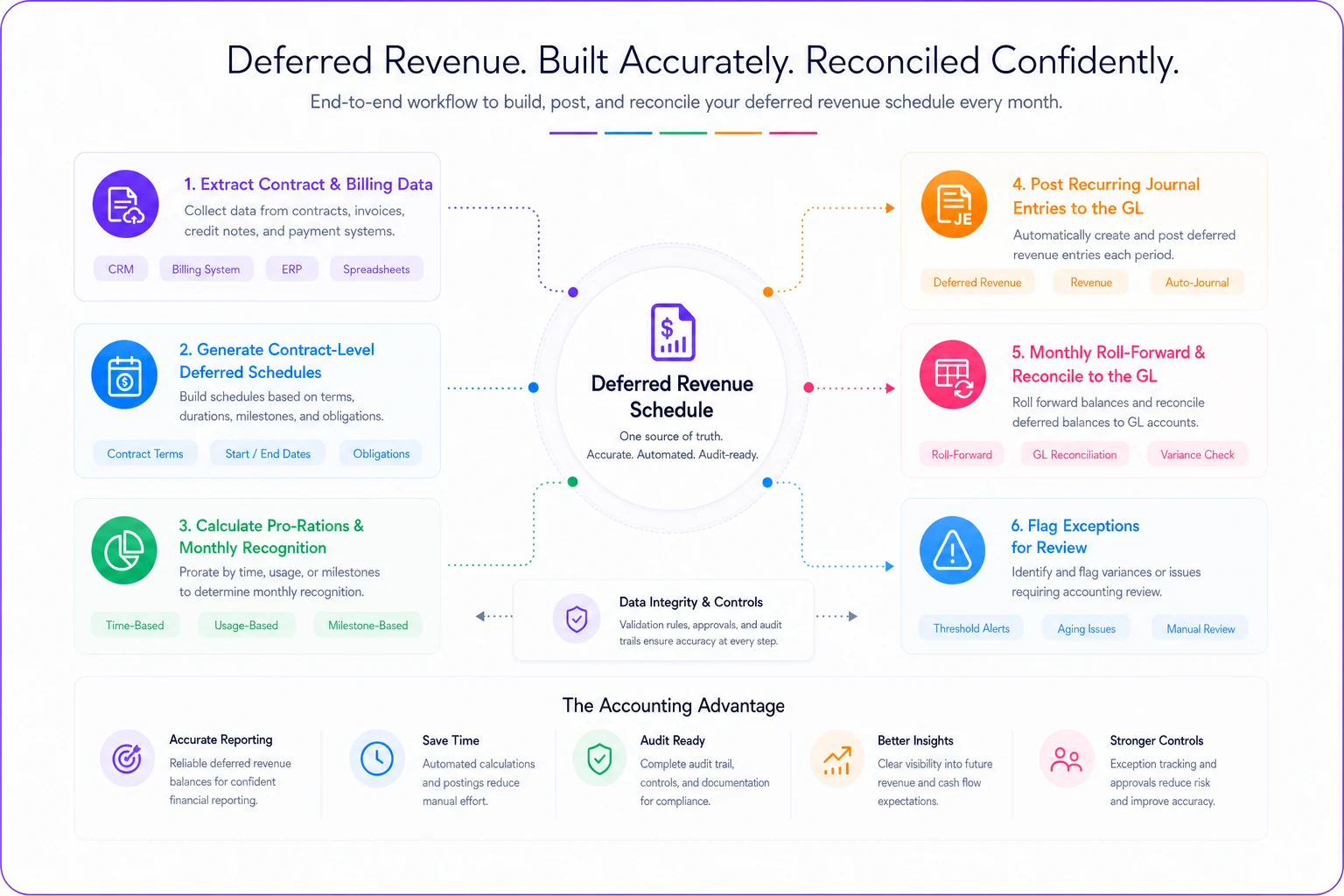
Use this workflow as a checklist during monthly closes to ensure each step has supporting documentation.
The minimum evidence pack that satisfies investors and auditors
Auditors don't need perfect documentation — they need consistent, logical documentation that demonstrates control over the revenue process. For early-stage SaaS, this means five essential components:
1. Revenue recognition policy memo A two-page document stating your recognition approach. When revenue gets recognized (ratably over service period), how you handle modifications, what constitutes a performance obligation. This doesn't need to be complex — just clear and consistently applied.
2. Contract-to-cash reconciliation For any sampled transaction, you need to show: signed contract → invoice/payment record → bank deposit → journal entry → deferred revenue schedule → monthly recognition entries. This chain of documentation proves revenue integrity.
3. Monthly recognition calculation support Auditors will sample random months and ask "how did you calculate this revenue number?" You need worksheets showing: beginning deferred balance, new contracts added, amounts recognized, ending balance, with contract-level detail that sums to totals.
4. Modification tracking Every upgrade, downgrade, cancellation, or credit needs a paper trail. Email approval, calculation of adjustment, journal entry support. These exceptions get the most scrutiny because they're where errors cluster.
5. Analytical reconciliation High-level proof that revenue makes sense: number of customers × average price = approximate revenue. Month-over-month growth reconciliation. Deferred revenue days outstanding. These analytics catch systematic errors that transaction testing might miss.
Common documentation gaps that trigger audit findings
Missing contract amendments Sales negotiates a discount or different terms via email, but the original contract never gets updated. Finance recognizes based on the contract while billing uses the email agreement. The mismatch creates unexplainable variances that auditors flag immediately.
Inconsistent start date definitions Some contracts use signature date, others use go-live date, others use first login. This inconsistency makes it impossible to verify if recognition timing is correct. Pick one definition and enforce it across all contracts.
No systematic modification tracking Upgrades and downgrades get processed ad-hoc without consistent documentation. By audit time, you're searching through Slack messages and email threads trying to support why customer revenue changed mid-contract. Every modification needs a standard form or ticket that captures the change details, approval, and effective date.
Automation opportunities in subscription revenue recognition
The repetitive nature of subscription revenue patterns makes them perfect for automation. The same journal entries, the same calculations, the same roll-forwards — just with different numbers and dates. Modern AI-powered operational software can handle these workflows systematically while maintaining audit trails.
Consider the monthly recognition process. Instead of manually calculating recognition for each contract, updating the deferred schedule, creating journal entries, and reconciling to the GL, automated systems can process all contracts simultaneously. Contract data flows directly from your billing system, recognition calculations happen based on predefined rules, journal entries generate automatically with full supporting detail, and exceptions get flagged for review rather than hiding in spreadsheets.
Setting up a reporting-first chart of accounts becomes especially important here. When your revenue accounts are properly structured from the start, automated recognition can post directly to the right GL accounts without manual mapping. The deferred revenue account structure should mirror your revenue categories — if you track revenue by product line, your deferred revenue should break out the same way.
The efficiency gains come from standardizing documentation creation. When a new contract gets signed, the system can automatically generate the revenue recognition schedule, create the initial deferred revenue entry, schedule monthly recognition entries, and build the audit support package. What typically takes hours of manual work happens instantly with perfect consistency.
This systematic approach also helps with building meaningful financial metrics beyond just recognized revenue. When your recognition process is automated and reliable, you can trust metrics like committed ARR, revenue retention, and recognition velocity. These operational metrics matter more than perfect GAAP compliance for day-to-day decisions.
When to implement formal revenue recognition processes
When should a SaaS startup move from cash-basis booking to proper revenue recognition? The textbook answer says "from day one," but that's not realistic for most early-stage companies.
Three triggers indicate you need formal processes:
Audit requirement approaching If you're raising institutional capital, acquiring another company, or selling to enterprises that require audited financials, you need clean revenue recognition at least twelve months before the audit. Retroactive cleanup takes three times longer than doing it right initially.
Subscription complexity increasing Once you have multiple pricing tiers, annual and monthly options, and regular upgrades/downgrades, cash-basis accounting can't provide accurate financial pictures. You need to know actual monthly revenue, not just cash collected.
Deferred revenue becoming material When deferred revenue exceeds one month of recognized revenue, errors in recognition timing materially impact financial statements. At this point, informal processes create real financial reporting risk.
For most SaaS companies, this happens between $500K and $2M ARR. Below that threshold, the complexity cost exceeds the accuracy benefit. Above it, the errors compound faster than you can correct them manually.
Building your subscription revenue recognition checklist
Your checklist needs three levels of detail:
Daily processing checklist:
-
New contract → create deferred schedule
-
Payment received → record deferred revenue
-
Modification request → document and adjust schedule
-
Cancellation → calculate and process refund/credit
Monthly close checklist:
-
Run recognition calculations for all active contracts
-
Post recognition journal entries
-
Reconcile deferred revenue schedule to GL
-
Review and clear any recognition suspense accounts
-
Document any manual adjustments with explanations
Audit prep checklist:
-
Revenue recognition policy documented and current
-
All contracts match deferred revenue schedule
-
Monthly roll-forwards tie for past twelve months
-
Modification history tracked with support
-
Analytics show revenue trends make sense
-
Sample transactions have complete documentation chain
The checklist becomes your operational defense against audit surprises. When each pattern has documented entries, calculations stay consistent, and evidence packs are complete, audits become confirmation exercises rather than archaeological expeditions.
The reality of maintaining recognition compliance
Perfect revenue recognition is a myth for early-stage SaaS companies. You'll always have edge cases, one-off negotiations, and scenarios that don't fit the standard patterns. The goal isn't perfection — it's consistency, documentation, and the ability to explain variations.
What matters is having a systematic approach that handles 95% of scenarios automatically while flagging the 5% that need human judgment. When auditors arrive, they care less about perfect compliance and more about demonstrated control. Can you explain your methodology? Can you show consistent application? Can you support the numbers with documentation?
These questions matter more than whether you properly applied every nuance of ASC 606.
Proper revenue recognition isn't just about satisfying auditors. It's about understanding your actual business performance. When you know exactly how much revenue you've earned versus collected, you make better operational decisions. You price more intelligently. You forecast more accurately. You build a stronger business.
The checklist and processes outlined here work for SaaS companies from their first customer through Series B. After that, you'll need more sophisticated systems and probably a full-time revenue accountant. But until then, these patterns, documentation requirements, and systematic approaches will keep you audit-ready without overwhelming your small finance team.
Start with the eight patterns. Build a simple deferred revenue schedule. Document your modifications. Create those journal entry templates. Then when the auditors call, you're ready with answers instead of apologies.
Ready to take control of your finances?
Join over 2,000 businesses using Acctaly to simplify accounting, accelerate cash flow, and ensure tax readiness.