

Most SMBs discover they need a 13-week cash flow forecast SMB system about three weeks too late. The bank calls about covenant compliance, a major customer delays payment, or payroll hits right when three large supplier invoices come due. Suddenly everyone's scrambling to build projections on the back of napkins, pulling numbers from five different systems, arguing about which receivables will actually convert.
The real problem isn't the lack of a forecast. It's that most cash flow models treat AR, AP, and payroll as abstract line items instead of operational realities. Your collections person knows exactly which invoices that one customer always pays late. Your AP coordinator has the vendor payment terms memorized. None of that knowledge makes it into the spreadsheet that determines whether you can make payroll next month.
Companies that survive volatility don't just track cash—they build operational handoffs between the people who handle money daily and the ones making strategic decisions. A 13-week rolling forecast isn't about predicting the future perfectly. It's about creating a system where information flows from operations to strategy fast enough to actually matter.
Why indirect methods fail when cash gets tight
Traditional cash flow forecasting starts with net income and adds back non-cash items. Works great for annual reports. Falls apart completely when you need to know if you can cover Thursday's ACH run.
The indirect method assumes your accrual-based financials reflect operational reality. But what actually happens in small businesses: that $47,000 in accounts receivable includes three invoices from a customer disputing charges, another $12,000 from someone who only pays after the third reminder email, and about $8,000 that's technically past due but you know is coming because they texted you yesterday about cutting the check.
Your P&L might show $340,000 in monthly revenue. Your bank account shows $23,000. The indirect method tries to bridge that gap with depreciation schedules and working capital adjustments. Meanwhile, your AR person could tell you exactly which $127,000 will hit your account in the next two weeks if anyone bothered to ask them.
This disconnect gets worse as businesses scale. A two-person finance team carries all the context in their heads. By the time you hit ten people, that same information lives across three different systems, four Excel files, and someone's personal notebook. The forecast becomes an academic exercise divorced from actual cash movements.
Direct-method forecasting flips the approach: start with who owes you money, who you owe money to, and when those specific dollars move. No adjustments, no assumptions about converting accruals. Just explicit tracking of actual cash.
Mapping AR into weekly cash buckets (not wishful thinking)
The biggest lie in most cash forecasts is the receivables line. "We have $200,000 in AR, so we'll collect roughly $50,000 per week." Except that's not how collections work.
Stop letting accounting slow your business down.
Acctaly automates your financial operations so you can focus on growth and compliance.
- Automated bookkeeping
- Real-time financial reporting
- Integrated tax management
No credit card required
Real AR aging looks more like geological strata. Fresh invoices that'll pay on standard terms. The 30-day aged stuff where half will pay this week and half will need a reminder. The 60-day bucket split between customers with genuine cash flow issues and ones who just need aggressive follow-up. And that ancient 90+ day layer where you're deciding between collections agencies and write-offs.
Operational AR mapping works like this:
Start with your aging report, but add three columns: collection probability, expected payment week, and collection actions required. Now you're not just tracking age—you're tracking behavior.
That customer who always pays 15 days late? Their $23,000 invoice from two weeks ago goes in Week 3 with 95% probability. The government contract that pays net-45 like clockwork? Week 6, 100% probability. The startup client who's been "waiting for their funding to close" for two months? Week 8, 30% probability, with a note to call their CFO directly.
For a two-person team, this lives in a single spreadsheet the AR person updates daily. They know every customer's payment patterns, have context from recent conversations, can adjust probabilities based on actual behavior. The forecast becomes a living document, not a monthly guess.
When you scale to ten people, the system needs more structure. Customer payment history gets tracked systematically—average days to pay, standard deviation, seasonal patterns. A new invoice from Customer X automatically slots into Week 4 because that's when they've paid the last eight invoices. Probabilities adjust based on data, not gut feeling.
But here's what breaks: at two people, everyone knows that Customer Y pays faster if you email their AP contact directly instead of using the portal. At ten people, that kind of institutional knowledge disappears unless you build explicit handoff protocols.
The AP side: from vendor chaos to payment calendars
Payables feel simpler than receivables until you realize most SMBs don't actually know when bills are due. They know when bills arrive, when vendors start calling, and when late fees hit. The actual optimal payment date? Buried in contract terms nobody's looked at since signing.
A functional AP forecast starts with payment terms mapping. Every vendor gets classified: critical operations (must pay on time), flexible partners (can push 15-30 days if needed), and opportunistic relationships (take early pay discounts when you're flush).
The classification isn't just about importance—it's about consequences. Missing your payroll processor payment locks your account. Missing the AWS bill shuts down your platform. Missing the office supplies invoice adds a 1.5% late fee you'll probably never notice. These aren't equal risks, but most AP systems treat them identically.
For smaller teams, this means a simple payment priority matrix. Column A lists vendors. Column B shows real payment flexibility—not contract terms, but actual relationship dynamics. Column C tracks operational impact of late payment. Column D notes early payment discounts available.
Now you can build actual payment scenarios. Base case: pay everyone on terms. Cash crunch scenario: push non-critical vendors two weeks, absorb late fees on low-impact suppliers, preserve critical operations. Cash surplus scenario: capture those 2/10 net 30 discounts you usually ignore.
The ten-person version needs approval workflows, but the principle stays the same. Every payment decision flows from operational impact, not just due dates. The controller knows they can push the marketing agency payment without anyone noticing, but delaying cloud hosting requires escalation.
Payroll: the immovable object meets uncertain cash
Payroll is binary. You make it or you don't. No partial credit, no payment plan, no negotiation. Yet most cash forecasts treat payroll like it's just another expense line.
In a 13-week cash flow forecast SMB model, payroll is your primary constraint. Everything else adjusts around payroll dates. This seems obvious until you watch a company optimize their cash cycle without accounting for the fact that their biggest outflow hits every two weeks on Friday.
Smart payroll mapping starts with understanding your actual cash requirements. Gross payroll is one number. Add employer taxes, benefits that draft separately, the 401k match that processes three days later. Your $125,000 "payroll" is actually $143,000 across four different transactions hitting on different days.
Small teams handle this by working backward from payroll dates. If payroll processes Thursday for Friday payment, you need cleared funds by Wednesday morning. That means customer payments must hit by Monday to clear in time. Your thirteen-week forecast becomes thirteen two-week sprints, each anchored to a payroll cycle.
The handoff here matters. Whoever runs payroll needs to communicate timing changes immediately. Moving payroll by even one day cascades through your entire cash plan. That customer payment you were counting on for Thursday's run—if Monday is a bank holiday you forgot about, you're now scrambling for bridge funding.
Larger teams need more structure but the same discipline. Payroll becomes the fixed point everything else orbits around. The forecast shows three views: days until next payroll, coverage ratio for that payroll, and backup funding sources if primary collections fall short.
Building scenario templates that actually reflect operational reality
Most scenario planning is fiction. "What if revenue drops 20%?" Sounds sophisticated. Means nothing operationally. Revenue doesn't just "drop"—specific customers delay payment, particular contracts don't renew, certain markets soften. The spreadsheet is always more optimistic than the real situation.
Real scenarios start with actual trigger events. Customer concentration risk: what happens if your largest client, representing 35% of revenue, shifts from net-30 to net-60? Supply chain disruption: your main supplier demands COD instead of net-45. Market shift: that seasonal spike you count on every March doesn't materialize.
Each scenario needs three components: the trigger event, the operational response, and the cash impact timeline. It's not enough to know that losing Customer X hurts revenue. You need to know that their monthly $47,000 payment—usually hitting on the 15th—won't come in, you'll have roughly three weeks to replace that cash, and you'll need to immediately freeze discretionary spending and delay two vendor payments to cover the gap.
For a two-person team, scenarios live in parallel forecast tabs. Optimistic case: everyone pays on time. Realistic case: known payment delays baked in. Disaster case: three slowest payers all stretch to 60 days simultaneously. Update all three weekly and watch how the gaps shift.
Scaling to ten people requires explicit scenario owners. The AR manager owns customer payment scenarios. The controller owns vendor negotiation scenarios. The CFO owns funding scenarios. Each person maintains their piece based on operational intelligence, not theoretical modeling.
The value comes from speed of activation. When early warning signals appear—that usually-reliable customer mentions "cash flow challenges" on a call—you don't start building a model. You flip to the existing scenario, adjust for specifics, and know immediately whether action is required.
Bank covenant triggers and board reporting
Banks don't care about your carefully crafted financials. They care about covenant compliance, and they want to know about problems before they become defaults. Your 13-week forecast needs to speak their language.
Most SMB credit facilities include basic covenants: minimum cash balance, maximum debt-to-equity ratio, minimum debt service coverage. Trip one and your loan becomes immediately callable, your rate jumps, or you lose access to the credit line right when you need it most.
The forecast must track covenant compliance explicitly—not just today's numbers, but projected compliance across all thirteen weeks. That means building in your loan amortization schedule, tracking when interest payments hit, understanding how your receivables borrowing base calculation works.
For small teams, this is a manual check. Every forecast update includes a covenant compliance row. Green means you're clear with buffer. Yellow means you're within 20% of tripping. Red means you call your banker today, not when you actually violate.
Proactive communication matters enormously here. Banks hate surprises more than they hate problems. Tell them three weeks early that you might get tight on the minimum cash covenant and they'll work with you. Tell them after you've violated it and you're negotiating from weakness.
Tell your banker three weeks early that you might get tight on the minimum cash covenant so you can negotiate from a position of partnership rather than surprise.
Larger teams benefit from automated covenant tracking, where every forecast scenario runs through a compliance check and flags potential violations weeks in advance. But automation without understanding backfires. There are companies with perfect covenant tracking systems that missed violations because someone classified a credit line drawdown as operating cash instead of debt. The CFO saw healthy cash balances. The bank saw a blown leverage ratio.
The 2-person handoff: when everyone knows everything
In a two-person finance team, information transfer happens through proximity. You sit ten feet apart, share every customer interaction, jointly stress about payroll. The challenge isn't communication—it's documentation.
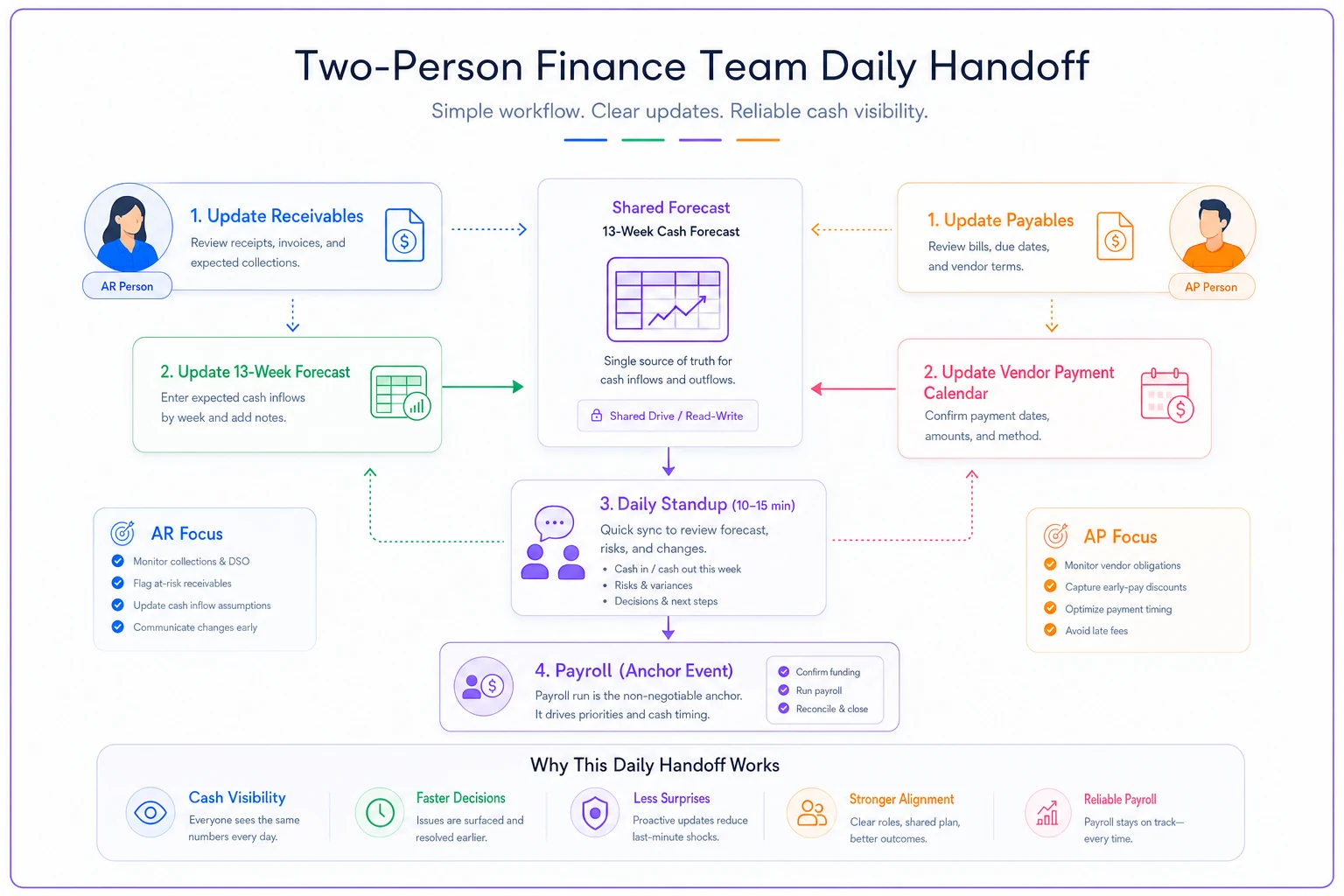
The 13-week cash flow forecast SMB system for small teams needs radical simplicity. One spreadsheet, two tabs maximum, updated daily by whoever touched cash that day. The AR person adds new invoices and payment confirmations. The AP person updates vendor payment schedules. Both can see everything.
The handoff protocol is verbal with written backup. "Customer ABC just pushed payment two weeks"—immediately reflected in the forecast. "Vendor XYZ offered 3% for early payment"—added to the opportunity list. Every conversation that affects cash gets logged, not in elaborate notes, but in forecast adjustments.
The discipline comes from daily standup reviews. Five minutes every morning: what cash came in yesterday, what's expected today, what problems are emerging. It's not a meeting—it's a habit. Like checking your bank balance, but with forward visibility.
This illustrates the simple daily handoff and information flow between AR, AP, and the shared forecast.
This breaks when one person goes on vacation, gets sick, or quits. Suddenly half the context vanishes. That's why even two-person teams need systematic documentation. Not elaborate procedures, just consistent notation. Customer payment delays get a note explaining why. Vendor payment timing includes context about flexibility. The forecast becomes the documentation.
Scaling to 10: when handoffs become critical
At ten people, informal coordination fails. The AR specialist doesn't talk to the AP coordinator daily. The controller doesn't know about every customer conversation. Information silos form naturally unless you forcefully prevent them.
The 13-week forecast becomes a coordination hub, not just a prediction tool. But it needs structure that didn't matter at two people—clear ownership of inputs, defined update frequencies, explicit escalation triggers.
The AR team owns the receivables forecast, but they can't just drop in numbers. They need to provide collection confidence scores, note customer communication, flag emerging risks. The weekly close process feeds directly into forecast updates—what you collected versus what you expected tells you how to calibrate future weeks.
AP ownership includes more than payment dates. They track vendor flexibility scoring, maintain early payment discount opportunities, flag when critical vendors tighten terms. This connects to your chart of accounts structure to ensure expense classifications align with payment priority.
-
Monday morning
AR provides updated collection forecast for the week
-
Tuesday afternoon
AP confirms payment run for the week
-
Wednesday
Controller updates master forecast with actual cash movements
-
Thursday
CFO reviews scenarios and flags any covenant concerns
-
Friday
Full forecast rolls forward, adding week 13
Each handoff has a specific format, specific data requirements, specific quality checks. The AR update isn't just "we expect $73,000 this week." It's broken down by customer, probability-weighted, with notes on any amounts requiring extra collection effort.
This feels like bureaucracy until you miss payroll because AR knew a major payment was delayed but never told AP to hold vendor payments. The structure isn't overhead—it's insurance against coordination failure.
Integration points and automation opportunities
The manual 13-week forecast works until it doesn't. Usually breaks somewhere around $5-10M in revenue, when transaction volume makes daily updates unsustainable. At that point, your accounting system, banking platform, and forecast need to talk to each other.
Most SMBs automate the wrong things first. They'll spend months building elaborate Excel models with automatic scenario generation while still manually entering every customer payment. They'll integrate their accounting system with their forecast but not their banking platform, so the numbers are always a few days stale.
Smart automation starts with the highest-frequency, lowest-complexity tasks. Bank transaction import comes first—no more manual entry of what cleared yesterday. Then payment scheduling—your approved AP run automatically updates the forecast. Then receivables tracking—paid invoices automatically reduce future collection expectations.
The AI automation layer adds value through pattern matching. Instead of manually classifying every customer payment, the system learns that payments from Customer DEF always reference invoice numbers, while Customer GHI always wires lump sums that need manual allocation. Over time, the system handles routine classification and flags only exceptions for human review.
But the point worth emphasizing: automation should enhance operational intelligence, not replace it. Your AR person's knowledge that Customer JKL is in merger discussions and might delay payment doesn't come from a data feed. The forecast system needs to capture both systematic patterns and the human context that no dashboard can surface automatically.
For small teams, this might mean AI-assisted data entry—the system suggests forecast updates based on bank activity, but humans confirm and add context. For larger teams, it's about exception management—the system handles routine updates while escalating anomalies for investigation.
The integration architecture matters less than the operational workflow. Plenty of companies with elaborate technical stacks produce worse forecasts than those running simple spreadsheets, because they automated data flow without preserving human insight.
When your forecast becomes a decision tool (not just a report)
Most cash forecasts are archaeological artifacts—they tell you what happened, not what to do. The weekly update meeting reviews numbers, everyone nods, nothing changes. Two weeks later, there's a cash crunch nobody saw coming, except it was right there in the forecast.
A functional 13-week cash flow forecast SMB system drives actual decisions. That requires different information architecture. Not just "we'll have $43,000 in week 7" but "we need to choose between taking the early payment discount from Supplier M or preserving cash for the week 8 payroll gap."
Decision triggers need to be explicit. When cash drops below 1.5x next payroll, activate collection acceleration protocols. When it exceeds 3x payroll, capture available early payment discounts. When the forecast shows covenant pressure in week 6, start banker conversations in week 2.
For small teams, these triggers can be manual flags. The forecast shows decision points, humans make judgment calls. But consistency matters—the same conditions should trigger the same evaluation process, even if the ultimate decision varies by context.
Larger teams benefit from systematic trigger management. The forecast generates decision alerts, routes them to appropriate stakeholders, tracks resolution. The controller doesn't just see cash getting tight—they receive a specific alert that says "projected minimum cash balance of $47,000 in week 4 triggers vendor payment delay protocol."
Every cash crunch is a learning opportunity. Why didn't we see it coming? What signal got missed? What decision should have happened earlier? These lessons get encoded into the forecast as new scenarios, new triggers, new handoff protocols.
Practical implementation: starting tomorrow morning
Building a 13-week cash flow forecast SMB system sounds overwhelming until you realize you don't build it all at once. Start with whatever is breaking most obviously in your current cash management.
If you're constantly surprised by customer payment delays, start there. Build just the AR component first. List your top 20 customers, their standard payment patterns, current outstanding invoices. Update it daily for two weeks. You'll immediately see patterns your accounting system obscures.
If vendor payments are chaos, begin with AP mapping. Export recent payment history, classify vendors by criticality, note available payment flexibility. Even without a full forecast, you now have a payment priority guide for tight cash weeks.
The full system builds through gradual connection. Week 1: track AR. Week 2: add AP. Week 3: incorporate payroll. Week 4: build your first scenario. Week 5: add covenant tracking. By week 13, you have a complete system built on actual operational data, not theoretical frameworks.
-
Map current state cash positions
-
Build basic AR collection forecast
-
Add AP payment calendar
-
Integrate payroll requirements
-
Create three scenarios (optimistic/realistic/pessimistic)
-
Add covenant compliance tracking
-
Define decision triggers
-
Establish update/handoff protocols
-
Automate data collection
-
Add AI-assisted pattern recognition
| Step | Action |
|---|---|
| 1 | Map current state cash positions |
| 2 | Build basic AR collection forecast |
| 3 | Add AP payment calendar |
| 4 | Integrate payroll requirements |
| 5 | Create three scenarios (optimistic/realistic/pessimistic) |
| 6 | Add covenant compliance tracking |
| 7 | Define decision triggers |
| 8 | Establish update/handoff protocols |
| 9 | Automate data collection |
| 10 | Add AI-assisted pattern recognition |
Each step delivers value independently. You don't need step 10 to benefit from step 1. But each builds on the previous, creating compounding improvements in cash visibility and control.
The compound effect of systematic cash management
Companies that implement consistent 13-week rolling forecasts don't just avoid cash crunches—they fundamentally change how they operate. When you know exactly when cash arrives and leaves, you make different decisions about growth, hiring, and investment.
The sales team stops celebrating deals that won't convert to cash for 90 days when they can see the forecast impact. Operations thinks twice about that bulk inventory purchase when it collides with payroll on the calendar. The CEO stops promising aggressive growth investments without understanding the working capital implications.
More subtly, the forecast becomes a cultural artifact. It forces cross-functional coordination, breaks down silos between AR and AP, creates shared ownership of cash outcomes. The monthly fire drill becomes a weekly rhythm. The quarterly surprise becomes a manageable variance.
For businesses navigating rising rates and tightening credit, the 13-week forecast provides something more valuable than prediction—it provides control. You might not know if that customer will pay on time, but you know exactly what happens if they don't. Scenarios are tested, triggers are defined, responses are ready.
The gap between companies that survive volatility and those that don't usually isn't about revenue or margins. It's about reaction time. The 13-week forecast shrinks reaction time from weeks to days, sometimes hours. That's the difference between scrambling for emergency funding and calmly executing plan B.
Every SMB thinks they'll implement better cash management "when things calm down." Things never calm down. The chaos is exactly why you need the system. Start with whatever piece makes sense tomorrow morning. Build from there. In thirteen weeks, you'll wonder how you ever operated without it.
Ready to take control of your finances?
Join over 2,000 businesses using Acctaly to simplify accounting, accelerate cash flow, and ensure tax readiness.