



Most finance teams handle refunds reactively. A customer cancels during a trial, someone cuts the credit, and it hits the P&L whenever it happens. That works fine when refunds are random noise. It falls apart the moment you run promotions.
Promos change the shape of your refund curve. A "first month 80% off" offer doesn't produce the same refund pattern as a "30-day free trial" or a "buy annual, get two months free" deal. Each one creates a distinct liability that shows up weeks or months after the cash lands. If your reserve logic treats them all the same, you get surprised twice — once in the P&L when refunds spike, and again in cash when the actual money goes out.
This post is about building promo-type-specific refund reserves for subscriptions, writing the journal entries that keep them clean, and wiring the whole thing into your rolling forecast so nothing lands as a surprise.
Why one blanket reserve rate breaks down
A lot of SMBs carry a single refund reserve — something like "2% of monthly subscription revenue" — and apply it across the board. The number usually came from a trailing average of mostly organic signups. It was never stress-tested against a promotional cohort.
The problem is straightforward. Organic subscribers who pay full price refund at a low, predictable rate. People who signed up because the price was slashed behave completely differently. They're more price-sensitive, more likely to forget they subscribed, and much more likely to chargeback or request a refund when the discounted period ends and the full rate hits their card.
Refund rates on discount cohorts can run 3x to 6x the organic rate, and they cluster around specific trigger points — the end of the trial, the first full-price renewal, the annual anniversary. A blanket reserve smears that lumpiness into a flat line, which is exactly the thing that makes forecasts wrong.
The second issue is timing. Reserves aren't just about how much — they're about when. A free-trial refund risk is concentrated in days 7–30. An annual-plan "two months free" promo carries refund risk that can sit on your books for 10–11 months before it resolves. Those are two entirely different cash events, and a single reserve rate hides both.
The four promo types that need their own reserve logic
Before touching journal entries, you need to classify your promos. The reserve heuristic and the forecast treatment both flow from the type. These four cover most SMB subscription setups.
Stop letting accounting slow your business down.
Acctaly automates your financial operations so you can focus on growth and compliance.
- Automated bookkeeping
- Real-time financial reporting
- Integrated tax management
No credit card required
| Promo type | Where refund risk concentrates | Typical reserve heuristic | Forecast horizon to model |
|---|---|---|---|
| Free trial (no card / card required) | Days 0–30, spiking at trial-end conversion | 15–30% of converted-to-paid value in month 1 | 1–2 months |
| Deep intro discount (e.g., 80% off first month/quarter) | First full-price renewal | 8–15% of first full renewal revenue | 2–4 months |
| Annual prepay bonus (e.g., "2 months free") | Scattered across year, with early cancellation clusters in months 1–3 | 4–8% of annual contract value, front-loaded | 11–12 months |
| Win-back / reactivation promo | Days 0–45, high churn-back rate | 20–35% of reactivated MRR | 1–2 months |
A couple of things worth flagging from this table.
Free trials that require a card convert higher but refund harder at the trial-end mark, because the charge catches a chunk of users off guard. Card-up-front trials often need a reserve on the high end of that range even though they look cleaner on paper.
Annual prepay bonuses are the sneaky one. The cash comes in all at once, which feels great, but you're now holding a refund liability for nearly a year. If your promo terms allow prorated refunds on cancellation, that reserve is real money you shouldn't be spending. Businesses that treat annual prepay cash as fully available tend to scramble when a batch of early cancellations hits in month two — and it happens more than you'd expect.
Building the reserve heuristic from your own data
The ranges in that table are starting points, not gospel. The right move is to pull your own cohort data and back into a rate. Here's the process:
-
1. Isolate each promo cohort by signup reason. Tag subscriptions with the specific promo code or campaign at the point of sale. If you can't trace a subscriber back to the exact offer, you can't build a clean reserve — fix the tagging first.
-
2. Track refunds and chargebacks against that cohort for a full resolution window. For trials, 60 days. For annual bonuses, 12 months. Don't average a 12-month liability over a 30-day window.
-
3. Plot the refund timing, not just the total. You want to know that, say, 60% of a deep-discount cohort's refunds land in the first full-price billing cycle. That timing is what drives the forecast integration later.
-
4. Set the reserve rate at roughly the 75th percentile of recent cohorts, not the mean. Averages understate risk because one clean cohort pulls the number down. You're reserving against bad months, not typical ones.
-
5. Re-estimate every quarter. Promo behavior drifts. A win-back offer that refunded at 22% last year might run hotter if you've already reactivated your easy wins and you're now fishing a colder list.
One pattern worth internalizing: the deeper the discount, the later and larger the refund spike tends to be, because the pain is deferred to the first real charge. Shallow discounts refund early and small. Discount depth and refund timing move together — that's the relationship that matters most when you're building the reserve.
Journal entry templates
Once you have a per-promo reserve rate, the accounting is straightforward but needs to be consistent. These templates assume accrual accounting and a contra-revenue treatment for the reserve.
1. Establishing the reserve when promo revenue is recognized
Dr Refund & Allowances (contra-revenue) $X Cr Refund Reserve Liability $X
Where $X = recognized promo revenue × promo-specific reserve rate.
Keep a separate reserve sub-account per promo type if you can. One line called "Refund Reserve" that mixes free-trial and annual-bonus liabilities becomes impossible to true up later.
2. Applying an actual refund against the reserve
Dr Refund Reserve Liability $Y Cr Cash (or Customer Credit) $Y
If the refund includes a processor fee reversal or retained fee, split that out so your fee reconciliation stays clean.
3. Truing up the reserve at period close
At each close, compare the reserve balance to your updated estimate of remaining refund exposure for open cohorts.
If you're over-reserved: Dr Refund Reserve Liability $Z Cr Refund & Allowances (contra-revenue) $Z
If you're under-reserved, flip it. The true-up is where most teams get lazy, and it's exactly where the surprises hide. A reserve that's never adjusted is just a guess that's aging badly.
4. Releasing the reserve when a cohort resolves
Once a cohort passes its full refund window with no further exposure, release any remaining balance back through contra-revenue. For an annual-bonus cohort, that release can be a meaningful positive adjustment 11–12 months out — plan your forecast so it isn't a mystery when it appears.
Wiring reserves into the rolling forecast
This is the part most people skip, and it's the part that actually prevents surprises. A reserve sitting on the balance sheet does nothing for cash planning unless you model when it converts to an outflow.
Treat each open promo cohort as a small forecasted cash event, timed to its refund curve rather than smeared flat. The distribution matters more than most people realize — especially when you're running multiple promo types simultaneously and the outflows start stacking.
Here's a simple visualization of the workflow.
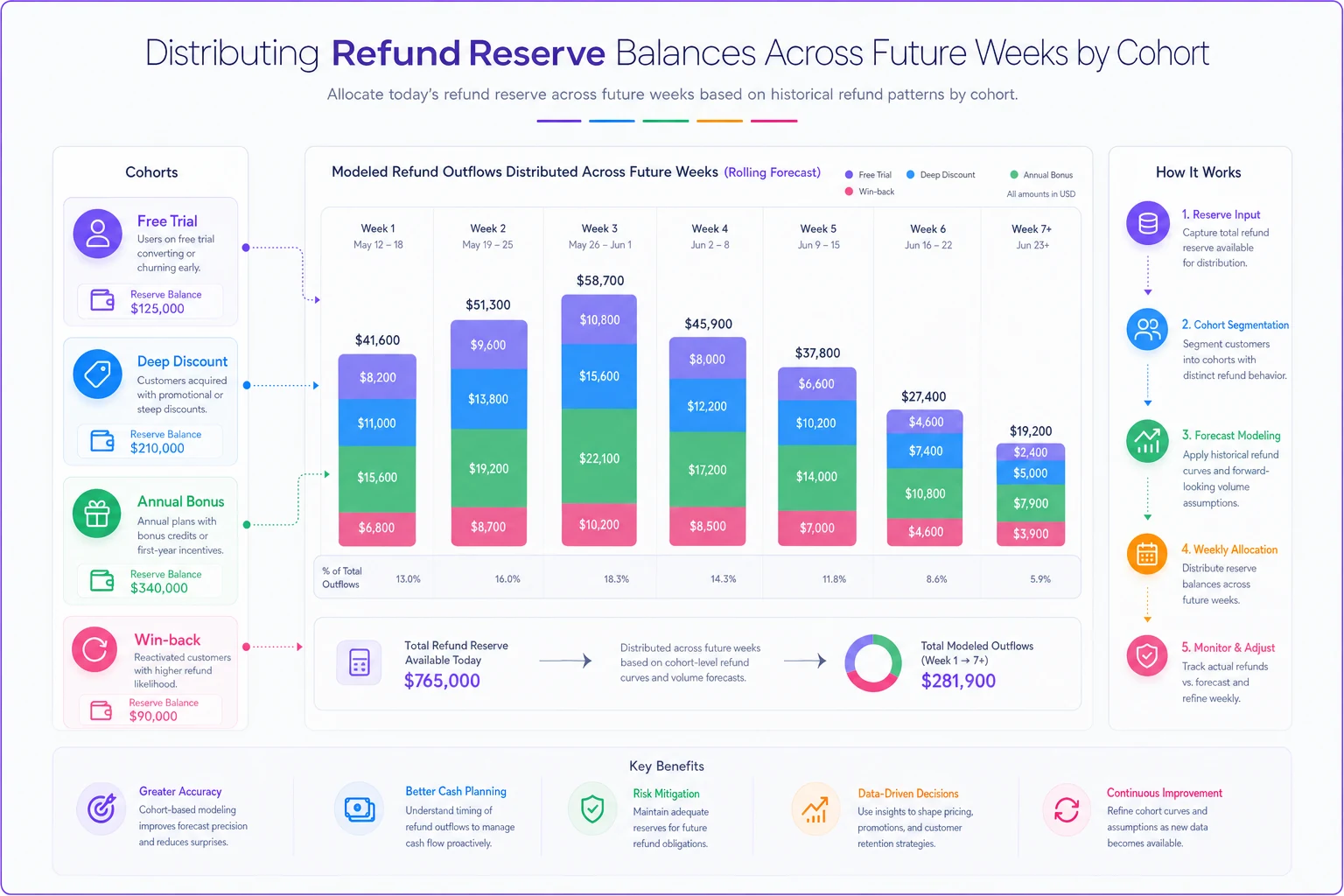
Here's the workflow in plain terms:
-
For every active promo cohort, take the reserve balance and distribute it across future weeks according to the refund-timing curve you built from cohort data — not evenly.
-
A free-trial cohort from last week pushes most of its modeled refund outflow into the next 2–4 weeks.
-
A deep-discount cohort pushes its outflow to the week of the first full-price renewal.
-
An annual-bonus cohort spreads a thin reserve across the year with a slightly heavier weight in the first 8–12 weeks.
-
Layer all cohorts together and you get a refund-outflow line that rises and falls with your promo calendar instead of sitting as a flat assumption.
[Rolling Forecast: Refund Outflow by Cohort and Week] Week: W1 W2 W3 W4 W5 W6 ... W12 Free Trial: $800 $900 $600 $300 $100 — — Deep Discount: — — — — $1.2k $2.1k — Annual Bonus: $200 $200 $200 $200 $200 $200 $200 ───────────────────────────────────────────────────────── Total outflow:$1k $1.1k $800 $500 $1.5k $2.3k $200
If you're already running a 13-week rolling cash forecast, this slots in as a dedicated refund-outflow row driven by cohort timing. The key discipline is that when marketing schedules a big promo push, the forecast should automatically carry the matching refund reserve into the right future weeks — not get discovered after the refunds start landing.
This also feeds cleaner unit economics. If you're building per-customer margin models, promo cohorts need their refund reserve baked into the margin calculation, otherwise a discount channel looks far more profitable than it actually is once refunds settle.
A real scenario
A mid-sized SaaS tool running around $140k MRR launched a "first quarter 75% off" acquisition push to juice Q3 signups. The campaign landed roughly 900 new subscriptions over six weeks. Finance was carrying a flat 2% refund reserve across all revenue.
The campaign cash looked fantastic on the way in. The problem showed up when the discounted quarter ended and the first full-price charges hit. Refunds and chargebacks on that cohort ran close to 11% of first full-price revenue — more than five times the blanket rate — and they clustered into roughly a two-week window.
Because the reserve had been flat and the forecast didn't model cohort timing, that refund wave hit as an unplanned P&L contra-revenue adjustment of around $28k–$32k in a single month, plus a matching cash drain nobody had slotted into the plan. It didn't threaten the business, but it blew the month's variance and triggered a round of "why is this off" meetings that ate a week of back-and-forth.
After the fact, they rebuilt the reserve by promo type, set the deep-discount rate at 12% front-loaded to the first renewal cycle, and added a cohort-driven refund row to the forecast. The next promo of similar size produced a comparable refund wave — but it was already sitting in the forecast and fully reserved. Same economics, no surprise, minor variance.
When this level of rigor makes sense — and when it doesn't
When it's worth it: You run promotions regularly, discounts are deep (50%+ off or free trials), or you sell annual prepay with refund terms. Any of those means your refund liability is both large and lumpy, and cohort-level reserves pay for themselves the first time they prevent a blown forecast.
When it's overkill: If promos are rare, discounts are shallow, and your refund rate barely moves between cohorts, a single well-chosen reserve rate is fine. Don't build four reserve sub-accounts to manage a liability that rounds to nothing.
Who should not bother yet: Very early-stage businesses with no meaningful promo volume. You don't have enough cohort history to estimate anything credible, and you'll just be reserving against noise. Get the promo tagging in place now so the data exists when you do need it — but don't over-engineer the accounting before the volume justifies it.
A short checklist to put this in place
The mechanics here aren't complicated, but they do require consistency. The teams that mess this up aren't missing the knowledge — they're skipping steps under deadline pressure, usually during a close. Running a checklist keeps the reserve process from getting sloppy when things are busy.
-
- [ ] Tag every subscription with its originating promo at the point of sale
-
- [ ] Classify active promos into trial / deep-discount / annual-bonus / win-back
-
- [ ] Pull refund-and-chargeback data per cohort across the full resolution window
-
- [ ] Set reserve rates at roughly the 75th percentile of recent cohorts
-
- [ ] Open a reserve sub-account per promo type
-
- [ ] Book the reserve as contra-revenue when promo revenue is recognized
-
- [ ] Apply actual refunds against the liability, never back through revenue
-
- [ ] True up the reserve at every close against updated open-cohort exposure
-
- [ ] Distribute reserve balances into the forecast by refund-timing curve, not flat
-
- [ ] Re-estimate rates quarterly as promo behavior drifts
The whole point is to make promo refunds boring. When every promo carries its own reserve rate, its own journal entries, and its own place in the forecast, the refund wave that used to blow up a month just shows up on schedule, already accounted for. The discount still cost what it cost — you just stop being surprised by the back half of the bill.
The whole point is to make promo refunds boring. When every promo carries its own reserve rate, its own journal entries, and its own place in the forecast, the refund wave that used to blow up a month just shows up on schedule, already accounted for. The discount still cost what it cost — you just stop being surprised by the back half of the bill.
Ready to take control of your finances?
Join over 2,000 businesses using Acctaly to simplify accounting, accelerate cash flow, and ensure tax readiness.