



Refunds in a services business are messier than most accountants want to admit. There's no inventory going back on a shelf. The "cost" was labor that already walked out the door. And the timing between when you book revenue and when a client asks for money back can stretch weeks or months — which means your reserve is either too fat, too thin, or built on a gut number someone picked a few years ago and never revisited.
The core problem isn't whether to hold a refund reserve. Most teams know they should. It's that the reserve doesn't move with reality. Revenue keeps getting recognized on one schedule, refunds happen on a completely different rhythm, and nobody trues the two up until the auditor asks why the liability account has been flat for three quarters while refund volume doubled.
This piece is about building refund accounting logic that's trigger-based — reserves that respond to actual events and cohort behavior — plus the timing rules and journal entries to keep your revenue and liability schedules aligned with what you're actually forecasting.
Why service refunds break standard reserve logic
Retail reserves are conceptually straightforward. You sell 1,000 units, historically 6% come back, you reserve 6%. The return either happens or it doesn't, usually inside a 30-day window.
Services don't cooperate. A refund on a services engagement can be triggered by:
-
A client canceling a retainer mid-month
-
A milestone that gets rejected after delivery
-
A dissatisfaction credit issued weeks after the work
-
A dispute or chargeback on a card payment
-
A contractual SLA miss that entitles the client to a partial refund
Each of these has a different probability, a different timing profile, and a different dollar exposure. Lumping them into one flat percentage is where most reserves go wrong. A single blended refund rate tends to hide two or three very different refund behaviors that are moving in opposite directions.
A common example: an agency books a flat 4% refund reserve against all revenue. Their retainer refunds are actually running near 1%, but one-off project refunds are closer to 9% because scope disputes are routine. The blended 4% looks fine on the surface, but when project revenue grows as a share of the mix, the reserve quietly becomes under-funded — and nobody notices until a bad quarter.
Trigger-based reserve rules instead of flat percentages
The fix is to stop reserving against "revenue" as one number and start reserving against events that predict refunds. A trigger-based rule ties a reserve entry to a specific condition in your billing or delivery data.
Stop letting accounting slow your business down.
Acctaly automates your financial operations so you can focus on growth and compliance.
- Automated bookkeeping
- Real-time financial reporting
- Integrated tax management
No credit card required
Here's the difference in practice:
| Approach | How the reserve is set | What goes wrong |
|---|---|---|
| Flat percentage | X% of all recognized revenue | Blind to mix shifts, over/under-reserves by segment |
| Segment percentage | Different % per revenue type | Better, but static and slow to react |
| Trigger-based | Reserve adjusts when defined events fire | Responsive, but needs clean event data |
A trigger-based rule looks like a set of if/then conditions:
-
When a new one-off project is booked → reserve at that segment's cohort refund rate immediately, not at month-end
-
When a client passes 60 days without engagement on a retainer → increase reserve on their remaining balance (churn-adjacent refunds spike here)
-
When a milestone is delivered but not approved within the SLA window → hold a partial reserve against the disputed portion
-
When a chargeback is filed → move the full disputed amount from reserve to a separate dispute-liability line
The point is that the reserve reacts to leading indicators, not to a calendar. A retainer that's gone quiet is a refund risk long before the client actually asks for money back. If the reserve only updates once a month against total revenue, you're always reserving for last month's business while this month's risk builds up invisibly.
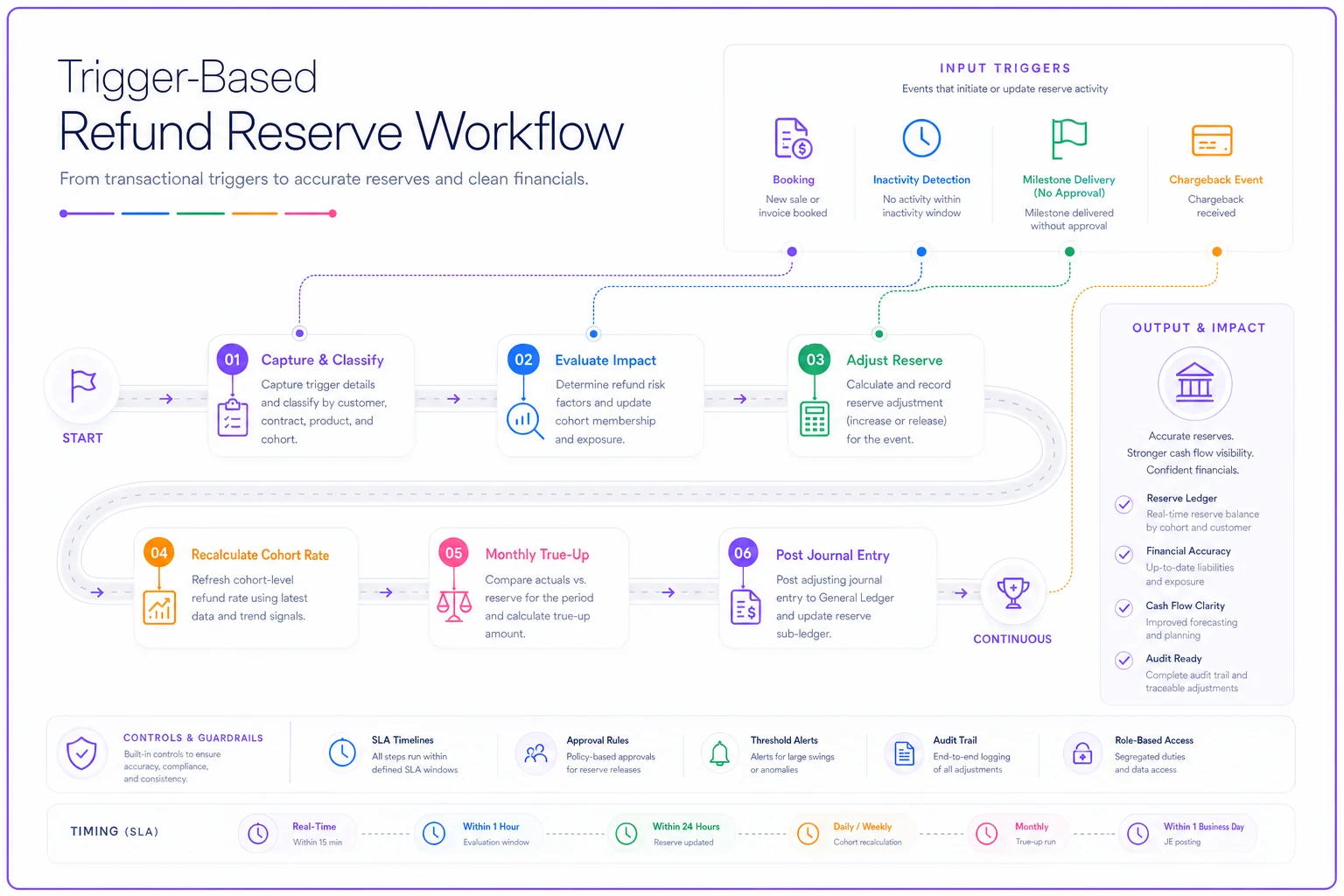
This diagram lays out the event-to-entry flow and where timing SLAs should enforce recording deadlines.
Timing SLAs: when each entry has to hit the books
Reserves drift out of alignment mostly because of timing, not math. Revenue gets recognized on the day of delivery, but the refund reserve adjustment happens whenever someone remembers to run the analysis. That gap is where the liability schedule goes stale.
Setting timing SLAs for refund accounting forces the two schedules to stay in step. A workable set looks like this:
-
At booking — initial reserve entry posts the same day the contract or invoice is created, using the segment's current cohort rate.
-
At delivery/recognition — reserve is re-checked against the recognized amount; if recognition differs from booking (partial delivery), reserve is scaled to match.
-
Within 5 business days of a refund request — the actual refund is recorded and the reserve is drawn down.
-
Monthly — cohort rates are recalculated and the aggregate reserve is trued up to the new blended expectation.
-
Quarterly — a full look-back compares reserved vs. actual refunds by cohort to catch systematic over/under-reserving.
The 5-day SLA on actual refunds matters more than people expect. When refunds sit in someone's inbox for three weeks before being recorded, the reserve looks artificially healthy and your cash forecast is wrong by exactly the amount of those pending refunds. A tight recording window keeps the liability line honest.
Record refund transactions into the GL within the 5-business-day window to prevent overstated reserve balances and bad cash forecasting.
A tight recording window keeps the liability line honest.
Sample journal entries
Here's how the entries play out through a realistic services scenario. Assume an agency that recognizes revenue on delivery and holds a refund reserve as a contra-revenue liability.
1. Booking a project and establishing the initial reserve
Project booked for $40,000, project-segment cohort refund rate is 8%. Reserve = $3,200. Dr Accounts Receivable 40,000 Cr Service Revenue 40,000 Dr Refund Expense (contra-rev) 3,200 Cr Refund Reserve (liability) 3,200
2. A refund actually happens
Client disputes a milestone and gets a $6,000 partial refund. Dr Refund Reserve (liability) 3,200 Dr Refund Expense (contra-rev) 2,800 Cr Cash / AR 6,000
The reserve only covered $3,200 of the $6,000. The remaining $2,800 hits expense directly because this refund exceeded what was reserved for the project. If that keeps happening, the cohort rate for this segment is too low — which is exactly what the quarterly look-back is designed to catch.
3. Monthly true-up when the cohort rate moves
Say the recalculated project-segment refund rate rose from 8% to 11%, and you have $500,000 of open project revenue still exposed. The reserve needs to reflect 11% ($55,000) instead of 8% ($40,000). Dr Refund Expense (contra-rev) 15,000 Cr Refund Reserve (liability) 15,000
4. Releasing over-reserved amounts
If a cohort ages past its refund window with fewer refunds than expected, release the excess back: Dr Refund Reserve (liability) 4,000 Cr Refund Expense (contra-rev) 4,000
That release entry is the one most teams skip. They're comfortable adding to a reserve but nervous about releasing it, so the liability accumulates and revenue stays understated. A clean cohort look-back gives you the defensible basis to release — which auditors will actually ask for.
Tying reserves to cohort and unit-economics data
A flat reserve tells you nothing about which clients are driving refunds. Cohort-based reserving does, and it connects your refund logic to the unit economics you're already tracking.
The idea is to group revenue by cohort — signup month, service line, deal size band, acquisition channel — and calculate refund behavior per cohort rather than in aggregate. A few patterns that consistently show up:
-
Larger deals refund at higher rates but slower (disputes take time to surface).
-
Certain acquisition channels bring in clients who churn-and-refund faster.
-
New service lines have volatile refund rates for the first two or three cohorts until delivery stabilizes.
Once refunds are cohort-tagged, they feed directly into your margin math. A client segment that looks profitable on gross revenue can be marginal after refunds — you'll only see that if refunds are allocated back to the cohort that generated them. That's the same discipline behind building reliable per-customer unit economics — refunds are just another allocation that has to land on the right customer to mean anything.
It also connects to revenue accuracy upstream. If your billing events aren't clean, your cohort refund rates are built on bad denominators. Getting row-level billing reconciliation right first is what makes the cohort refund analysis trustworthy — otherwise you're calculating a refund rate against revenue you never actually recognized correctly.
Aligning the reserve with your forecast
The reserve and the forecast should never disagree quietly. If FP&A is projecting a mix shift toward more project work next quarter, the refund reserve assumption needs to shift with it — because project work carries a higher refund rate. When those two things live in separate spreadsheets, you end up with a forecast assuming 4% refunds and a reserve built on last quarter's 6%, and neither number is right.
A simple alignment routine:
-
Pull the forecasted revenue mix by segment for the next two quarters.
-
Apply each segment's current cohort refund rate to its forecasted revenue.
-
Sum to get the forecasted reserve requirement.
-
Compare against the reserve trajectory your current book will produce.
-
Adjust the monthly reserve accrual so you're not scrambling to catch up.
This turns the reserve from a backward-looking plug into a forward-looking line that moves with expected business. When the mix actually shifts, the reserve is already leaning in the right direction instead of trailing by a quarter.
A quick real scenario
A mid-sized consulting firm running roughly $4M–$5M in annual revenue held a flat 5% refund reserve across everything. Their retainer book barely refunded, but fixed-scope implementation projects were refunding closer to 10–12% because scope disputes were routine.
When they split refunds by cohort, the picture changed. Retainers were near 1.5%. Implementations were running around 11%. The blended 5% had been over-reserving retainer revenue and under-reserving implementations — and since implementation revenue was growing, the gap widened every quarter.
After moving to segment-based cohort rates with trigger-based entries at booking, two things happened. The reserve on retainer revenue dropped, releasing a chunk of previously trapped revenue. And the implementation reserve grew to match reality, which meant the ugly refund quarter that used to blow a hole in results was already accounted for. Their variance between reserved and actual refunds tightened from double-digit swings to low single digits within a couple of quarters.
When trigger-based reserving isn't worth it
This approach earns its keep when you have real refund volume and genuinely different behavior across segments. It's overkill in a few situations:
-
Very low refund volume. If you refund a handful of clients a year, a simple percentage and honest judgment beats an event-driven system.
-
One homogeneous service. If everything you sell behaves the same way, segmentation adds complexity without much insight.
-
Dirty event data. If your booking and delivery events aren't reliably captured, trigger-based rules will fire on garbage. Fix the data plumbing before you build logic on top of it.
For most growing services businesses with mixed revenue types, though, the flat-percentage reserve is quietly making your revenue and liability lines wrong in opposite directions. That's not a rounding error problem — it's a structural one that compounds as the business grows.
Where tooling helps
The math here isn't hard — the discipline is. Trigger-based reserves need events captured consistently, cohort rates recalculated on schedule, and journal entries posted inside their SLA windows. Doing that by hand in spreadsheets is where it falls apart, because the person who ran the analysis last quarter is on vacation and the true-up slips two weeks.
Operational platforms that track billing and delivery events can post reserve entries when triggers fire, keep cohort refund rates current, and flag when reserved-versus-actual drifts past a threshold. That's less about replacing judgment and more about making sure entries actually hit the books on time and against the right cohort — which is the part that gets skipped when a close deadline hits.
The underlying logic still needs human input: setting the trigger conditions, reviewing cohort rate changes, and deciding when to release over-reserved amounts. What the tooling removes is the dependency on someone remembering to run the process on the right day.
Closing thought
Refund reserves fail quietly. Nothing breaks, no alarm goes off — the number just slowly stops matching reality while revenue and liability drift apart.
The fix isn't a fancier percentage. It's tying reserves to the events that actually predict refunds, recording them on a real schedule, and letting cohort behavior drive the rate instead of a stale assumption from a year ago. Do that, and your revenue schedule, your liability line, and your forecast finally tell the same story.
Refund reserves fail quietly. Nothing breaks, no alarm goes off — the number just slowly stops matching reality while revenue and liability drift apart. The fix isn't a fancier percentage. It's tying reserves to the events that actually predict refunds, recording them on a real schedule, and letting cohort behavior drive the rate instead of a stale assumption from a year ago. Do that, and your revenue schedule, your liability line, and your forecast finally tell the same story.
Ready to take control of your finances?
Join over 2,000 businesses using Acctaly to simplify accounting, accelerate cash flow, and ensure tax readiness.