


Negotiating a good vendor deal feels like a win. You get a 4% rebate on annual spend, a 2% early-pay discount, and an SLA that promises credits when the vendor misses delivery windows. Everyone shakes hands. The savings go into the budget.
Then you check the GL at year-end and the numbers don't match. The rebate never got booked. The early-pay discounts got eaten by late approvals. The SLA credits? Nobody tracked the misses, so nobody claimed them. The deal was real. The savings were real. But they never landed — because there was no system connecting the negotiation to the books.
That gap is what procure to GL governance is actually about. Not procurement policies for their own sake, and not accounting hygiene as a separate silo. It's the connective tissue that makes sure a dollar you negotiated in a contract shows up as a dollar in your financial statements. Most SMBs have strong intentions at the front (deal-making) and decent discipline at the back (bookkeeping), but the middle — where contract terms turn into recognized savings — is where everything leaks.
Where the leak actually starts
The failure almost never happens at the negotiation table. It happens in the handoffs afterward.
A typical example: procurement (which at a 15-person company is often the owner or an ops lead) closes a contract with a distributor. The contract says spend over $250k in a calendar year earns a 3% volume rebate, paid quarterly. That term lives in a PDF in someone's email. Accounting never sees the PDF. AP just pays invoices as they come in. Nobody is tracking cumulative spend against the $250k threshold, and nobody sends the quarterly rebate claim. By Q3 you've hit the threshold, but the claim window closed, and you've quietly forfeited roughly $7,500.
What shows up across a lot of businesses is that contracts get treated as legal artifacts instead of operational instructions. Once signed, they go into a folder and get ignored until renewal. But a contract with rebate tiers, SLA credits, and payment discounts isn't a legal artifact — it's a set of recurring financial events that someone has to trigger, measure, and record.
The other structural problem: the people who know the deal terms (whoever negotiated) are usually not the people who book the entries (whoever closes the month). Those two groups often don't talk in any structured way. So the knowledge of what savings should exist lives in one head, and the ability to record those savings lives in another system entirely.
The four pieces that have to connect
Governance here means stitching together four things that most companies run independently:
Stop letting accounting slow your business down.
Acctaly automates your financial operations so you can focus on growth and compliance.
- Automated bookkeeping
- Real-time financial reporting
- Integrated tax management
No credit card required
-
Vendor selection — who you choose and why
-
Contract clauses — the specific rebate, SLA, and discount terms
-
Scorecards — whether the vendor actually delivered what the contract promised
-
Monthly reconciliation — the cadence that pulls it all back into the GL
When these run as separate activities, savings evaporate in the seams. When they're linked, a rebate tier in a contract automatically becomes a tracked metric on a scorecard, which becomes a reconciliation line item, which becomes a journal entry.
Vendor selection: decisions that create downstream obligations
Vendor selection matters to the GL more than most people realize, because the terms you win at selection are the terms you'll be reconciling for years. A vendor chosen purely on unit price often costs more once you factor in missed SLAs, no rebate structure, and rigid payment terms.
The mistake is optimizing for the headline number. A supplier quoting $1.02/unit with no rebate and net-15 terms is frequently worse than one at $1.06/unit with a 5% volume rebate, a 2% early-pay discount, and enforceable delivery SLAs — if you actually capture those secondary terms. But the second vendor only wins if you have the machinery to track and claim what they promised. Choosing the richer contract and then failing to reconcile it is the worst of both worlds: you pay the higher unit price and never collect the offsetting savings.
Selection should record, in a structured place, exactly which financial mechanisms each contract contains. Not just "we picked Vendor B." Instead: Vendor B, 5% rebate at $200k annual spend, 2%/net-10 early-pay, 98% on-time SLA with 3% credit per missed window. That structured summary is the seed for everything downstream.
The contract-clause checklist
Before a contract gets signed, someone needs to extract the terms that will generate GL activity. Not the legal review — the financial mechanics review:
-
Rebate structure — Flat or tiered? What's the threshold? Measured on gross spend or net of returns? Calendar year or rolling 12 months?
-
Rebate payment mechanism — Paid as a check, a credit memo, or applied to future invoices? What's the claim window and who initiates it?
-
Early-payment discount — Percentage and terms (2%/net-10, etc.). Is it automatically applied or does it require you to pay early and flag it?
-
SLA definitions — What exactly counts as a miss? On-time delivery percentage, defect rate, response time? These need to be measurable, not vague.
-
SLA credit mechanics — How is a credit calculated, and how do you claim it? Automatic or claim-based? (Almost always claim-based, which means almost always forgotten.)
-
Price protection / caps — Is there a ceiling on annual price increases? A most-favored-customer clause?
-
True-up timing — When are rebates and credits reconciled — quarterly, annually? This sets your reconciliation cadence.
-
Termination and clawback — Do rebates get clawed back if you fall below threshold or exit early?
The pattern worth noticing: almost every valuable clause is claim-based. Rebates you have to request. SLA credits you have to document and demand. Early-pay discounts you have to actively pursue by paying on time. Contracts are written so that money flows to the vendor automatically and flows back to you only if you push. Governance is the discipline of pushing, consistently, without relying on memory.
Vendor scorecards: proof that the deal is being honored
A scorecard turns contract promises into measured reality. Without one, you have no basis to claim SLA credits and no way to know if the rebate you're accruing is even correct.
| Metric | Contract Target | This Period | YTD | Status | GL Implication |
|---|---|---|---|---|---|
| On-time delivery | ≥ 98% | 94% | 96% | Miss | Claim 3% credit on 6% of orders |
| Order accuracy | ≥ 99% | 99.2% | 99.1% | Met | None |
| Cumulative spend | $200k for rebate | $58k | $172k | On track | Accrue 5% rebate |
| Early-pay capture | Pay within 10 days | 8 of 11 invoices | 82% | Partial | 3 discounts missed (~$900) |
| Price adherence | ≤ 3% annual increase | Held | Held | Met | None |
What makes a scorecard useful isn't the metrics — it's the last column. Every row ties to a financial consequence. The on-time miss isn't just a service complaint; it's a claimable credit. The early-pay row isn't just a KPI; it's roughly $900 of discount you left on the table this period — the same kind of avoidable leak that shows up in loose card policies and weak reconciliation hygiene.
Run the scorecard on the same cadence as the contract's true-up timing. If rebates settle quarterly, review quarterly at minimum, but track the underlying spend monthly so nothing surprises you at the threshold.
The monthly reconciliation cadence
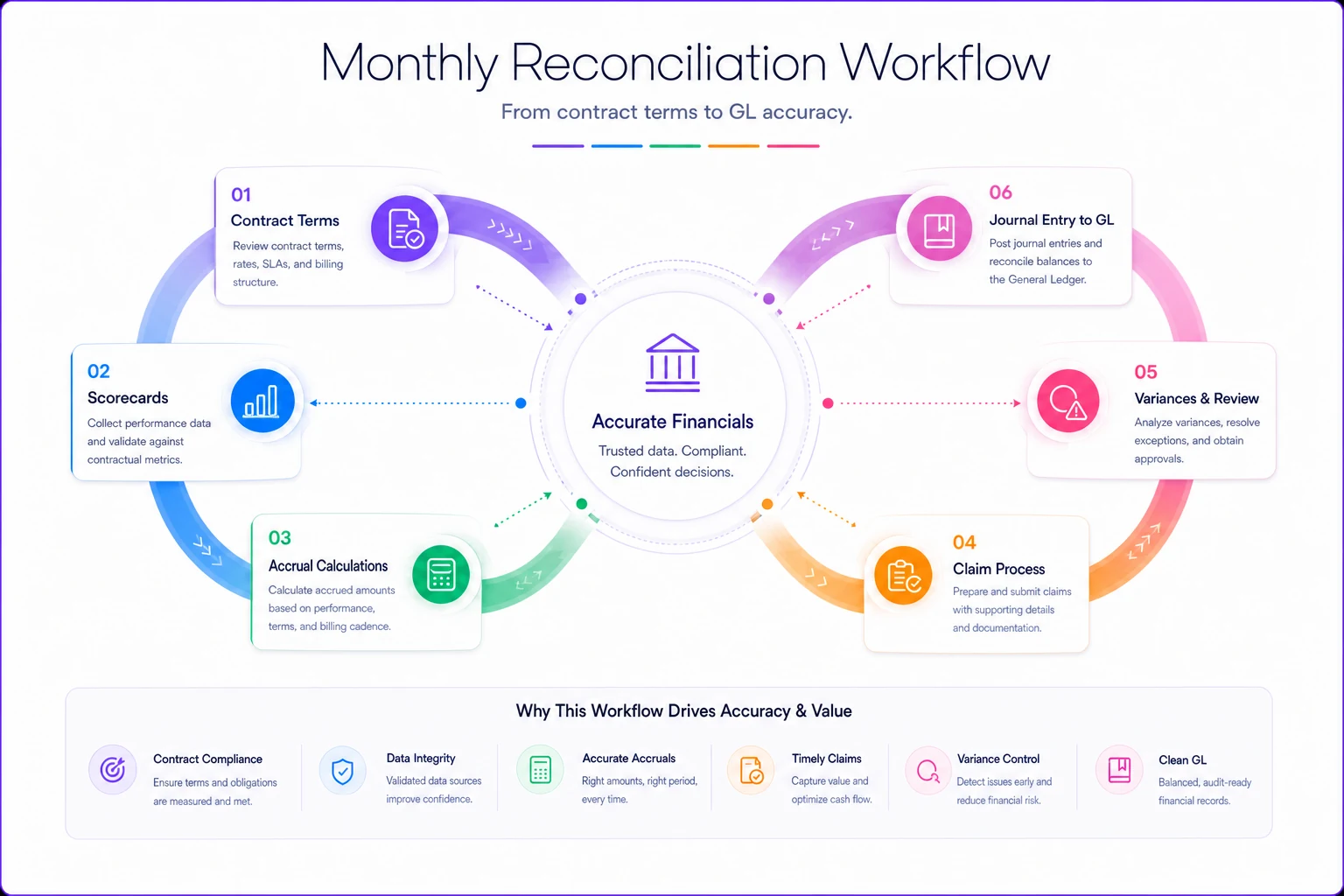
This is where governance either works or falls apart. The reconciliation cadence is the recurring check between "what the contracts promised" and "what the GL recorded."
-
Pull the spend by vendor. For each vendor with rebate or SLA terms, pull month-to-date and YTD spend from AP.
-
Update cumulative tiers. Compare YTD spend against rebate thresholds. Flag any vendor within ~15% of a threshold so nobody misses a tier crossing.
-
Calculate the earned rebate. Apply the contract rate to qualifying spend. This becomes your rebate receivable accrual.
-
Reconcile SLA performance. Cross-check the scorecard misses against contract credit terms. Quantify claimable credits.
-
Reconcile early-pay capture. Check which invoices were paid within discount terms and which weren't. Book captured discounts; log missed ones as a leakage metric.
-
Compare accruals to actuals. For rebates or credits that actually paid out, match the cash/credit memo against your prior accrual and clear it.
-
Post the entries. Book new accruals, reverse settled ones, and record the variance.
Here's a simple visual of that monthly reconciliation workflow.
The single most valuable artifact from this process is a reconciliation pivot — a table that shows, per vendor: negotiated savings expected, savings accrued to date, savings actually received, and the gap. That gap column is where forfeited money hides. When you see a vendor with $12k expected, $12k accrued, and $3k received with two quarters gone, you know a claim hasn't been filed.
Flag any vendor within ~15% of a threshold so nobody misses a tier crossing.
This cadence pairs naturally with how you segment and route suppliers in the first place. If you've already built supplier tiers and approval rules — the kind covered in the AP working-capital playbook — you can prioritize reconciliation effort on the vendors where the savings are actually material, instead of spreading attention evenly across every supplier.
Making the savings hit the GL: example journal entries
Talking about savings is meaningless until they appear as entries. This is the part most articles skip, and it's the whole point. Here's how negotiated terms actually get recognized.
Accruing a volume rebate you've earned but not yet received. You've spent $172k YTD toward a $200k / 5% rebate. On the qualifying spend, you've earned rebate. Say you're accruing on the portion that clearly qualifies — roughly $8,600 for the period being booked: Dr Vendor Rebate Receivable 8,600 Cr Cost of Goods Sold 8,600 The rebate reduces COGS because it's effectively a reduction in the cost of goods you purchased. Booking it to COGS (not "other income") keeps your margin reporting honest.
Receiving the rebate as a credit memo the next quarter: Dr Accounts Payable 8,600 Cr Vendor Rebate Receivable 8,600 The credit memo offsets what you owe the vendor and clears the receivable you accrued. If the received amount differs from the accrual, the variance goes back to COGS.
Booking an SLA credit you're claiming for missed delivery windows. The vendor missed on-time targets; the contract entitles you to a 3% credit on affected orders, totaling about $1,400: Dr Vendor SLA Credit Receivable 1,400 Cr Cost of Goods Sold 1,400
Capturing an early-payment discount at the time you pay. Invoice of $10,000, 2% discount for paying within 10 days: Dr Accounts Payable 10,000 Cr Cash 9,800 Cr Cost of Goods Sold 200 That $200 is a real, recognized saving — but only because you paid on time and recorded the discount rather than paying the full $10,000 out of habit.
The through-line: every negotiated term maps to a specific entry, and most of them reduce COGS or expense rather than showing up as miscellaneous income. That distinction matters because it keeps your gross margin accurate and makes the savings visible where operators actually look.
A real scenario
A regional wholesale distributor, around 30 employees, sourced from four main suppliers with roughly $2.1M in annual purchasing. All four contracts had rebate tiers; two had SLA credit terms. Their process was informal — contracts in a shared drive, AP paying invoices, no scorecards.
At year-end their controller did a manual sweep and found the pattern you'd expect. One rebate tier had been crossed but never claimed — about $14k forfeited because the claim window lapsed. Early-pay discounts were captured on maybe 60% of eligible invoices, leaking somewhere in the $9k–$11k range over the year. SLA misses were never documented, so roughly $6k in credits were never pursued. Somewhere north of $29k in negotiated savings existed on paper and never touched the GL.
They put in a monthly cadence built around a per-vendor reconciliation pivot and a simple scorecard for the two SLA vendors. Nothing fancy — a recurring monthly review, a spreadsheet tracking cumulative spend against thresholds, and a rule that no rebate or credit got closed out until the cash or credit memo matched the accrual. Within two quarters, early-pay capture climbed into the high 80s, both SLA vendors were getting claims filed on misses, and the tier-crossing that had been missed the prior year was flagged in month nine and claimed on time. Not a transformation — just money that was always theirs finally landing where it belonged.
When this level of governance makes sense
When it's worth building:
-
You have vendors with rebate tiers, SLA credits, or payment discounts worth more than a few thousand dollars a year
-
Your purchasing is concentrated in a handful of suppliers where terms are material
-
You've crossed a rebate threshold before without claiming it — that's the clearest sign the machinery is missing
When it's overkill:
-
You buy from spot vendors with no negotiated terms — there's nothing to reconcile
-
Your total addressable savings across all contracts is small enough that the tracking effort costs more than the recovery. Be honest about this. Governance for its own sake is waste.
Who should not start here: If your monthly close is still unreliable or your AP isn't reconciled, fix that foundation first. Procure-to-GL governance assumes you can already trust your spend data. Layering rebate tracking on top of shaky books just gives you confident-looking numbers built on sand. The same discipline that catches bank-fee leakage — mapping expected charges against what actually hit the account — applies here too, just pointed at vendor terms instead of bank fees.
Where tooling helps (and where it doesn't)
You don't need a dedicated procurement platform to do this well. What you need is a place where contract terms, cumulative spend, scorecards, and reconciliation pivots live together instead of scattered across four disconnected spots. The failure mode is fragmentation — terms in a PDF, spend in the accounting system, SLA performance in someone's memory, entries in the GL, and no thread connecting them.
Operational platforms that pull vendor spend automatically, track cumulative totals against thresholds, and flag when you're approaching a rebate tier or missing an SLA target remove the piece that always breaks: relying on a person to remember to check. AI-assisted tracking can watch spend accumulate and surface a claim window before it closes, turning the reconciliation cadence into a review of flagged items rather than a from-scratch manual sweep every month. But the tooling only helps if the underlying governance — the checklist, the scorecard structure, the cadence, the entries — is defined first. Software enforces a system. It can't invent one.
The real point
Negotiated savings aren't savings until they're recognized in the general ledger. Everything between the handshake and the journal entry — the contract terms, the scorecards, the monthly reconciliation — exists to close that gap. Most SMBs lose money here not because they negotiate badly, but because nobody owns the middle. The deal-makers assume the savings are automatic, and the bookkeepers never see the terms that would tell them what to claim.
Build the loop once — extract the financial clauses at signing, track them on a scorecard, reconcile monthly against a per-vendor pivot, and post the entries that pull the savings into COGS — and the discount you negotiated in March is still there in December, sitting in the books where you can actually spend it.
Ready to take control of your finances?
Join over 2,000 businesses using Acctaly to simplify accounting, accelerate cash flow, and ensure tax readiness.