


Most finance rollouts don't fail because the new process is bad. They fail because somebody flipped a switch for the whole team on a Monday, nobody was ready, the close slipped by four days, and by Thursday everyone had quietly gone back to the old spreadsheet. The "new system" became a graveyard tab that nobody opens.
Change in finance is different from change in marketing or sales. If a new campaign tool is confusing, you lose a week of reach. If a new approval workflow is confusing, you misstate your books, miss a payment run, or blow a bank covenant. The stakes make people cling to what they know, which is exactly why finance change management for SMBs needs its own playbook — tight, time-boxed, and reversible.
This is a 3-week pilot template with the pieces most teams skip: concrete rollback triggers, adoption KPIs that actually mean something, and the communication scripts that keep people from panicking. No 90-day transformation program. Three weeks, one scoped change, measurable results.
Why most finance change fails in week one
Before the template, it's worth being honest about how these rollouts actually die, because the pilot design is built to prevent each one.
The first killer is scope creep disguised as efficiency. Someone decides that since you're already changing the AP approval flow, you might as well also switch the GL coding rules and the vendor onboarding form. Now three things are moving at once, and when something breaks you can't tell which change caused it.
The second is no defined "done." The team is told to "start using the new process" with no measurable finish line. So there's no moment where anyone can say the pilot succeeded or failed. It just drifts.
The third — and this is the quiet one — is no exit plan. Nobody decided in advance what would make them stop. So when the close starts slipping, there's an awkward meeting where people argue about whether it's bad enough to revert, the controller doesn't want to admit the rollout was premature, and the team limps along in a half-broken state for a month.
A good pilot kills all three by being narrow, time-boxed, and reversible by design.
The one-change rule
Pick exactly one process to change in the pilot. Not a system, not a department — one workflow with a clear before and after.
Stop letting accounting slow your business down.
Acctaly automates your financial operations so you can focus on growth and compliance.
- Automated bookkeeping
- Real-time financial reporting
- Integrated tax management
No credit card required
-
Moving AP approvals from email to a structured routing rule
-
Switching month-end reconciliation from manual match to a tolerance-based rule set
-
Changing expense categorization at point of entry instead of at close
-
Replacing a manual payout reconciliation with an automated match-and-exception queue
What makes these good is that each has a measurable baseline you already track (approval turnaround, unreconciled items, reclass entries at close) and a limited blast radius — if it breaks, it breaks in one place you can watch.
If the change you want to pilot depends on a data migration or a fragile integration between systems, slow down. Those are different projects with different risks. The reconciliation and integration work needs to be solid before you pilot a process change on top of it — otherwise you're testing two unstable things at once. Teams dealing with brittle connections between their ledger and operational systems usually need to fix the underlying integration architecture and data contracts first.
The 3-week pilot template
Here's the structure. Each week has a job, and you don't move forward until the previous week's gate is met.
A simple visual of the pilot workflow can help align the team.
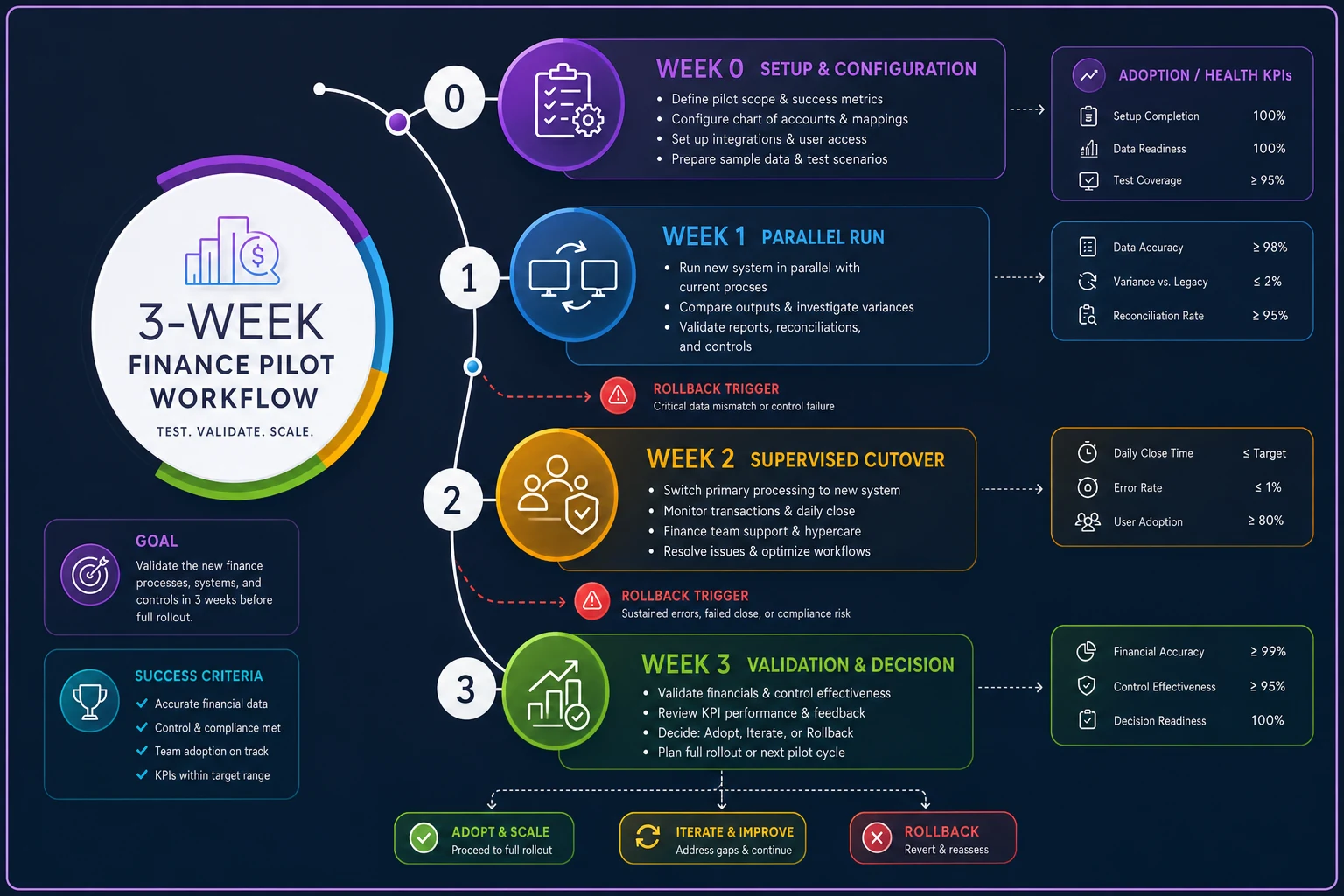
Week 0: Setup (the few days before you start)
This isn't officially "week one" but skipping it is why pilots feel chaotic.
-
Define the single change in one sentence. If you can't, the scope is too big.
-
Record the baseline. Pull the last 4–8 weeks of the metric you're trying to improve. You need real numbers, not a vibe.
-
Pick the pilot group. For a 1–10 person finance team, that might be one or two people plus the owner. For a 10–50 person team, pick one function (say, AP) and leave the rest on the old process.
-
Write the rollback triggers (covered below) before anyone touches anything.
-
Set the adoption KPIs and decide how you'll measure them. If you can't measure it without manual effort every day, pick a different KPI.
Don't skip week 0; skipping it is why pilots feel chaotic.
Week 1: Parallel run
The new process and the old process run at the same time. This is the part people hate because it's double work, but it's non-negotiable in finance. You cannot cut over blind.
During week 1:
-
Everyone does the real work in the old system AND logs it through the new process.
-
You compare the two outputs daily. Do the approvals route the same way? Do the reconciliation matches agree?
-
Every discrepancy gets written down. Not fixed yet — written down.
The insight most teams miss: week 1 isn't about speed or adoption. It's purely about correctness. If the new process produces different numbers than the old one, you need to know why before you trust it. A typical week-1 finding is "the new approval rule doesn't handle credit memos," which is exactly the kind of thing that would've blown up a full rollout.
Week 2: Supervised cutover
Now the new process becomes primary, but the old one stays available as a fallback and you're watching closely.
-
The pilot group uses the new process for real.
-
A designated owner reviews output daily — not weekly.
-
Discrepancies from week 1 should be resolved or have documented workarounds.
-
You start tracking adoption KPIs seriously now, because this is real usage.
Week 2 is where you learn whether people will actually use the thing when it's not being babysat every minute. Watch for the tell: people doing the new process for the review meeting but secretly keeping their old spreadsheet "just in case." That's not adoption. That's compliance theater, and it means something about the new process doesn't feel trustworthy yet.
Week 3: Validation and decision
The final week proves the change holds under normal conditions, including at least one real deadline (a payment run, a weekly close, a reporting cutoff).
-
Full usage with minimal supervision.
-
Measure the adoption KPIs against targets.
-
Run the pilot through a real month-end or payment event if the timing allows.
-
Make the go / no-go / extend decision with actual data.
The decision at the end of week 3 has three honest options: adopt (hit the targets, roll wider), extend (close but one fixable issue remains — add one more week, max), or revert (hit a rollback trigger, go back cleanly). The point of naming all three up front is that reverting stops being a failure and becomes a valid, pre-agreed outcome.
Rollback triggers: decide when to quit before you start
This is the section most change plans skip and the one that saves you. A rollback trigger is a pre-agreed condition that forces a return to the old process — no debate, no ego, no "let's give it one more week."
| Trigger category | Example threshold | Action |
|---|---|---|
| Close delay | Close tasks slip more than 2 business days vs. baseline | Revert immediately, close on old process |
| Error rate | Reconciliation mismatches exceed 2x the baseline rate | Pause, investigate before continuing |
| Payment risk | Any missed or duplicate payment caused by the new flow | Immediate rollback, full stop |
| Adoption collapse | Fewer than half the pilot group using it by end of week 2 | Pause, diagnose why before extending |
| Data integrity | Any unexplained variance in GL totals between old and new | Immediate rollback, root-cause before retry |
Notice the asymmetry. Adoption problems get a pause and diagnose. Anything touching payments or GL integrity gets an immediate full stop. In finance, a convenience problem and a correctness problem are not the same emergency.
One more thing: a rollback is not a verdict on the whole idea. It's a verdict on this attempt, this week, under these conditions. Plenty of changes that got rolled back on attempt one succeeded on attempt two after one fix. Treating rollback as information rather than defeat is what keeps teams willing to try again.
Adoption KPIs that actually tell you something
"Is everyone using it?" is not a metric. Here's what to actually track, split between adoption (are people using it) and health (is it working).
Adoption KPIs:
-
Active usage rate — % of the pilot group completing the real task through the new process, not the old one. Target: 90%+ by end of week 3.
-
Shadow-process rate — how often people also maintain the old spreadsheet or email thread alongside the new flow. This should drop to near zero. If it doesn't, adoption is fake.
-
Time-to-complete — how long the task takes now vs. baseline. Early on it'll be slower; by week 3 it should match or beat the old way.
Health KPIs (tied to your SLA dashboards):
-
Discrepancy rate — mismatches between new and old output in week 1, then error rate after cutover.
-
Close impact — days added or removed from your close timeline.
-
Exception volume — how many items the new process couldn't handle and kicked to manual review.
The most useful one is the shadow-process rate, because it's the honest signal. People will tell you in a meeting that the new process is great. The fact that they still have the old spreadsheet open tells you the truth. When that spreadsheet finally gets closed and stays closed, you've actually won.
If your finance team already runs service-level dashboards for close timing and reporting cadence, wire these pilot KPIs into the same board. A rollout that improves adoption but quietly degrades your SLA numbers isn't a success — it's a trade you didn't agree to.
Communication templates
Bad communication turns a good pilot into a rumor mill. People hear "we're changing the AP process" and assume it means layoffs, blame, or a system they'll hate. Three short messages prevent most of that.
1. The kickoff message (before week 0)
> We're running a 3-week pilot on [specific process] starting [date]. Goal: [one-sentence outcome, e.g., cut AP approval turnaround from 3 days to under 1]. Only [pilot group] is involved for now — everyone else continues as normal. We've set clear criteria for what success looks like, and if it doesn't work, we'll go back to the current process cleanly. No surprises.
The two phrases that matter: "everyone else continues as normal" (kills panic) and "we'll go back cleanly" (kills the fear that they're stuck with something broken).
2. The weekly check-in (end of each week)
> Week [X] update: [one metric that moved]. What's working: [specific]. What's not yet: [honest specific]. Next week: [what changes]. Questions or problems, send them to [person].
Keep it three lines. The honesty about what's not working is what builds trust — people stop believing rollout updates that are all good news.
3. The decision message (end of week 3)
> Pilot decision: [adopt / extend one week / revert]. Here's what the numbers showed: [2–3 KPIs]. [If adopting] Rollout to the rest of the team happens [when], here's what to expect. [If reverting] We're back on the old process effective now; here's what we learned and whether we'll retry.
A real scenario
A regional services company with a seven-person finance team wanted to move expense coding from "fix it at close" to "code it at entry." Their baseline: roughly 40–50 reclassification entries every month-end, eating about a day and a half of someone's close time.
They scoped it tight — just the expense coding change, nothing else. Week 1 parallel run surfaced the real problem fast: about a third of their expenses were from a handful of vendors that mapped to different accounts depending on context, and the entry-level coding couldn't handle that nuance. Under the old plan-and-pray approach, they'd have rolled it out and discovered this after misclassifying a month of expenses.
Instead, they used that week-1 finding to build a small set of vendor-specific coding rules before week 2's cutover. By the end of week 3, reclass entries at close dropped to under 10, and the close task that used to take a day and a half took a couple of hours. The shadow-process rate hit zero — people stopped keeping their own coding notes because the new way just worked.
The quiet win wasn't the time saved. It was that nobody felt forced into a broken system, because the design gave them an exit they never needed to use.
When a 3-week pilot makes sense — and when it doesn't
When it works well:
-
The change affects one workflow with a measurable baseline.
-
You can run old and new in parallel without doubling your entire workload.
-
There's a clear owner who can watch daily for three weeks.
When to extend the timeline: If the change spans a genuinely different process each week — like a tax cycle or a quarterly reporting event that only happens once in your window — a three-week pilot can't observe it. Stretch to catch at least one full cycle of whatever you're changing.
Who should NOT run this as a quick pilot: If your change depends on migrating or cleaning data first, the pilot isn't your real risk — the data is. Validating and cleaning before you switch is its own discipline, and rushing a process pilot on top of dirty data just hides the problem until close. Teams facing a system switch usually need to work through a prioritization matrix and test-sample reconciliation plan before any process pilot makes sense.
The pilot checklist
Before you start, you should be able to check every box:
-
The change is written in one sentence
-
Baseline numbers are recorded (last 4–8 weeks)
-
Pilot group is chosen and small
-
Rollback triggers are written down with thresholds
-
Adoption and health KPIs are defined and measurable
-
Kickoff message is sent
-
Week 1 is parallel run, not cutover
-
Someone owns daily review for all three weeks
-
The go / extend / revert decision is scheduled for end of week 3
-
Everyone knows reverting is an acceptable outcome
If any box is empty, you're not ready — and starting anyway is how you end up with a graveyard tab.
The point of all this
The reason finance change feels so risky is that most teams treat every rollout as permanent and all-or-nothing. A three-week pilot with real rollback triggers changes the psychology entirely. Suddenly the question isn't "are we betting the close on this?" — it's "let's test this narrowly for three weeks and see what the numbers say."
That's what makes people willing to change at all. Not a better pitch, not a mandate from the top — a process that's small enough to try and safe enough to undo. Get the scope tight, write the exit before you start, and measure the honest signals like whether the old spreadsheet ever actually gets closed. The change management takes care of itself after that.
The reason finance change feels so risky is that most teams treat every rollout as permanent and all-or-nothing. A three-week pilot with real rollback triggers changes the psychology entirely. Suddenly the question isn't "are we betting the close on this?" — it's "let's test this narrowly for three weeks and see what the numbers say."
That's what makes people willing to change at all. Not a better pitch, not a mandate from the top — a process that's small enough to try and safe enough to undo. Get the scope tight, write the exit before you start, and measure the honest signals like whether the old spreadsheet ever actually gets closed. The change management takes care of itself after that.
Ready to take control of your finances?
Join over 2,000 businesses using Acctaly to simplify accounting, accelerate cash flow, and ensure tax readiness.