

Reimbursements are the one spending category where controls that work fine for a co-located team quietly fall apart the moment people are spread across time zones. No manager glancing at a receipt on someone's desk. No hallway "did you already expense that?" Just a Slack ping, a photo of a receipt, and a lot of trust.
That trust is fine until it isn't. And the failures don't look like dramatic fraud — they look like a $47 duplicate here, a per-diem claimed for a day someone was actually home, a mileage log that's suspiciously round. Small, individually forgettable, collectively expensive.
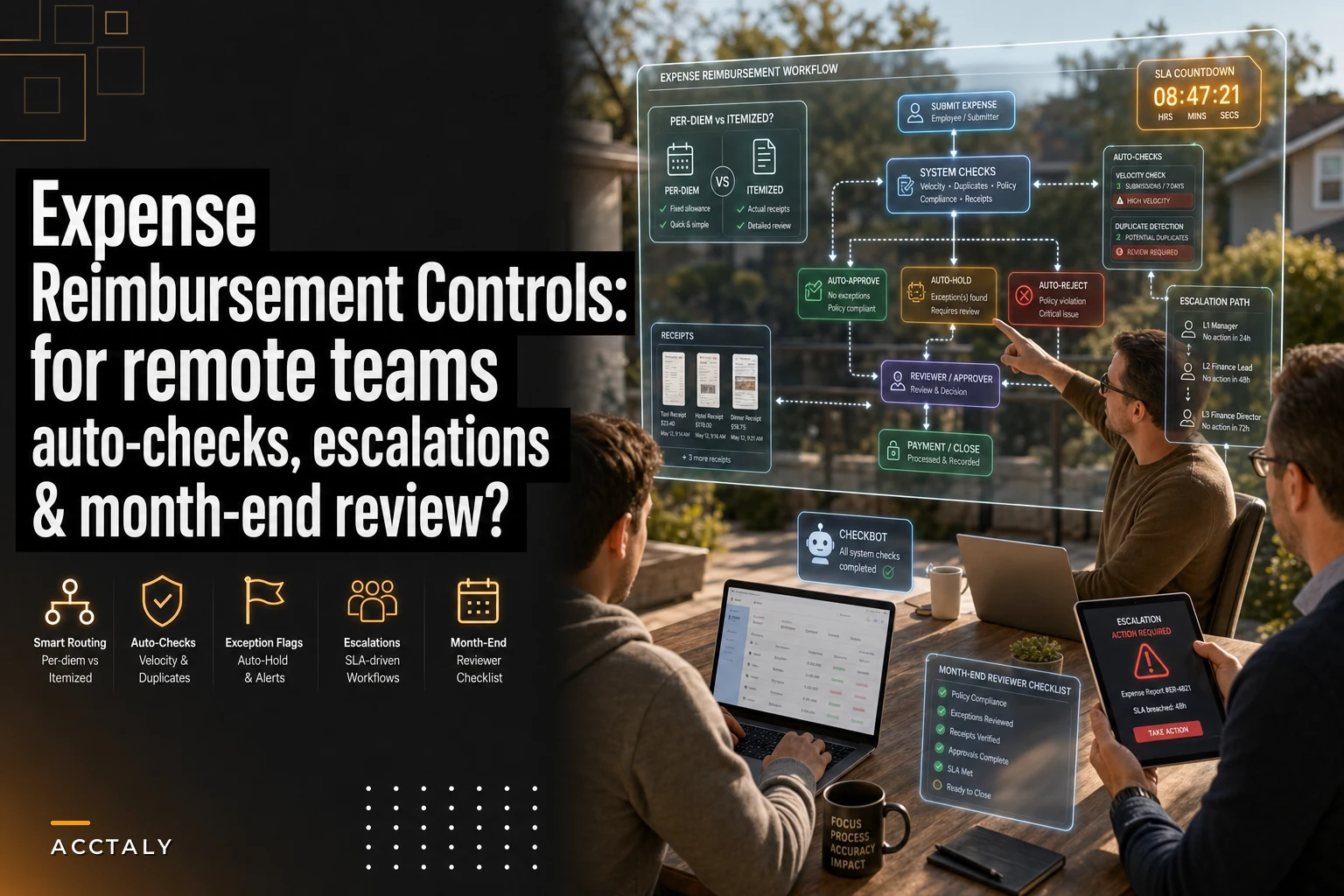
This post is narrowly about that: building an expense reimbursement policy for remote teams that decides per-diem vs itemized on purpose, runs velocity and fraud checks automatically, flags exceptions before a human touches them, and gives your month-end reviewer a checklist they can actually finish before the close. No broad travel-policy lecture. Just the controls.
Per-diem vs itemized: pick per category, not per company
The most common mistake isn't choosing wrong between per-diem and itemized. It's choosing one for the whole company. Remote teams have wildly different spend shapes — the engineer who travels twice a year vs the sales rep on the road weekly vs the fully-remote designer who never travels but expenses home-office stuff every month. A single policy forces you to over-control the low-risk spend and under-control the high-risk spend.
Decide per category. Here's the decision table worth handing to a finance lead:
| Spend category | Per-diem | Itemized | Why |
|---|---|---|---|
| Meals during travel | ✅ Default | Optional above cap | Receipts for $14 lunches waste reviewer time; per-diem removes the noise |
| Lodging | ❌ | ✅ Required | High dollar, high fraud surface, needs folio + dates |
| Ground transport (rideshare, parking) | Small daily cap | ✅ Above cap | Low fraud if capped; itemize the outliers |
| Mileage (personal vehicle) | Rate per mile | Log required | The log is the itemization; velocity-check it |
| Home-office / equipment | ❌ | ✅ Required + approval | One-time, high dollar, needs asset tracking |
| Software / SaaS on personal card | ❌ | ✅ Required | These belong on a card policy, not reimbursement |
| Client entertainment | ❌ | ✅ Required + attendees | Tax + fraud reasons; you need who was there |
The insight most people miss: per-diem isn't the "loose" option. When you cap meals at a daily rate and require nothing else, you eliminate an entire category of receipt-fudging fraud, because there's nothing to fudge. The person gets $60/day whether they ate at Whole Foods or a gas station. Your fraud surface for meals drops to near zero. You've traded a small potential overpayment for a significant reduction in review labor and dispute risk.
Itemized is where the real risk lives, and it's exactly where remote teams have the least natural oversight. So the rule of thumb: per-diem the small, repetitive, low-dollar stuff. Itemize the big, one-off, high-dollar stuff. Then aim your automated checks at the itemized side.
One thing to write into the policy explicitly
Per-diem days must tie to something verifiable — a calendar event, a booked flight, a client meeting. What tends to leak across distributed teams is per-diem claimed for "travel days" that were actually work-from-home days. If the per-diem trigger isn't anchored to an independent record (a flight confirmation, a hotel folio, an approved trip), it becomes a flat monthly bonus people quietly learn to claim.
Velocity and fraud checks that actually catch the remote-specific stuff
Traditional expense fraud checks assume you can eyeball a physical receipt. Remote teams need checks that work on data alone, because that's all you have. The digital trail distributed teams generate is actually cleaner than what most in-office teams produce — the problem is nobody's looking at it.
Stop letting accounting slow your business down.
Acctaly automates your financial operations so you can focus on growth and compliance.
- Automated bookkeeping
- Real-time financial reporting
- Integrated tax management
No credit card required
Here are the velocity and pattern checks worth running on every submission, ranked by how often they catch something real:
-
Duplicate detection across submitters. Same vendor, same amount, same date, two different people. This is the single most common remote reimbursement error — two people at a team dinner both expense the full bill. Not malicious. Still money out the door twice.
-
Duplicate across time. Same receipt resubmitted 60 days later hoping nobody remembers. Match on amount + vendor + date, not on the image, because people re-photograph.
-
Round-number clustering. A mileage log that's always exactly 50 or 100 miles. Meal claims that hit the per-diem cap every single day including weekends. Round numbers are a fingerprint of estimation, not record-keeping.
-
Weekend / off-hours velocity. Per-diem or travel meals claimed on days with no corresponding travel record. Easy to catch when you cross-reference the trip approval.
-
Submission clustering at deadlines. A person who submits 30 expenses in the last two days of the month, every month, is not keeping up in real time — they're reconstructing. Reconstructed expenses are where the guesses live.
-
Vendor anomalies. A rideshare charge in a city the person has never traveled to. A restaurant far from any client site or their home base.
-
Amount-just-under-threshold clustering. If receipts are required above $75, watch for a pile of $71–$74 claims. That pattern is people learning the threshold, not coincidence.
The pattern worth internalizing: on remote teams, most reimbursement loss is drift, not theft. People aren't defrauding you. They're estimating, rounding, forgetting, and double-claiming honestly. Which means your checks should be tuned to catch sloppiness at scale, not to build a criminal case. That changes how you set thresholds — you want flags that trigger a quick correction, not an HR investigation.
Automated exception flags: what to auto-approve, auto-hold, and auto-reject
The reviewer's time is the scarce resource. If a human looks at every reimbursement, your close slows down and the reviewer starts rubber-stamping by day three. The goal is to route by risk so a person only sees the 10–15% that actually needs judgment.
A workable three-tier ruleset looks like this. Start with auto-approvals, then route exceptions upward based on risk.
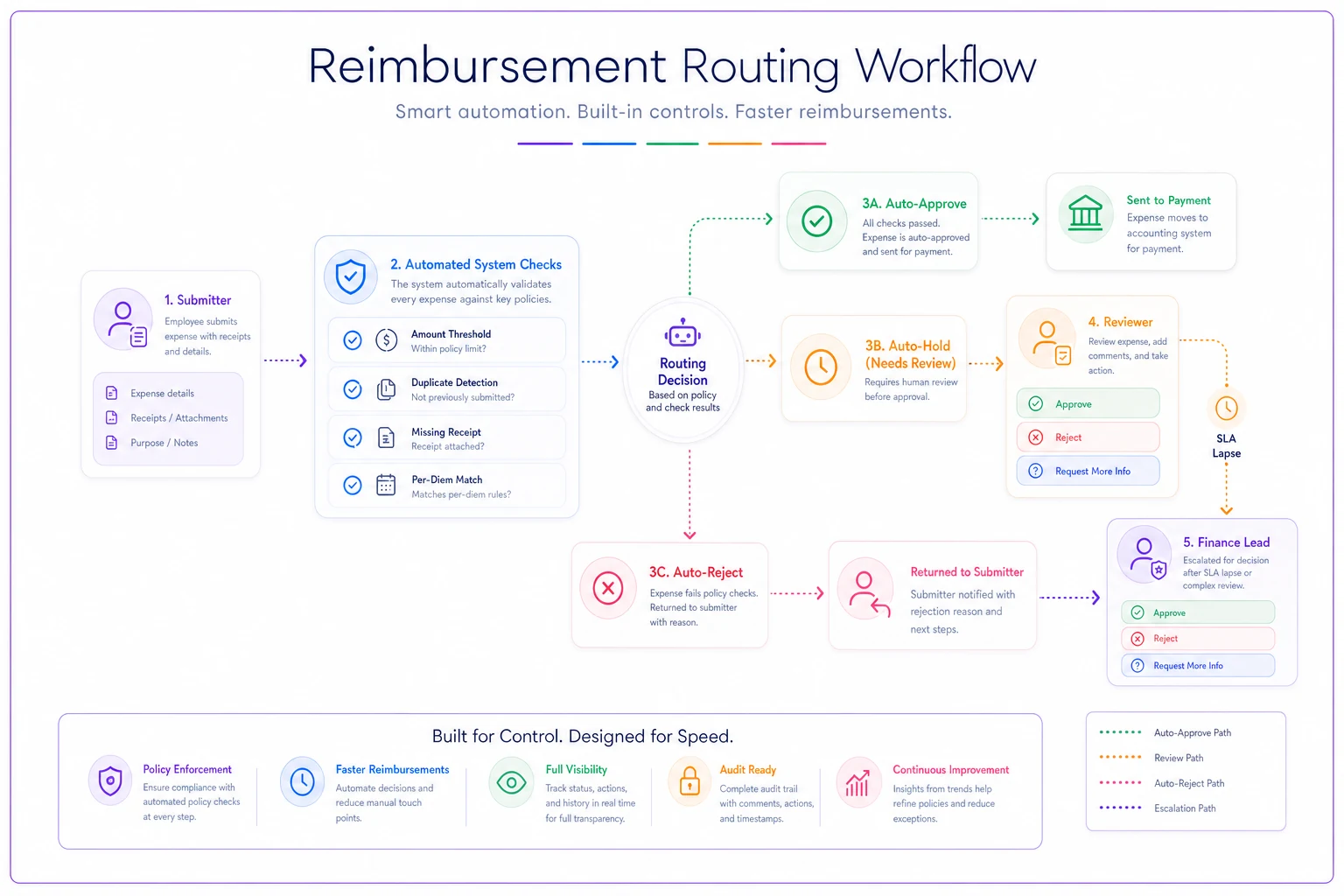
Auto-approve (no human touch) when ALL of these are true:
-
Amount under the itemization threshold (say, $75)
-
Category is per-diem-eligible or on the low-risk list
-
No duplicate match
-
Submitter has a clean 90-day history
-
Within monthly category budget
Auto-hold for reviewer when ANY of these hit:
-
Amount over threshold, or lodging/equipment/entertainment category
-
Any velocity flag (duplicate, round-number cluster, deadline clustering)
-
Per-diem day with no matching trip record
-
New employee (first 60 days — higher error rate, worth watching)
-
Missing required attachment on an itemized category
Auto-reject (bounce back to submitter) when:
-
Required receipt missing on an itemized claim over threshold
-
Duplicate of an already-reimbursed expense
-
Outside policy window (e.g., older than 90 days)
-
Missing attendees on entertainment
Auto-reject is the most underused rule in most policies, and probably the highest-leverage one. Bouncing an incomplete claim back to the submitter immediately — instead of a reviewer chasing it during close — moves the work back to the person who has the information. That single rule does more to speed up month-end than any reviewer productivity hack.
This is the same logic that makes an automated corporate-card rulebook work: enforcement happens at submission, not at review. The difference with reimbursements is that the person is spending their own money first, so your bounce-back has to be fast and clearly explained, or people stop submitting and start resenting the process.
Reviewer SLAs so approvals don't rot in a queue
Controls with no time limit create a different failure: everything gets flagged, nothing gets reviewed, and employees wait three weeks for $200 back. On distributed teams this compounds because there's no in-person nudge. People just stop trusting the system and start putting things on the company card that shouldn't be there — which pushes the problem into card reconciliation instead.
| Item type | Reviewer SLA | Escalation if breached |
|---|---|---|
| Auto-approved | Instant | N/A |
| Standard held claim | 3 business days | Auto-escalate to finance lead |
| High-dollar (>$1,000) | 2 business days | Escalate + require second approver |
| Bounced-back (needs resubmission) | Employee has 5 days to fix | Auto-close if no response, re-openable |
| Month-end batch | Cleared 2 days before close | Blocks close checklist if not done |
The escalation rule matters more than the SLA number. Without auto-escalation, a reviewer who's on vacation becomes a silent bottleneck for the whole team. Route around them automatically after the SLA lapses. And publish the reviewer's own numbers — average approval time, backlog size — the same way you'd track any finance SLA that keeps the close predictable. A reviewer whose queue is measured behaves differently from one whose queue is invisible.
A real scenario: distributed agency, 22 people
A digital agency with about 22 people — roughly 8 of them traveling to clients regularly — was running reimbursements through a shared inbox and a spreadsheet. Receipts came in as email attachments. One person in finance reviewed everything manually, usually in a two-day crunch right before close.
-
Two duplicate team-dinner claims per quarter, averaging around $180 each, that nobody caught because different people submitted them
-
Meal per-diems claimed on several non-travel days each month — small individually, but adding up to somewhere around $400–$600 monthly across the travel team
-
The reviewer spending close to 9–10 hours a month just on reimbursements, most of it chasing missing receipts and re-reading the policy to people who'd forgotten it
After splitting the policy into per-diem meals (capped, no receipts) and itemized everything-else, plus turning on duplicate detection and per-diem-to-trip matching, things shifted over about two months. Duplicates dropped to effectively zero — the check caught them before payment. Per-diem-without-travel claims got flagged and quietly stopped once people knew the days were being cross-checked. Reviewer time fell to roughly 3 hours a month, and almost all of it was spent on genuinely ambiguous claims instead of chasing paperwork.
Total recovered leakage landed somewhere around $8k–$11k annualized — not dramatic, but real money for a 22-person shop. The reviewer also got most of a workday back each month, which matters just as much.
Month-end reviewer checklist for distributed teams
Wire this into your close process. It's tuned for the remote case specifically — the cross-referencing that co-located reviewers never have to think about.
-
[ ] All held claims cleared or escalated (queue at zero)
-
[ ] Per-diem days reconciled against trip/flight records — no per-diems on non-travel days
-
[ ] Duplicate scan run across all submitters for the month
-
[ ] Round-number check on mileage and meal claims
-
[ ] Any submitter with an unusual spike in volume or dollars reviewed
-
[ ] Bounced-back claims either resubmitted or auto-closed
-
[ ] Entertainment claims have attendees + business purpose recorded
-
[ ] High-dollar (>$1,000) claims have second-approver sign-off
-
[ ] Reimbursements that should've been on a company card flagged for policy follow-up
-
[ ] Category spend vs budget reviewed — any category running hot
-
[ ] SLA breaches from the month logged (which claims, why)
The one line people consistently skip: reviewing which reimbursements should have been card purchases. On remote teams, personal-card-then-reimburse becomes a habit that quietly moves spend outside your card controls entirely. Catch it monthly or it compounds.
When tighter controls are worth it — and when they're not
Not every team needs all of this. Fewer than five people submitting expenses and total monthly reimbursements under a couple thousand dollars? A per-diem policy plus a monthly duplicate scan is probably enough. The automated flagging and SLAs are overhead you don't need yet.
It becomes clearly worth building out once you have a mix of travelers and non-travelers, more than one person reviewing, or reimbursement volume where a single missed duplicate costs more than the review time. That's usually somewhere north of 15 people, or when reimbursements cross a few thousand a month consistently.
One situation where this won't help: if the real problem is people putting company spend on personal cards to avoid procurement, tightening reimbursement controls just pushes the leak somewhere else. Fix the card and approval policy first, then come back to reimbursements.
The through-line
Remote reimbursement controls fail not because people are dishonest, but because the informal checks a physical office provided — the glance at a receipt, the hallway question, the manager who knew who was actually traveling last week — vanished, and nothing replaced them. You replace them with two things: a policy that decides per-diem vs itemized deliberately by category, and automated checks that do the cross-referencing a distributed reviewer simply can't do by eye.
Get those two right and the reviewer stops being a bottleneck, leaks get caught before payment instead of after, and month-end stops turning into a receipt scavenger hunt. Everything else — the SLAs, the checklist — is just making sure the system keeps running when the person who built it takes a week off.
Ready to take control of your finances?
Join over 2,000 businesses using Acctaly to simplify accounting, accelerate cash flow, and ensure tax readiness.