


Most covenant problems don't come from bad numbers. They come from a bank structure that makes the numbers hard to prove.
You can have plenty of liquidity and still trip a lender's confidence because your cash is scattered across seven accounts, two sweep rules nobody documented, and a "restricted" balance that's really just money you forgot was earmarked. When a lender or auditor asks a simple question — how much unrestricted cash do you actually control, and is that consistent with your reporting? — the answer takes three days and two Slack threads to assemble.
That gap between "we have the cash" and "we can cleanly show the cash" is exactly what a solid bank relationship playbook SMB teams should be built around. This piece is narrow on purpose: account mapping, sweep mechanics, reconciliation touchpoints, and a covenant reporting checklist. Not forecasting philosophy, not banking strategy in general — just the plumbing that makes your cash defensible.
Start with the account map, because most SMBs don't actually have one
Ask a finance lead for their account map and you usually get a login to the bank portal. That's not a map. A map tells you what each account is for, who can move money in and out, and how it rolls up into the covenant definitions your loan agreement uses.
The mistake that shows up constantly: businesses open accounts reactively. A new payment processor needs a settlement account. Payroll gets its own account after a fraud scare. A state requires a separate account for sales tax. Two years later there are nine accounts and no single document explaining how they connect. When the credit agreement says "Consolidated Cash," nobody's totally sure which accounts count.
A workable account map has four buckets, and every account you own should fit into exactly one:
| Account type | Purpose | Counts toward covenant cash? | Sweep behavior |
|---|---|---|---|
| Operating (concentration) | Primary hub, day-to-day AP/AR flows through here | Yes | Receives sweeps |
| Collection / settlement | Processor deposits, wire receipts, lockbox | Yes (usually) | Sweeps up to operating daily |
| Restricted / reserve | Debt service reserve, escrow, tax holdbacks, security deposits | No — must be excluded | No sweep, or one-way in |
| Disbursement | Payroll, dedicated vendor runs | Yes until spent | Funded from operating |
The single most useful column is the third one. Auditors and lenders care intensely about the line between unrestricted and restricted cash, because covenant tests almost always run on unrestricted balances. If your map doesn't clearly flag which accounts are legally or contractually restricted, you're going to overstate available liquidity — and the correction, when someone catches it, looks worse than the original number.
Practical rule: name your accounts to match the map. "Checking 4471" tells you nothing. "OPERATING-Concentration" and "RESTRICTED-DSRA" tell you everything at a glance, and they show up cleanly in downloaded statements when you're building a reconciliation.
Sweep mechanics: automate the movement, document the logic
A sweep is just an automated transfer that keeps money where it should be — pulling settlement deposits up into your operating account, or pushing idle cash into a savings or investment sweep overnight. The mechanics are easy. What breaks is the documentation and the timing around reporting dates.
Stop letting accounting slow your business down.
Acctaly automates your financial operations so you can focus on growth and compliance.
- Automated bookkeeping
- Real-time financial reporting
- Integrated tax management
No credit card required
The pattern that comes up across a lot of SMBs: sweeps get configured once, at the bank, by someone who has since left. They work fine day to day, so nobody thinks about them — until a covenant test lands on the last day of the quarter and the sweep timing distorts the balance that gets measured.
A concrete version of this: your investment sweep pulls everything above a $50k floor out of operating at end of day and parks it in an overnight money market. If your measurement date snapshots the operating account after the sweep, your operating balance looks like $50k. If the covenant definition only counts your operating account and not the sweep vehicle, you just reported yourself into a liquidity problem that doesn't exist.
The three sweep decisions that matter for reporting
-
Direction and trigger. Is it a concentration sweep (collection → operating), a target-balance sweep (keep operating at $X, move the rest), or a zero-balance sweep (disbursement accounts fund to zero)? Write down the trigger amount and the schedule.
-
Timing relative to your measurement date. Know whether your covenant snapshot is taken before or after the daily sweep runs. If a quarter-end sweep pushes cash into a vehicle your lender doesn't count, consider suspending or adjusting sweeps for the reporting date — and disclose it.
-
Where swept cash lands and whether it counts. An overnight money market sweep is usually still "cash and equivalents." A sweep into a longer-term investment might not be. Match this to the exact covenant definition, not your general sense of what's liquid.
The thing most teams miss: sweeps aren't just a yield optimization. They're the mechanism that determines what your balances look like on the days people are watching. Treat sweep configuration as part of your reporting controls, not as a treasury nicety.
A quick diagram of the sweep workflow helps clarify where timing affects covenant snapshots.
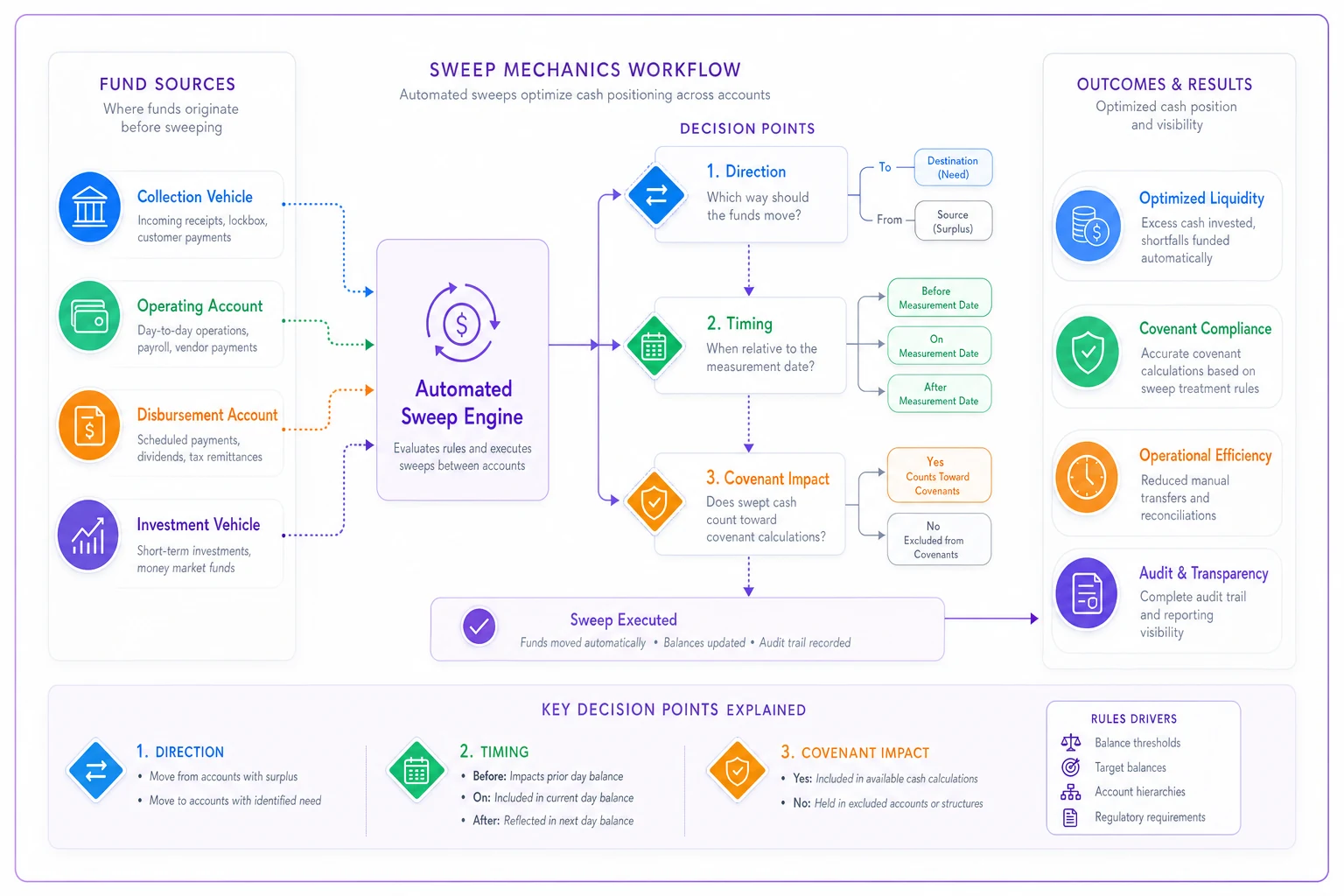
The diagram should make it obvious whether a measurement date falls before or after each scheduled sweep, and which sweep destinations count toward covenant cash.
Reconciliation touchpoints: reconcile the movement, not just the balances
Standard bank recs check that the ending balance ties. That's necessary but it misses what lenders and auditors actually probe: the transfers between your own accounts. Intercompany and inter-account movements are where errors hide, because a transfer touches two accounts and it's easy for one side to be miscoded.
Set up reconciliation at these specific touchpoints rather than only at month-end:
-
Daily Every sweep and internal transfer nets to zero across the account map. Money that left the collection account showed up in operating, same day, same amount. A non-zero net is your earliest warning that a sweep failed or a transfer got fat-fingered.
-
Weekly Restricted-account activity review. Nothing should move out of a reserve or escrow account without a documented reason. A single unexplained debit from a debt-service reserve is exactly what an auditor flags.
-
Monthly Full three-way tie — bank statement to your ledger to your covenant worksheet. The covenant worksheet is the piece people skip, and it's the one that gets scrutinized.
-
Quarterly (measurement date) A point-in-time snapshot of every account with its map classification, restricted flag, and the sweep state at that moment. This becomes your evidence file.
The touchpoint that saves the most pain is the daily net-to-zero check on internal transfers. It sounds trivial. But when a sweep silently fails on a Friday and nobody notices until month-end close, you've got a week of downstream balances that don't behave the way your model assumes — and if a measurement date fell in that window, you're explaining a discrepancy to a lender instead of catching it in-house.
Automate the daily net-to-zero check so treasury gets an immediate alert when a sweep or internal transfer fails.
This connects directly to how you run cash operations overall. If your reconciliation feeds the same system that governs spending decisions, exceptions surface where people will actually act on them — the logic behind building a cash-operations system that gates AR/AP and CapEx decisions rather than treating recs as a backward-looking chore.
The covenant reporting checklist
Covenant reporting fails in predictable ways: the definition in your compliance certificate drifts from the definition in your credit agreement, or the numbers in the certificate don't tie to the financials you submitted alongside it. Both are avoidable with a repeatable checklist.
Before you send anything to a lender, run through this:
-
[ ] Pull the exact covenant definitions from the credit agreement — not your memory of them. "EBITDA" and "unrestricted cash" have contract-specific meanings that override the standard ones.
-
[ ] Confirm which accounts count toward each cash-based covenant, using your account map's restricted flags.
-
[ ] Verify sweep state as of the measurement date and confirm swept balances are included or excluded correctly per the definition.
-
[ ] Tie the compliance certificate to the submitted financials — the cash number on the cert must equal the cash number on the balance sheet, reconciling items documented.
-
[ ] Recompute each ratio independently from source figures, not by copying last quarter's worksheet and updating cells (this is where stale formulas hide).
-
[ ] Document any cure or adjustment — if you suspended a sweep or reclassified an account, note it with a one-line reason.
-
[ ] Keep the evidence file — quarter-end statements, the map, the sweep config, and the worksheet, together, dated.
The recurring error here is treating the compliance certificate as a form to fill rather than a claim to prove. When a certificate says the current ratio is 1.4 and the auditor rebuilds it at 1.2 from your own financials, the problem usually isn't fraud — it's that the certificate used a cash figure that quietly included a restricted reserve. That's a self-inflicted covenant scare.
Because covenant tests are almost always cash-and-liquidity sensitive, this whole exercise gets far easier when your forecast already speaks the same language as your covenants. Teams running a 13-week rolling cash-forecast system with the covenant definitions baked in can see a breach coming weeks out instead of discovering it on the measurement date.
A short real scenario
A light-manufacturing business, roughly $6M in revenue, carried a term loan with a minimum unrestricted cash covenant of $250k tested quarterly. They ran six accounts: operating, two processor settlement accounts, payroll, a tax reserve, and a debt-service reserve required by the loan itself.
Their problem wasn't cash — they usually sat around $400k–$450k combined. It was that their quarterly certificate simply summed all bank balances. Two of those accounts — the tax reserve and the debt-service reserve, together around $180k — were restricted. Their actual unrestricted number was closer to $260k–$280k, uncomfortably near the floor and much lower than they'd been reporting.
When their auditor rebuilt the number correctly, it forced an awkward conversation with the lender about a year of overstated compliance. Nothing was fraudulent — just a missing account map and a certificate that didn't distinguish restricted cash.
The fix took about two weeks: they built the four-bucket map, renamed accounts to match, added a daily net-to-zero transfer check, and rewrote the certificate to pull from the map's unrestricted total. The following quarter's reporting took a few hours instead of a few days, and the lender got a certificate that tied cleanly to the financials. The liquidity was always fine — the presentation had been the risk the whole time.
When this level of structure makes sense — and when it's overkill
If you have one operating account, no debt covenants, and no restricted balances, you don't need a formal account map or a covenant checklist. A clean monthly rec is enough, and building this machinery would just be busywork.
This structure earns its keep the moment you have any of the following: a loan with financial covenants, multiple accounts including restricted or reserve balances, automated sweeps, or an audit where cash classification matters. Once restricted cash exists in your business, the line between it and unrestricted cash is no longer optional to track — it's the single thing lenders and auditors test most.
The teams that get burned are the ones in the middle: enough complexity to have restricted accounts and sweeps, but still reporting as if they had one simple checking account. That mismatch is where covenant scares are born.
The takeaway
Your cash structure is a reporting instrument, not just a place to hold money. Map every account to a purpose and a restricted flag, document how your sweeps behave around measurement dates, reconcile the movement between accounts and not just the balances, and prove your covenant certificate against your actual financials every single time.
Do that, and the question that used to take three days — how much unrestricted cash do you really control? — becomes something you can answer, and defend, in about thirty seconds. That's what a lender is actually paying attention to.
Your cash structure is a reporting instrument, not just a place to hold money. Map every account to a purpose and a restricted flag, document how your sweeps behave around measurement dates, reconcile the movement between accounts and not just the balances, and prove your covenant certificate against your actual financials every single time.
Do that, and the question that used to take three days — how much unrestricted cash do you really control? — becomes something you can answer, and defend, in about thirty seconds. That's what a lender is actually paying attention to.
Ready to take control of your finances?
Join over 2,000 businesses using Acctaly to simplify accounting, accelerate cash flow, and ensure tax readiness.