

Most SMB software disasters don't look like disasters at signing. They look like a reasonable $400/month tool that solved a real problem. Eighteen months later, that tool has three integrations nobody documented, two part-time people who "kind of own it," a renewal that auto-bumped 22%, and data flowing into your GL that nobody can fully trace. The sticker price was never the problem. The system around the sticker price was.
When finance leads procurement, the question stops being "is this tool good?" and becomes "what does this tool actually cost across its full life, who has to babysit it, and how do we get out cleanly if we need to?" That's a different muscle, and most small teams never build it. They buy like consumers and inherit the consequences like operators.
This is the playbook for buying like an operator. It's built around four things you can copy: a TCO model you can drop into a spreadsheet, an integration-risk checklist, owner and resourcing templates sized to your headcount, and a vendor lifecycle policy that runs procure → pilot → govern → decommission. The goal is that finance technology procurement in an SMB stops being a series of one-off decisions and becomes something repeatable.
Why procurement quietly breaks at small scale
There's an uncomfortable pattern here. A 6-person company buys tools fast because speed is survival. A 40-person company buys tools fast out of habit — and now every fast decision touches payroll, revenue, or the close. The buying behavior that worked at 6 is actively dangerous at 40, and almost nobody notices the moment it flipped.
What actually breaks:
-
Ownership diffusion. Nobody formally owns the tool, so three people half-own it. When something goes wrong, they each assume the other is handling it.
-
Integration sprawl. Each new tool connects to two or three others. By tool number twelve, you have a web of connections nobody mapped, and a single API change can silently corrupt data downstream.
-
Renewal autopilot. Contracts auto-renew because reviewing them is nobody's job. You end up paying for seats you cut, tiers you outgrew, and overlap you forgot about.
-
Shadow spend. Department heads expense SaaS on cards. Finance finds out at reconciliation, not at purchase.
In practice, this usually shows up as a finance team that can confidently account for maybe 60% of the software the company actually pays for. The rest lives on personal cards, in annual invoices buried in email, and in "free" tools that quietly started charging.
The fix isn't more discipline from everyone. It's a system where finance is the choke point for anything that touches money or data — and where the evaluation is structured enough that non-finance people can follow it without feeling like they're being blocked.
The TCO model: what the sticker price hides
The single biggest procurement mistake is treating the subscription line as the cost. It's usually 40–60% of the real number. A proper TCO model forces the other half into daylight.
Stop letting accounting slow your business down.
Acctaly automates your financial operations so you can focus on growth and compliance.
- Automated bookkeeping
- Real-time financial reporting
- Integrated tax management
No credit card required
Every tool gets scored across the cost categories below, projected over a realistic 3-year horizon. Most SMB tools don't survive longer than that, and if they do, you re-score at renewal anyway.
| Cost category | What goes here | How people underestimate it |
|---|---|---|
| Direct subscription | Per-seat or platform fee, by tier | Forgetting the price jumps at the next usage tier |
| Implementation | Setup, data migration, config, consultants | Assuming "we'll do it internally" is free |
| Integration build | Connecting to GL, payroll, CRM, bank feeds | Treating integrations as one-time, not maintained |
| Internal labor | Admin time, training, ongoing babysitting | Not pricing the hours anyone spends on it monthly |
| Overlap / redundancy | What this replaces or duplicates | Rarely retiring the tool it was supposed to replace |
| Switching / exit cost | Data export, re-training, contract cleanup | Never estimated until you're trapped |
| Renewal escalation | Expected annual price increase | Modeling flat pricing forever |
A worked example makes the gap obvious.
-
Direct subscription
$500/mo × 36 = $18,000
-
Implementation (config + policy setup, ~30 hours internal)
$1,800
-
Integration to GL + card feeds (initial build + ~2 hrs/mo upkeep)
$900 build + $4,300 upkeep = $5,200
-
Internal admin (controller spends ~3 hrs/mo at a loaded ~$55/hr)
$5,900
-
Training new hires over 3 years (~15 people × ~1 hr)
~$800
-
Renewal escalation (assume ~12% bump at each renewal)
~$2,400 added
Three-year "sticker" view: $18,000. Three-year actual TCO: roughly $34k.
Nearly double. And none of that hidden cost is exotic — it's just labor and maintenance nobody budgeted for. When you run two competing tools through the same worksheet, the cheaper subscription frequently loses once integration and admin load are counted in. That reversal is the entire point of the model. It changes which tool you pick, not just how you feel about the one you already wanted.
A quick rule for the TCO horizon
Score low-stakes tools — a scheduling app, a design tool — on a 1-year horizon and move on. Reserve the full 3-year model for anything that:
-
writes to or reads from your general ledger
-
touches payroll, tax, or banking
-
holds customer or revenue data
-
would take more than a week to replace
For those, the TCO model isn't bureaucracy. It's the difference between a reversible decision and an expensive hostage situation.
Integration-risk assessment: where data quietly rots
Subscription cost is finite and predictable. Integration risk is the one that compounds. Every connection you add is a place where data can drift, duplicate, or silently stop syncing — and in finance tooling, silent failures are the worst kind because you trust the numbers until suddenly you don't.
Before any tool that moves financial data gets approved, run it through this checklist. If you want the deeper architectural version, our breakdown on implementing cloud accounting software with a data-lineage checklist goes further than this summary.
-
[ ] Direction of flow. Does this tool write into systems of record, read from them, or both? Write access is higher risk — score it accordingly.
-
[ ] Data model match. Do the tool's fields map cleanly to your chart of accounts, customer IDs, and SKU structure? Mismatches mean someone transforms data manually, indefinitely.
-
[ ] Sync mechanism. Real-time API, scheduled batch, or manual CSV? Manual exports are a reconciliation landmine.
-
[ ] Failure visibility. When a sync fails, does anyone get alerted, or do you discover it at month-end?
-
[ ] Idempotency. If a sync runs twice, do you get duplicate transactions? (You'd be surprised how often the answer is "we don't know.")
-
[ ] Ownership of the connection. Is there one named person responsible for this specific integration?
-
[ ] Vendor API stability. Has the vendor broken their API before? Do they version and give proper notice?
-
[ ] Exit path for the data. Can you export everything in a usable format if you leave?
Each unchecked box isn't necessarily a dealbreaker — it's a staffing and governance signal.
Mapping integration risk to staffing
| Integration risk level | Characteristics | Governance + staffing rule |
|---|---|---|
| Low | Read-only, clean field mapping, API sync, rare failures | No dedicated owner; review at quarterly tool audit |
| Medium | Write access OR manual element, moderate field mismatch | Named owner, ~1–2 hrs/mo reconciliation, documented runbook |
| High | Write access to GL/payroll, manual syncs, poor failure alerts | Named owner + backup, weekly check, monthly reconciliation, exit plan on file |
The companies that get burned are the ones running three or four high-risk integrations with zero named owners. The data breaks, the close slips, and everyone's surprised — even though the risk was fully predictable at purchase. Deciding when your connection patterns justify a structural change is its own topic; we cover the triggers in when to switch finance integration topologies for growing SMBs.
Pro-tip: Make the named owner responsible for the runbook and the monthly reconciliation schedule so ownership isn't just a name on a doc.
Deciding when your connection patterns justify a structural change is its own topic; we cover the triggers in when to switch finance integration topologies for growing SMBs.
The vendor lifecycle: procure → pilot → govern → decommission
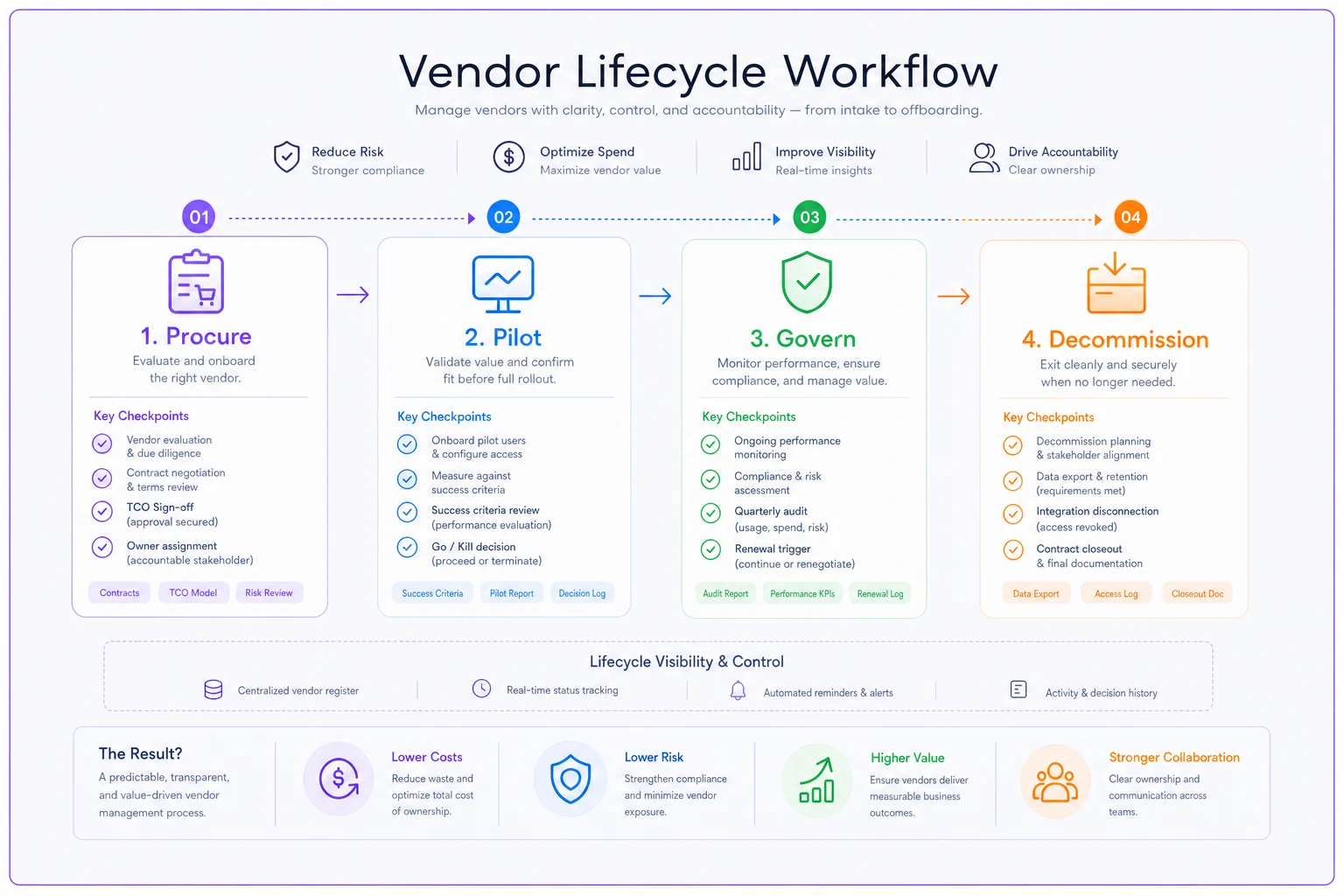
A tool isn't a purchase. It's a relationship with four phases, and most SMBs only manage the first one. Here's the full lifecycle, sized so a small team can actually run it.
Vendor lifecycle workflow — four sequential stages (Procure, Pilot, Govern, Decommission) with key process checkpoints at each stage.
1. Procure
This is where the TCO model and integration checklist live. The decision checkpoint before signing:
-
TCO scored over the right horizon
-
Integration risk assessed and mapped to a staffing rule
-
Named owner assigned before purchase, not after
-
Overlap check — what does this replace, and is retirement of the old tool scheduled?
-
Exit terms reviewed (notice period, data export, auto-renewal clause)
If any of these are blank, the purchase waits. Not forever — just until there's an owner and an exit plan.
2. Pilot
The pilot phase exists to catch the gap between the demo and your reality. Demos are run on clean data by people who built the tool. Your pilot should run on your messy data, by the person who'll actually own it day to day.
-
runs 30–45 days, not open-ended
-
has 2–3 pre-written success criteria (e.g., "cuts reconciliation time by at least a third," "syncs without manual fixes for two weeks straight")
-
includes a deliberate failure test — unplug an integration, feed it a weird edge case, see what breaks
-
ends with a go/kill decision, documented
The kill decision is the one most teams fumble. By the time the pilot wraps, everyone's already emotionally committed, so a mediocre result gets rationalized into a purchase. Writing success criteria before the pilot is the only reliable defense against that.
3. Govern
Governance is the phase that runs for years, and it's where TCO either holds or quietly explodes. The governing checkpoints:
-
Quarterly tool audit. Every active tool, its owner, cost, and renewal date in one place. This single list kills most shadow spend and overlap.
-
Renewal review trigger. Every renewal gets looked at 60 days out — seats, tier, usage, price change. No silent auto-renewals on anything material.
-
Integration health check. High-risk connections get their scheduled review per the staffing rule above.
-
Usage check. Are people actually using it? A tool at 20% adoption is a cost with no return and a candidate for the next phase.
The quarterly audit sounds trivial. It's also the highest-leverage thing in this entire playbook. In practice, it's where teams discover they're paying for two tools that do the same job, or 30 seats when 18 are active. Those findings routinely cover the cost of the discipline several times over.
4. Decommission
Nobody plans for the exit, which is exactly why exits are so painful. A clean decommission:
-
Confirm the replacement (or confirmed obsolescence) is live and stable
-
Export all data in a usable, documented format
-
Disconnect integrations deliberately — and verify downstream systems still reconcile after
-
Revoke access and remove seats
-
Cancel the contract with proper notice (check that notice period you reviewed at procurement)
-
Archive the data and the exit documentation
The step people miss is step 3 — verifying reconciliation after disconnection. Pull a tool out carelessly and you can leave a hole in your data lineage that doesn't surface until the next close. Decommissioning is a finance event, not just an IT cleanup.
Owner and resourcing templates by headcount
The right governance weight depends entirely on your size. A 5-person company running a 40-person process will grind to a halt. A 40-person company running a 5-person process is quietly bleeding money. Match the structure to the stage — the same logic behind a staged finance-ops maturity model for SMBs.
1–10 people
-
Owner model
founder or office manager owns the full tool list
-
Governance
one lightweight shared sheet, reviewed quarterly
-
Procurement rule
anything over ~$100/mo or touching the GL gets a quick TCO sketch and a named owner
-
Don't overbuild. You don't need a committee. You need one list and one person who keeps it.
11–25 people
-
Owner model
finance lead owns the process; each tool has a department owner
-
Governance
quarterly audit becomes formal; renewals tracked with 60-day triggers
-
Procurement rule
full TCO + integration checklist for anything high-risk; pilots required for financial tools
26–50 people
-
Owner model
controller owns procurement policy; documented runbooks for high-risk integrations; backup owners assigned
-
Governance
quarterly audit + monthly health checks on critical integrations
-
Procurement rule
formal checkpoints enforced; no material tool bought without TCO, pilot, and exit terms on file
When this is a bad idea
Don't bolt a heavy procurement process onto a 4-person company still chasing product-market fit. At that stage, speed genuinely outweighs governance, and the cost of a bad $300/month tool is trivial compared to the cost of moving slowly. Apply the full playbook when your money-touching or data-touching tools cross roughly a dozen, or when you can no longer name every tool and its owner from memory. That's the real trigger — not a headcount number, but the moment your own stack has become something you can't fully see.
A real scenario
A roughly 30-person professional services firm had drifted into about 20 active SaaS subscriptions. Finance could confidently account for maybe 14 of them. Three tools overlapped heavily in function. Two integrations wrote into the GL via manual CSV uploads that nobody formally owned, which meant month-end reconciliation regularly dragged an extra few days chasing mismatches.
They ran the playbook over one quarter. The first quarterly audit alone surfaced two redundant tools and a block of unused seats — roughly $900/month in dead spend. Running their top five money-touching tools through the TCO model flipped one renewal decision outright: the "cheaper" option they'd been about to renew was actually costing more than the alternative once manual integration labor was counted. Mapping the two GL integrations to a high-risk staffing rule got them a named owner and a monthly reconciliation routine, which pulled that chronic close delay out of the process for good.
Nothing here was dramatic. No big platform migration, no new hire. Just a system applied to spend they already had.
The point isn't to buy less
It's to buy with your eyes open and retire with your eyes open too. Finance-led procurement isn't about saying no to tools. It's about making every tool decision reversible, owned, and priced at its true cost — so the stack you end up with is the stack you actually chose, not the one that accumulated while nobody was watching.
Start with the quarterly audit and the TCO model. Those two alone will tell you more about your operation than any new tool will. Once you can see the full picture, the lifecycle policy mostly runs itself — procure deliberately, pilot honestly, govern on a schedule, and decommission cleanly. The discipline compounds in the same quiet way the sprawl used to.
Ready to take control of your finances?
Join over 2,000 businesses using Acctaly to simplify accounting, accelerate cash flow, and ensure tax readiness.