



Running a marketplace means you're basically operating a bank without wanting to be one. You collect money from buyers, hold it, then send it to sellers. Simple enough until Thursday afternoon when your CFO asks why the liability account shows $847,000 but your payment processor says you're holding $862,000. Or worse, a seller is calling about missing funds while your system shows the payout was processed three days ago.
That disconnect between what your platform thinks it owes and what it actually owes creates a specific kind of operational chaos. The kind where you're manually downloading CSVs at 11pm, cross-referencing transaction IDs in Excel, and praying the numbers match before tomorrow's board meeting.
The three-state money problem
The three-state money problem
Every dollar flowing through your marketplace exists in one of three states, and most platforms only track two of them properly. Incoming payments, held funds waiting to clear, and outgoing payouts. Sounds straightforward until each state starts introducing its own timing quirks and edge cases.
The incoming payment hits your Stripe account immediately, but your platform doesn't record it until the webhook fires. Sometimes that's instant. Sometimes it's 20 minutes later. Meanwhile, your accounting system is waiting for the nightly batch import. Same transaction, three systems, three different states.
Then there's the hold period. Most platforms hold funds for 7–14 days before releasing to sellers. But what triggers that countdown? The authorization? The capture? When the product ships? Every platform has slightly different rules, and those rules compound into reconciliation gaps.
The payout phase is messier still. You initiate a transfer Monday. Your platform marks it "paid." The ACH takes 2–3 business days to clear. If it fails, you might not know until Thursday. By then you've already updated your liability accounts and sent confirmation emails. Now you're scrambling to reverse entries and figure out why the transfer bounced.
Why standard accounting software breaks at marketplace scale
Why standard accounting software breaks at marketplace scale
Stop letting accounting slow your business down.
Acctaly automates your financial operations so you can focus on growth and compliance.
- Automated bookkeeping
- Real-time financial reporting
- Integrated tax management
No credit card required
Traditional accounting tools weren't built for this level of transaction complexity. QuickBooks thinks in terms of invoices and bills. Xero wants everything to be a contact with a clean payment history. Neither understands that you're processing thousands of micro-transactions that need to be grouped, held, split, and reconciled across multiple states.
A mid-sized marketplace processing around 400 daily transactions — each one touching at least six different records: the original charge, the platform fee split, the tax calculation, the seller credit, the liability adjustment, and eventually the payout record. That's roughly 2,400 individual entries that need to reconcile perfectly. Miss one webhook, hit one timeout, or run into one edge case, and your books are off.
The reconciliation burden grows from there. You're not just matching bank deposits to invoices. You're tracking whether payment ID ch1234 from Monday properly reduced the liability for seller789, and whether that reduction matches the po_5678 transfer initiated Wednesday that may or may not have cleared by Friday. Multiply that by hundreds of sellers and thousands of transactions and you start to understand why marketplace accounting teams live inside spreadsheets.
Building an event-driven reconciliation system that actually works
Building an event-driven reconciliation system that actually works
The only sustainable approach is to build your reconciliation process around events, not balances. Stop trying to match ending numbers and start tracking state transitions. Every payment, hold, and payout should fire an event that updates your liability ledger in real-time.
Here's the framework that holds up in production:
Payment received → Create liability record
-
Transaction ID
ch_3KL9mN2eZvKYlo2C1tX4gP8R
-
Amount
$127.43
-
Seller ID
seller_4829
-
Platform fee
$6.37
-
Net liability
$121.06
-
Hold until
[timestamp + 7 days]
-
Status
HOLDING
Hold period expires → Flag for payout
-
Liability ID
liab_9823
-
Original transaction
ch_3KL9mN2eZvKYlo2C1tX4gP8R
-
Ready for payout
[current timestamp]
-
Status
READYTOPAY
Payout initiated → Update liability status
-
Payout ID
po_1KL9qR2eZvKYlo2C0vX7kL9M
-
Liability IDs
[liab9823, liab9824, liab_9825]
-
Total amount
$487.22
-
Initiated
[timestamp]
-
Status
PENDING_TRANSFER
Transfer confirmed → Close liability
-
Payout ID
po_1KL9qR2eZvKYlo2C0vX7kL9M
-
Confirmed
[timestamp]
-
Status
COMPLETED
This event chain creates an auditable trail from payment to payout. When reconciliation breaks, you can pinpoint exactly which event failed and why.
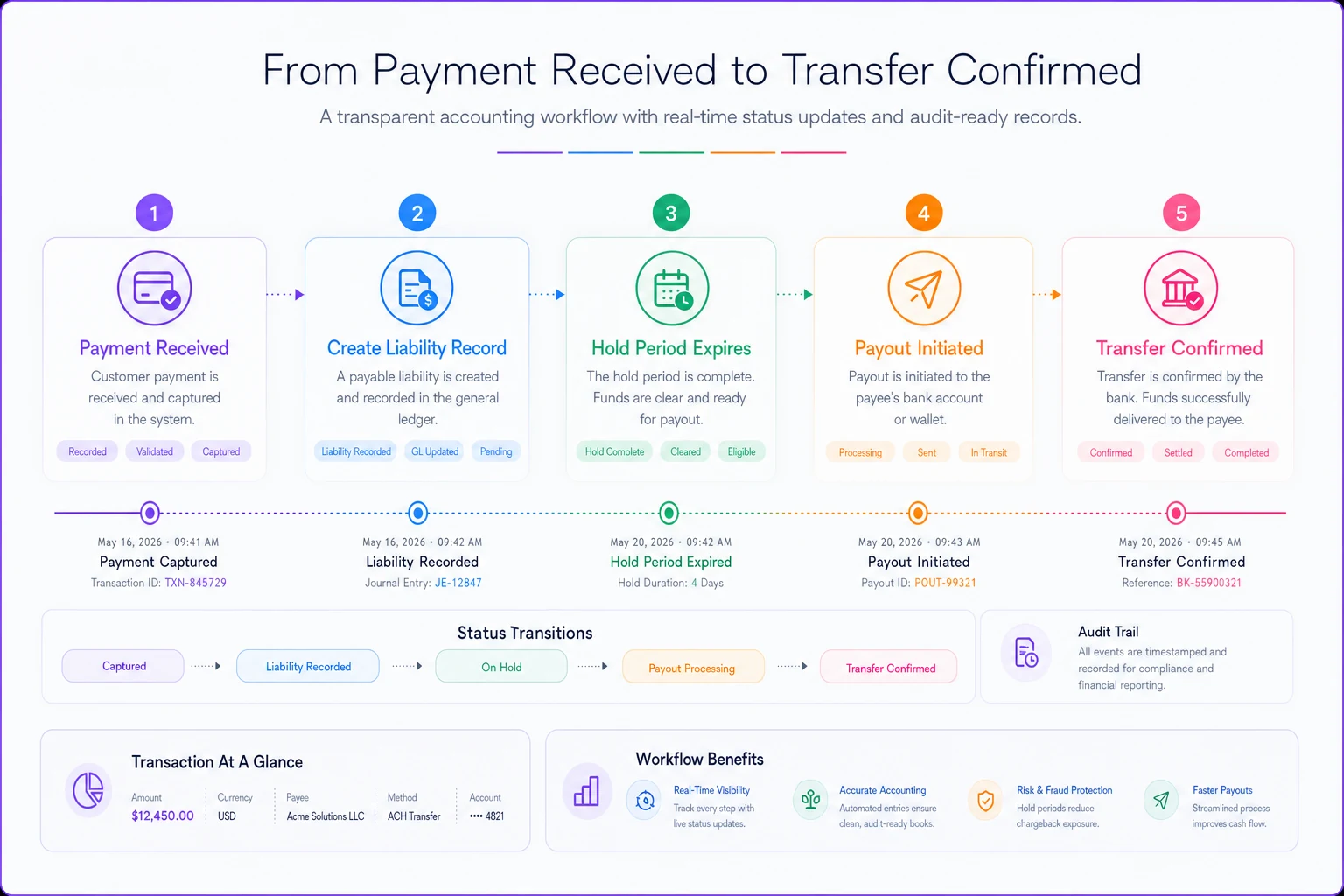
A simple visual of that flow makes it obvious where events stopped firing or where delays occurred.
The liability schedule that prevents midnight Excel sessions
The liability schedule that prevents midnight Excel sessions
Most platforms try to reconcile their entire liability balance at once. That's like debugging code by staring at the final output. Instead, build a rolling liability schedule segmented by date, seller, and status.
This breakdown tells you immediately where problems are hiding. That $287 in failed transfers from the Oct 22–28 cohort needs investigation today. The $48,900 ready to pay should match exactly what you're planning to transfer tomorrow.
| Cohort | Amount Held | Ready to Pay | In Transit | Failed | Days Aging |
|---|---|---|---|---|---|
| Oct 15-21 | $47,832 | $0 | $41,200 | $0 | 14-20 |
| Oct 22-28 | $52,109 | $48,900 | $0 | $287 | 7-13 |
| Oct 29-Nov 4 | $61,445 | $0 | $0 | $0 | 0-6 |
| Totals | $161,386 | $48,900 | $41,200 | $287 | - |
The schedule also surfaces timing issues. If you're holding $161,386 but your payment processor shows $163,000, you know to look for transactions from the last few hours that haven't been recorded yet. Without that segmentation, you're just comparing two big numbers and hoping they land close enough.
Payout cadence: daily vs. weekly vs. on-demand
Payout cadence: daily vs. weekly vs. on-demand
How often you run payouts has a real impact on reconciliation complexity. Daily payouts mean more transactions to track but smaller variances when something breaks. Weekly payouts reduce transaction volume but create larger gaps that are harder to diagnose.
Daily payouts work well for high-volume marketplaces with strong operational discipline. You're processing 20–30 payout batches, each with 15–50 individual transfers. When something fails, you're investigating hundreds of dollars, not tens of thousands. The tradeoff is operational overhead — someone needs to monitor those batches, handle exceptions, and run daily reconciliations.
Weekly payouts reduce that overhead but concentrate risk. A single batch might include 200–300 transfers. One failed webhook or API timeout can throw off thousands of dollars across dozens of sellers. And when sellers expect weekly payment, a failed batch on Friday means angry emails all weekend.
On-demand payouts sound great for seller satisfaction but create reconciliation problems unless you've built robust real-time infrastructure. With transfers happening continuously throughout the day, your liability balance is constantly in flux. Matching processor balances becomes nearly impossible because something is always in flight. Unless you've genuinely invested in real-time reconciliation, stick with scheduled batches.
Exception handlers for failed and delayed payouts
Exception handlers for failed and delayed payouts
Failed payouts are inevitable. Bank accounts close. Routing numbers change. Sanctions flags trigger. The question is how quickly you detect and resolve them.
These exception handlers belong in every payout flow:
Instant failure detection
Monitor your payment processor's webhooks for failure events. Don't wait for nightly reconciliation to discover that po_8234 bounced. When Stripe or PayPal fires a transfer.failed webhook, immediately flag that payout and reverse the liability reduction.
Three-strike retry logic
-
First failure
Wait 24 hours, retry automatically
-
Second failure
Wait 48 hours, retry with seller notification
-
Third failure
Mark as manual intervention required
Roughly 60% of failures resolve on the first retry — usually temporary bank issues. Another 25% or so resolve on the second attempt after the seller updates their bank details. The remaining failures need manual investigation.
Seller communication workflows
-
Failed payout attempt 1
Internal flag only
-
Failed payout attempt 2
Email seller about updating bank details
-
Failed payout attempt 3
Email + in-app notification + suspend future payouts
-
After 7 days
Transfer to unclaimed funds liability account
Aging failed payouts tracking
| Days Outstanding | Count | Total Amount | Action Required |
|---|---|---|---|
| 0-3 days | 8 | $1,247 | Auto-retry pending |
| 4-7 days | 3 | $892 | Seller contacted |
| 8-14 days | 2 | $2,109 | Manual review |
| 15+ days | 1 | $423 | Legal/compliance review |
Track aging closely so manual interventions happen before sellers escalate or compliance gets involved.
The reconciliation workflow that scales from 10 to 10,000 sellers
The reconciliation workflow that scales from 10 to 10,000 sellers
Small marketplaces can survive manual reconciliation for a while. But somewhere around 50 active sellers or 500 weekly transactions, the spreadsheet approach falls apart. You need a systematic workflow that scales without adding headcount.
Start with automated daily balance checks. Every morning, your system should compare:
-
Yesterday's closing liability balance
-
Plus new payment obligations created
-
Minus payouts initiated
-
Equals today's opening liability balance
If these don't match within a reasonable tolerance — call it $10–20 for rounding — trigger an alert. Don't wait for month-end to find out you're off.
Next, implement transaction-level matching for every payout batch. Before initiating transfers, generate a manifest that includes:
-
Each seller getting paid
-
Their specific transactions being paid out
-
The gross amount, fees, and net transfer calculation
-
The liability records being cleared
After transfers clear, match confirmations back to that manifest. Any mismatches get flagged immediately, not discovered weeks later during monthly close.
For fraud detection patterns in marketplace transactions, run automated checks before each payout batch. Flag sellers with unusual patterns — sudden volume spikes, multiple failed payouts, transactions from flagged buyers. These checks prevent you from sending money you'll have a hard time recovering later.
Generate and store the payout manifest as a single source of truth used for both initiating transfers and post-transfer matching.
Automate what you can, and make exceptions easy to investigate.
Platform-specific templates and SQL queries
Platform-specific templates and SQL queries
Different marketplace types need slightly different reconciliation approaches. A service marketplace has different patterns than a product marketplace. But the core queries are similar across the board.
Daily liability reconciliation query:
WITH liabilitycalc AS ( SELECT DATE(createdat) as cohortdate, SUM(CASE WHEN status = 'HOLDING' THEN netamount ELSE 0 END) as held, SUM(CASE WHEN status = 'READY' THEN netamount ELSE 0 END) as ready, SUM(CASE WHEN status = 'PENDING' THEN netamount ELSE 0 END) as pending, SUM(CASE WHEN status = 'FAILED' THEN netamount ELSE 0 END) as failed FROM liabilityledger WHERE createdat >= CURRENTDATE - INTERVAL '30 days' GROUP BY DATE(createdat) ) SELECT * FROM liabilitycalc ORDER BY cohort_date DESC;
Seller payout readiness check:
SELECT s.sellerid, s.businessname, COUNT(l.id) as pendingpayouts, SUM(l.netamount) as totalpending, MIN(l.createdat) as oldesttransaction, DATEDIFF('day', MIN(l.createdat), CURRENTDATE) as dayswaiting FROM sellers s JOIN liabilityledger l ON s.sellerid = l.sellerid WHERE l.status = 'READY' AND s.payoutstatus = 'ACTIVE' GROUP BY s.sellerid, s.businessname HAVING COUNT(l.id) > 0 ORDER BY days_waiting DESC;
Run these every morning, compare against your processor balances, and investigate variances right away — not at the end of the month.
How AI automation transforms marketplace reconciliation
How AI automation transforms marketplace reconciliation
The manual workflows described above work, but they're exhausting to sustain as transaction volume grows. AI-powered operational platforms can handle most of the routine work automatically. Instead of downloading CSVs and matching transactions in Excel, the system continuously monitors payment events, flags discrepancies in real-time, and surfaces exceptions that need human attention.
The real leverage is in pattern recognition. These systems learn what normal looks like for your marketplace and flag anomalies before they turn into problems. A seller who suddenly processed $50,000 after months of $2,000 weekly volume gets flagged before the payout goes out. A batch of transactions that hit your platform but never showed up in Stripe gets caught within minutes, not days.
For platforms serious about scaling their finance operations, that kind of automation can reduce the reconciliation burden from hours per day to something closer to a quick morning review. The system handles routine matching, and your team focuses on the exceptions that actually need judgment.
The 90-day implementation roadmap
The 90-day implementation roadmap
Days 1–30: Foundation
Build your liability ledger if you don't have one. Start tracking every state transition. Implement basic daily balance checks. Document your current payout process and identify the biggest gaps.
Days 31–60: Automation
Deploy automated reconciliation queries. Build exception handlers for common failures. Create seller communication templates. Run parallel reconciliations to validate your new process against the old one.
Days 61–90: Optimization
Fine-tune your payout cadence based on actual patterns. Layer in fraud checks. Build dashboards for real-time liability monitoring. Evaluate whether AI-powered tooling makes sense for your current volume.
The payoff is real. Platforms that implement proper reconciliation typically cut reconciliation time significantly, catch fraud faster, and eliminate most seller payout complaints. More importantly, they stop needing to add finance headcount every time transaction volume doubles.
When marketplace reconciliation becomes sustainable
When marketplace reconciliation becomes sustainable
The difference between marketplaces that scale and those that run into operational walls often comes down to how they handle money movement. Great product, strong growth, solid network effects — none of it matters if you can't reliably get money from buyers to sellers.
The patterns in this guide come from watching marketplaces at various stages, from small apps processing a few thousand dollars a month to platforms handling millions in daily volume. The consistent theme is that manual reconciliation tends to break somewhere around $500K monthly GMV. Platforms that don't build proper systems before hitting that threshold spend months trying to dig out.
Start with event-driven tracking. Build liability schedules that segment by cohort and status. Put exception handlers in place that catch and resolve failures quickly. These aren't optional features once you're past a certain scale — they're the foundation everything else sits on.
The platforms that get this right early avoid the painful emergency reconciliation sessions and angry seller emails. They build trust through consistent, reliable payouts. And their finance teams spend time on things that actually move the business forward instead of hunting missing transactions in processor portals at midnight.
Your marketplace reconciliation system is either an operational asset or a scaling bottleneck. Which one it becomes depends largely on decisions you make well before the cracks start showing.
Ready to take control of your finances?
Join over 2,000 businesses using Acctaly to simplify accounting, accelerate cash flow, and ensure tax readiness.