

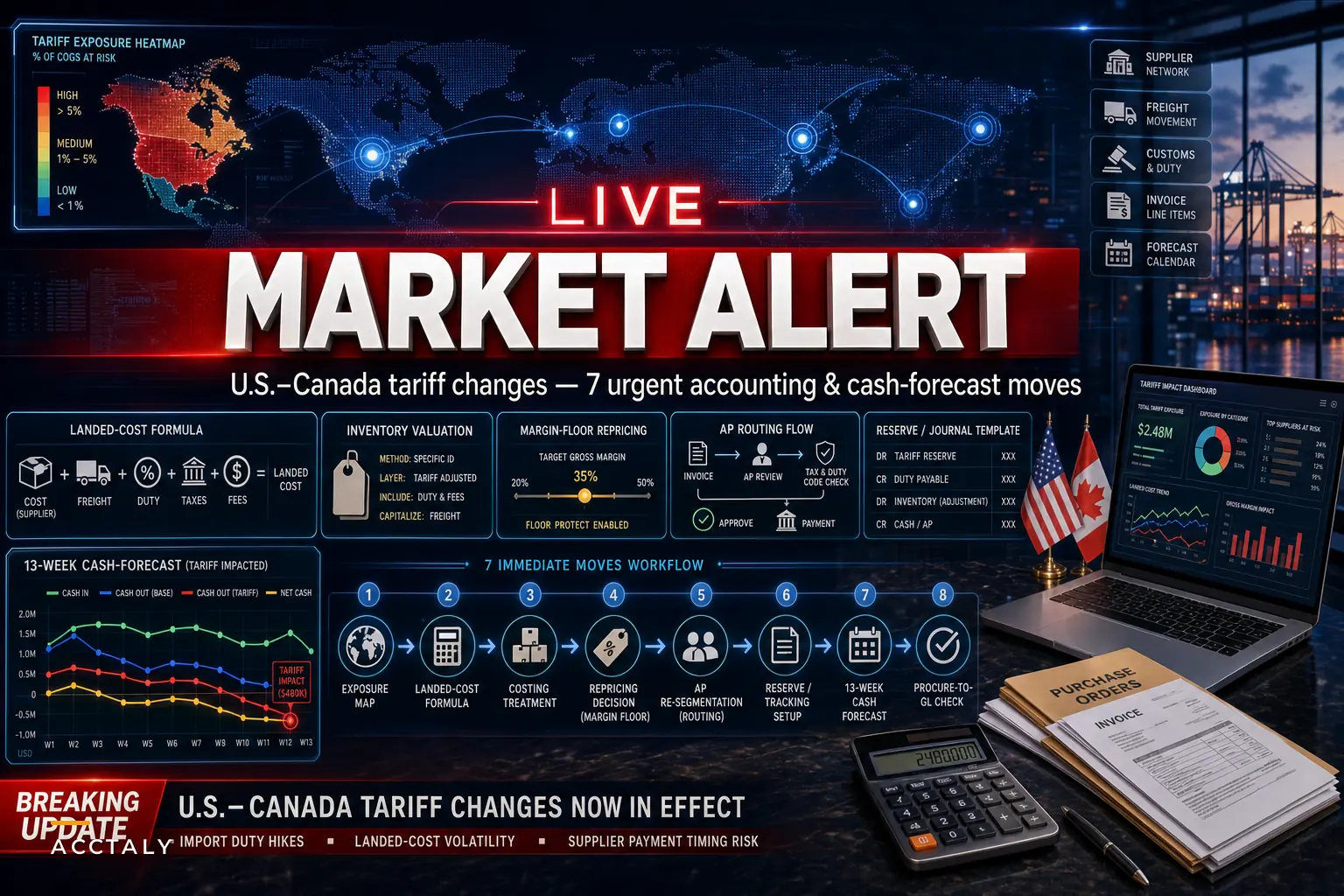

If you buy anything from Canada—steel, auto parts, lumber, processed food, packaging inputs—the amended tariff lists that rolled out in late October 2026 probably landed on your desk as a confusing mix of "which SKUs are affected," "when does this hit," and "how much does it actually cost me per shipment." That's the real problem. The headlines talk about percentages. Your finance team has to translate those percentages into journal entries, payment timing, inventory valuation, and a cash forecast that still holds up through the holiday selling period.
Reuters has reported that the U.S. and Canada are also working on a deal to ease steel and auto tariffs, which means the one thing you can count on is that the numbers you build today will change again. That's not a reason to wait—it's a reason to build your response so it can absorb those changes without a full rebuild each time.
This isn't a trade-law explainer. It's what to actually do in your books and your forecast over the next two to three weeks, assuming you already understand the basics of COGS, duties, and landed cost.
Start with exposure, not accounting entries
Most finance teams make the same first mistake: they jump straight to "how do we record the duty" before they even know which purchases are exposed and by how much. You can't book what you haven't scoped.
Before touching the GL, build a one-page exposure map. For the next 90 days of committed and expected purchasing, you want to know:
-
Which suppliers ship from Canada (by legal shipping origin, not where the invoice comes from—those differ more often than you'd expect)
-
Which of their SKUs appear on the amended product lists
-
Open POs already in transit versus POs you haven't placed yet
-
The duty rate that applies to each, including higher-rate targeted items
The Canadian government maintains a complete list of U.S. products subject to counter-tariffs, and the U.S.-side amended lists are summarized in Reuters' overview of doing business under the current tariffs and bans. Pull your SKUs against the relevant list and flag matches. If you're a two-person finance team, this is a spreadsheet afternoon, not a project.
Exposure is almost never evenly distributed. In most SMBs, 70–80% of the tariff cost impact concentrates in a handful of SKUs from one or two suppliers. Scope first, and every downstream decision—pricing, payment timing, reserves—can focus on what actually moves the needle.
The seven moves, in the order they actually matter
The order here matters because some of these feed the others. Do them out of sequence and you'll redo work.
Stop letting accounting slow your business down.
Acctaly automates your financial operations so you can focus on growth and compliance.
- Automated bookkeeping
- Real-time financial reporting
- Integrated tax management
No credit card required
Here's roughly how these seven steps connect when you work through them in sequence:
Exposure Map → Landed-Cost Formula → Costing Treatment ↓ Repricing Decision (margin floor) ↓ AP Re-segmentation → Reserve/Tracking Setup ↓ 13-Week Cash Forecast → Procure-to-GL Check
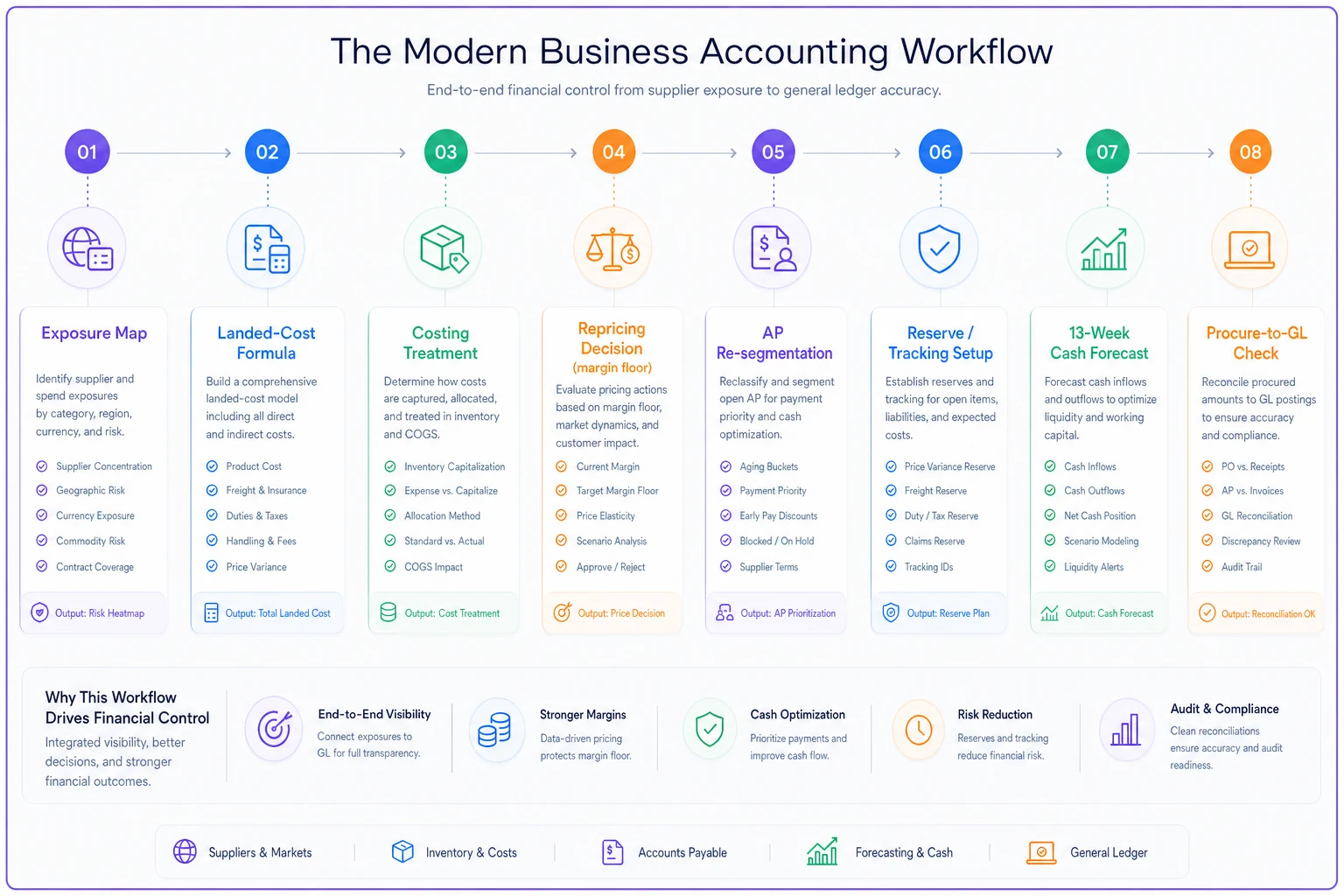
A quick visual of the sequence to follow.
Working backward from the GL check without the exposure map done first is where teams waste the most time. The seven moves below follow this sequence deliberately.
1. Lock down landed-cost calculation per affected SKU
A duty isn't just "add X%." Landed cost is unit price + freight + duty + brokerage + any currency spread. When duty goes up, your brokerage and insurance-on-value can shift too, because they're often calculated on declared value plus duty.
A practical example: a distributor importing a metal input at roughly $42/unit saw the stated duty bump push landed cost to about $63 once brokerage and value-based fees recalculated. The owner had budgeted "$42 plus the tariff percent" and was off by several dollars a unit because the cascading fees didn't register. Across around 3,000 units a quarter, that gap was close to $9k he hadn't planned for.
Build the full landed-cost formula once, per SKU, and keep it somewhere your costing entries actually pull from—not in someone's head.
2. Decide your inventory costing treatment *now*, before the first affected shipment clears
This is where teams quietly create a reconciliation mess. If you run weighted-average costing, a tariff-heavy shipment will shift your average cost, and the timing of when you record the duty against that inventory layer matters. If you route duty to a generic expense account instead of capitalizing it into inventory, your COGS and margin reporting will both be wrong—and you probably won't catch it until month-end when the numbers don't tie.
Duties on goods for resale generally get capitalized into inventory cost, not expensed on receipt. Confirm your treatment, document it, and make sure whoever books the import entries knows the rule. The mistake that keeps showing up: one person expenses duty, another capitalizes it, and three months later nobody can explain why gross margin on the same product line swings 4 points between periods.
3. Reprice with a margin-floor rule, not a flat markup
The instinct is to pass the tariff straight through. Sometimes you can't—competitive pricing, contracts, or customer tolerance won't absorb a full pass-through right before the holidays. So decide your rule in advance:
-
Which products get full pass-through
-
Which absorb part of the cost to protect volume
-
What your absolute margin floor is per product line (below which you stop selling or renegotiate)
Businesses that set a margin floor make faster, cleaner pricing decisions than businesses that argue it out product-by-product every week. The floor turns a hundred small debates into one policy.
4. Re-time AP for duty-exposed suppliers
This is the move most people skip, and it's where your runway actually lives. When landed costs jump, your cash outflow per order jumps too—even at the same order quantity. If your payment terms and reorder cadence don't adjust, you quietly accelerate cash out the door without realizing it.
This is exactly the kind of situation our working-capital playbook for supplier segmentation, routing and approval rules was built for. The short version for tariff season: re-segment suppliers by cash impact, not just spend volume. A supplier you used to pay net-30 without thinking might now represent a much larger single outflow, which could justify negotiating net-45, splitting shipments, or timing payments around your receivables cycle.
5. Set a tariff-cost reserve or tracking account
Because rates and lists are still moving—and a steel/auto easing deal may partially reverse some of this—you want tariff-related costs traceable, not blended invisibly into COGS. Create a dedicated tracking dimension (a sub-account, class, or tag) so you can answer two questions instantly: "How much has the tariff change actually cost us this quarter?" and "If rates drop, what's our repricing or recovery opportunity?"
Tag affected POs at receipt so the tariff tracking dimension shows up in your reports immediately.
Teams that blend tariff cost into general COGS lose the ability to make that argument later. The tracking dimension costs you nothing and saves a painful reconstruction project down the road.
6. Rebuild the 13-week cash forecast around duty timing
Duty is often payable at or near import clearance—frequently before you've sold the goods. That's a timing gap that doesn't exist for your normal operating expenses. Your forecast needs to show the duty outflow in the week it's actually paid, not smeared across the month.
Map each expected affected shipment to its clearance week and drop the duty cash outflow there. Then look for weeks where a big duty payment lands on top of payroll or rent. Those collision weeks are where SMBs get caught off guard.
7. Add a procure-to-GL check so tariff costs land correctly every time
Scope it, price it, forecast it—then make sure the actual bookings match the plan.
Put a simple control in place: every affected PO gets reviewed on receipt to confirm the duty was capitalized correctly, the landed cost matches the formula, and the tracking dimension was applied. One reviewer, five minutes per affected shipment.
A quick comparison: reactive vs. structured response
How you respond to the tariff changes matters almost as much as the fact that you respond at all. The table below shows where the two approaches diverge in practice.
| Dimension | Reactive approach | Structured approach |
|---|---|---|
| Exposure | Found out at invoice time | Mapped by SKU and supplier up front |
| Landed cost | "Price + tariff %" guess | Full formula including cascading fees |
| Inventory | Inconsistent duty treatment | Documented capitalization rule |
| Pricing | Argued per product weekly | Margin-floor policy decides fast |
| AP timing | Same terms, faster cash out | Re-segmented by cash impact |
| Forecast | Monthly blur | Duty mapped to clearance week |
| Traceability | Blended into COGS | Dedicated tracking dimension |
The structured column isn't more work overall—it's the same work done once instead of repeatedly in a panic. Most teams that end up reactive didn't choose it; they just never had a clean moment to stop and set the structure up. Tariff season is the moment.
A short real scenario
A mid-sized specialty food importer—roughly $6M in annual revenue, four-person finance team—sourced several packaged inputs from Canadian suppliers. When the amended list hit, three of their top SKUs landed on it.
Before restructuring: they passed duty straight into a general COGS account, kept net-30 terms unchanged, and their monthly reporting showed gross margin dropping about 3 points with no clear explanation. Two consecutive weeks hit a cash crunch when duty payments stacked onto payroll.
After about two weeks of work: they built the per-SKU landed-cost formula, capitalized duty into inventory consistently, tagged tariff cost to a dedicated sub-account, renegotiated two suppliers to net-45, and rebuilt the 13-week forecast around clearance timing. Margin was still compressed—tariffs are real cost—but now it was explained. Repricing covered the floor on two of the three SKUs, and the duty-vs-payroll collisions were visible weeks in advance instead of showing up as surprises. The qualitative outcome mattered most: decisions got faster because the data finally told a clean story.
When to move fast vs. when to wait
Move now if: you have open POs in transit, you're reordering for the holiday period, or any affected SKU sits near your margin floor. Waiting on these costs you real money per shipment.
You can wait a beat if: your exposure is small—a few hundred dollars of annual duty impact—or an affected product is one you're already planning to discontinue. Don't burn finance hours restructuring around a SKU you're dropping.
Worth flagging: be careful about repricing everything across the board "to be safe." Blanket price hikes right before peak season can cost you more in lost volume than the tariff costs you in duty. Scope first, then reprice only what the exposure map tells you to.
The underlying problem this exposes
Tariff shocks don't really create new problems—they expose the ones already there. The businesses struggling most this cycle are the ones whose landed costs were never truly calculated, whose duty treatment was inconsistent, whose AP terms were set once and forgotten, and whose cash forecast lived at the monthly level. The tariff just turned the volume up on all of it.
The teams handling this smoothly aren't smarter. They just had the plumbing in place: SKU-level costing, a documented inventory rule, supplier segmentation tied to cash impact, and a forecast granular enough to show timing collisions. Whether rates climb further or the steel and auto negotiations ease some of this back down, that infrastructure is what lets you adjust in an afternoon instead of a fire drill.
Build the exposure map first. Everything else follows from knowing exactly what you're dealing with.
Ready to take control of your finances?
Join over 2,000 businesses using Acctaly to simplify accounting, accelerate cash flow, and ensure tax readiness.