



The sneakiest revenue leaks aren't the ones where money disappears. They're the ones where a single sale gets chopped into pieces, lands in three different places, and never gets stitched back together. One $84 order shows up as $84 of gross revenue in your POS, $79.40 in your payout file, $4.60 in a fee bucket somewhere, and $84 of tax-inclusive total on the marketplace side — and when nobody owns the full chain, the ledger ends up telling a story that doesn't add up.
This is the core problem with POS to GL mapping rules: making sure every dollar that enters a channel maps cleanly through a subledger and into the general ledger exactly once, with fees, discounts, tax, and refunds landing where they belong. Get the mapping wrong and you get split-sales — one transaction recognized in parts, with some parts dropped — and slip-through leakage, where whole categories of activity never hit the books because no rule claimed them.
This post is a cookbook. Sample transforms, daily pivot checks, exception-classification rules, and an audit-sample routine. No theory padding.
Why channel sales fragment before they reach the GL
Picture a retailer selling through a physical POS, Shopify, and a marketplace like Amazon or Etsy. Each channel reports the "same" sale differently:
-
The POS reports gross sale + tax collected, settles via a card processor.
-
Shopify reports order total, discount, shipping, tax, settles via Shopify Payments or a third-party gateway.
-
The marketplace reports item price, marketplace fee, referral fee, shipping label, tax remitted on your behalf, and pays you a net payout days later.
Three channels, three definitions of "revenue," three settlement timelines. When a bookkeeper maps these by eye — or worse, just books the net deposit as revenue — the pieces scatter.
Fragmentation almost always starts at one of three seams:
-
Gross vs. net confusion. Someone books the marketplace payout ($79.40) as revenue instead of grossing up to $84 and expensing the $4.60 fee. Revenue is understated, fees are invisible.
-
Tax-handled-by-platform. The marketplace remits sales tax for you. If your mapping still books that tax as a liability you owe, you double-count. If it ignores it entirely, your gross-sales reconciliation to the platform report never ties.
-
Timing splits. A sale rings on the 30th, the payout lands on the 3rd. Without a clearing/subledger layer, the sale and the cash never share a home, so one of them gets "adjusted" into oblivion at month-end.
The fix isn't better eyeballs. It's a deterministic mapping layer where every channel field has exactly one destination.
The three-layer map: channel → subledger → GL
Never map a channel straight to the GL. Always route through a subledger — a clearing/control account — so that recognition and cash settlement can be reconciled independently.
Stop letting accounting slow your business down.
Acctaly automates your financial operations so you can focus on growth and compliance.
- Automated bookkeeping
- Real-time financial reporting
- Integrated tax management
No credit card required
Here's the shape of it:
| Layer | Purpose | Example accounts |
|---|---|---|
| Channel | Raw transaction data as the platform defines it | POS export, Shopify orders, Amazon settlement report |
| Subledger / clearing | Holds the sale until cash settles; absorbs fees, tax, timing | Shopify Clearing, Amazon Clearing, POS Card Clearing |
| GL | Final recognized position | Revenue – Retail, Revenue – Online, Processor Fees, Sales Tax Payable, Cash – Operating |
The clearing account is the hero here. A sale credits revenue and debits clearing. Fees debit the fee expense and credit clearing. The payout debits cash and credits clearing. When everything settles, each clearing account should net to zero for fully-settled orders. A non-zero balance that isn't explained by in-transit payouts is your leakage signal.
Here's a simple workflow visualization of routing from channel exports through a clearing subledger to the GL to make troubleshooting and reconciliations obvious.
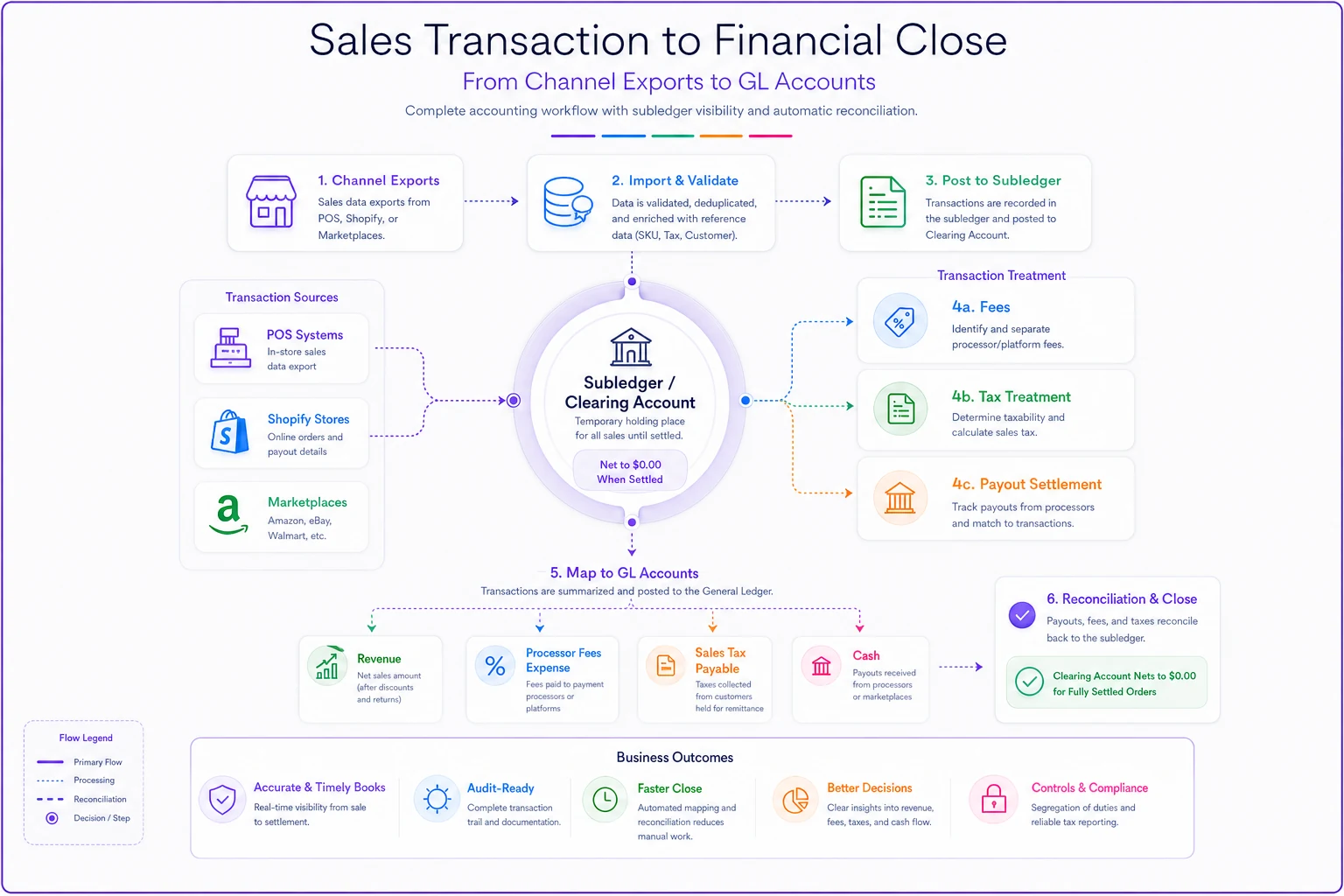
Use that workflow as the canonical reference when building transforms: every channel field must point to exactly one box on that diagram.
Sample transforms
These are the field-level rules that turn messy channel exports into clean journal entries. Treat each as a small, testable transform.
Transform 1 — Shopify order to JE (gross method)
DR Shopify Clearing 89.20 (cash expected after fee) DR Discounts – Online 6.00 DR Processor Fees 2.70 CR Revenue – Online 84.00 CR Shipping Income 5.00 CR Sales Tax Payable 6.90 CR Contra (balancing check) 1.00 -> should be 0
If the balancing line isn't zero, the transform has a gap — usually rounding or an unmapped fee component. Don't paper over it; flag it.
Transform 2 — Amazon settlement (platform remits tax)
DR Amazon Clearing 79.40 DR Referral Fee Expense 4.60 CR Revenue – Marketplace 84.00 Tax collected by Amazon -> Pass-Through Tax (memo), no liability booked
Transform 3 — Payout settlement
DR Cash – Operating 79.40 CR Amazon Clearing 79.40
After Transform 2 and Transform 3, Amazon Clearing for that order = 0. That's the whole point.
The recurring mistake: teams build Transform 1 and Transform 2 but skip the discipline of Transform 3 as a separate matched event. They book the deposit as revenue directly, and the clearing account quietly accumulates. For the deeper mechanics of splitting processor fees cleanly at the transaction level, the breakdown in allocating payment-processor fees per transaction covers the rounding rules that keep these transforms from drifting a cent at a time.
Daily pivot checks
Monthly is too late to catch split-sales — by then you're reconstructing, not reconciling. A few fast pivots run daily (or every close-of-business) catch the vast majority of problems while the data is still fresh.
-
Gross sales by channel (POS/Shopify/Amazon) vs. channel's own report. Any variance beyond a few dollars usually means an unmapped field or a dropped order.
-
Clearing balance by channel, aged. Anything sitting in clearing older than your longest payout window (say, 7 days for Amazon) is a stuck transaction.
-
Fee ratio by channel. Fees ÷ gross. If your Shopify fee ratio normally runs around 2.9% and today it's 4.1%, something got mapped to the wrong bucket.
-
Order count
channel report vs. GL entries.
A count mismatch is the clearest split-sale tell. 412 orders in Shopify, 404 JEs booked — eight orders slipped. -
Refund-to-sale ratio. A spike here often means refunds are being double-counted or mapped against the wrong channel.
Make the order-count check automated: row-level joins between channel export IDs and JE source references catch missing orders faster than dollar-based reconciliations.
That order-count check is underrated. Dollar totals can accidentally tie while individual orders are missing and offsetting each other. Counting rows catches what summing dollars hides — the same row-level logic laid out in row-level reconciliation for billing misses applies directly to channel flows.
Exception-classification rules
Not every mismatch is a crisis. The trick is a fixed classification so your team spends minutes, not hours, deciding what to do. Classify every exception the pivots surface into one of these:
-
Timing (benign). Sale booked, payout not yet arrived, within the normal window. Action: none, monitor.
-
Fee variance. Fee amount differs from expected. Action
re-map fee component, adjust the transform.
-
Tax mismatch. Platform-remitted tax landed in a liability account, or self-remitted tax didn't. Action: correct the tax routing rule.
-
Split-sale. Order exists in channel report but partially/never booked. Action: book the missing legs, investigate the transform gap.
-
Orphan cash. Payout with no matching sale. Action
hold in clearing, escalate — possible prior-period sale or a genuine unidentified deposit.
-
Duplicate. Same order booked twice (common after re-imports). Action: reverse one, add a dedupe key.
Worth internalizing: classes 1 and 2 are routine; classes 4, 5, and 6 are where real dollars leak. If your exception log is 90% timing items, that's a healthy sign. If split-sales and orphans are climbing week over week, your transforms are decaying and need a rebuild, not a patch.
An audit-sample routine for channel flows
Pivots catch aggregate drift. Sampling catches the specific broken transform that aggregates hide. Once a week, pull a small random sample and trace each order end-to-end.
-
Pull 15–20 orders at random across all channels (weight toward the highest-volume channel).
-
For each, trace all four events
sale booked, fee booked, tax handled, payout matched.
-
Confirm the clearing account nets to zero for any order whose payout has settled.
-
Verify the GL revenue amount equals the channel's gross — not the net payout.
-
Check tax treatment matches the channel's facilitator status.
-
Log every break into the exception classes above.
A realistic weekly sample takes one person 30–45 minutes. The value is early detection: a single broken transform touching 2% of orders can bleed quietly for a full quarter before a monthly review catches it. Sampling finds it in week one.
When this routine is overkill
If you're single-channel, low-volume (under roughly 150 orders a month), and your processor deposits net cleanly with a monthly statement you already reconcile, a full daily-pivot-plus-weekly-sample setup is more process than you need. A monthly gross-up check is probably sufficient. The three-layer mapping still matters — what you scale to volume is the frequency of checking.
Who should absolutely run it
Anyone selling across two or more settlement timelines — same-day card deposits plus 7-day marketplace payouts, for example — needs the clearing layer and at least the daily clearing-balance pivot. That timing gap is where split-sales breed.
A real scenario
A home-goods seller doing roughly $90k–$110k a month split across Shopify and two marketplaces had a persistent problem: their bookkeeper booked marketplace payouts as revenue and never grossed up. Revenue looked fine on the P&L, but referral and fulfillment fees were completely invisible — buried inside the net deposits.
When they rebuilt the mapping with clearing accounts and the gross method, two things surfaced. First, around $4,100 a month in marketplace fees had never been recorded as an expense — real money, just hidden inside "revenue." Second, the order-count pivot flagged a batch of roughly 20–25 orders per month that errored on import and were silently dropped — close to $1,800 in monthly sales never booked at all.
After the fix: revenue was recognized gross and accurate, fee expense became visible and negotiable, and the slip-through orders got caught the same week they happened instead of never. The P&L didn't improve in profit terms — but it finally told the truth, and fee visibility alone gave them leverage to push back on one marketplace's rate.
The one rule that prevents most of this
Never let a payout define your revenue. The channel's gross sale defines revenue; the payout only settles cash. Put a clearing account between them, make every clearing balance net to zero, and count your rows daily. Split-sales and slip-through leakage almost always come from collapsing those two ideas into one entry.
Mapping rules aren't glamorous, and nobody notices when they work. But the gap between a ledger that ties and one that merely looks right is exactly the width of a well-built clearing account and a weekly sample — and that gap is where the money quietly goes.
Mapping rules aren't glamorous, and nobody notices when they work. But the gap between a ledger that ties and one that merely looks right is exactly the width of a well-built clearing account and a weekly sample — and that gap is where the money quietly goes.
Ready to take control of your finances?
Join over 2,000 businesses using Acctaly to simplify accounting, accelerate cash flow, and ensure tax readiness.