

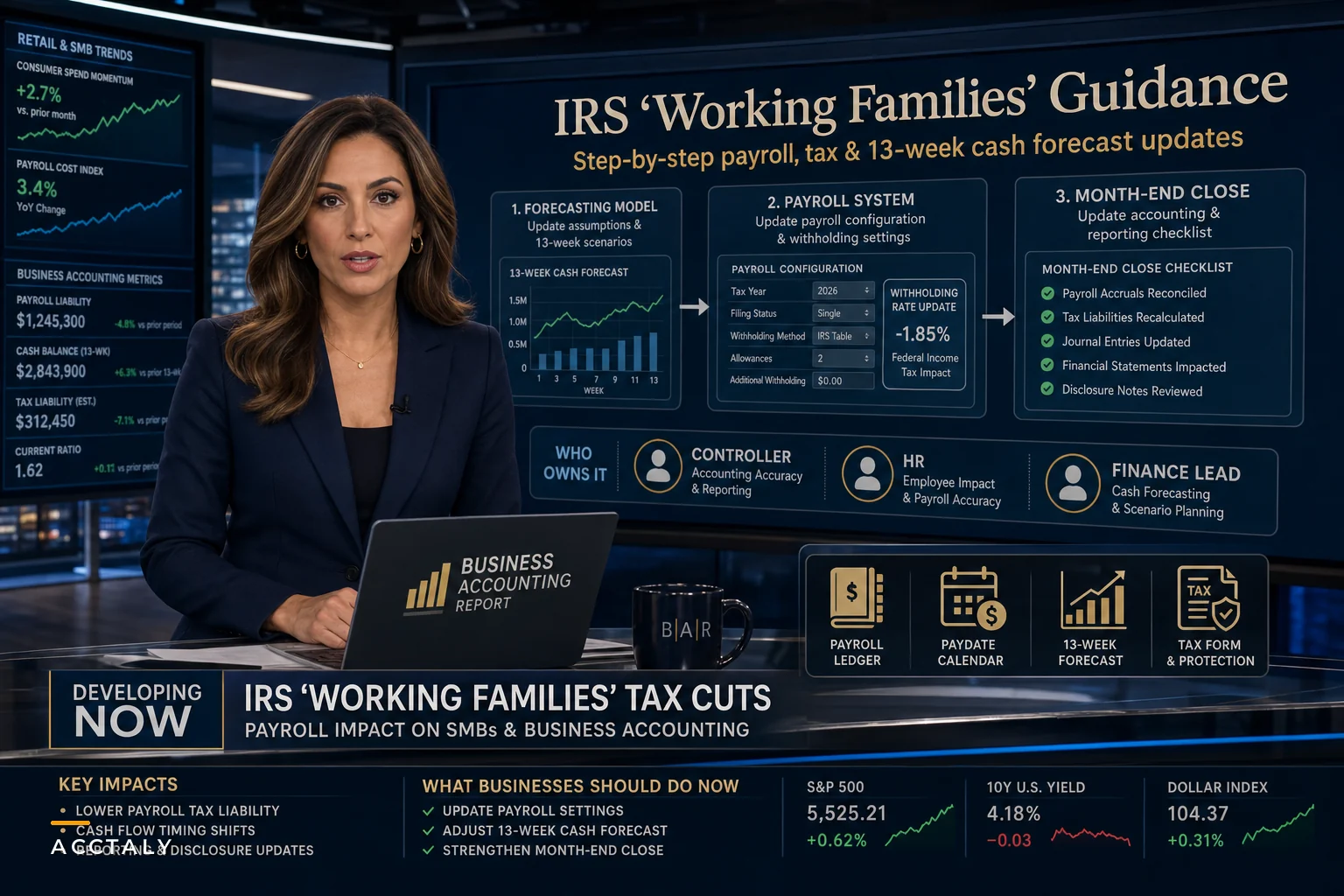

The IRS dropped their Working Families Tax Cuts update on July 28th, and if you're running payroll for a small–medium business, you've got roughly three weeks to figure out what actually changes before your next quarter-end close. The guidance page looks straightforward enough—depreciation adjustments, Employee Retention Credit limits, third-party network transaction rules. But what catches most SMBs off guard is that these aren't just compliance checkboxes. They're cash flow events that ripple through your entire forecast.
Last month I watched a 40-person logistics company scramble when depreciation schedule changes meant a $47,000 swing in their Q3 tax liability. Not because they missed the guidance—their bookkeeper flagged it immediately. The problem was their cash forecast treated tax adjustments as quarterly true-ups instead of weekly cash events. By the time they caught the impact, they'd already committed to equipment purchases based on outdated projections.
The operational gap between tax guidance and cash reality
Tax updates create this weird disconnect. Your payroll system needs new withholding tables. Your accounting software needs updated depreciation schedules. Your forecast model needs revised tax payment projections. But these systems rarely talk to each other in real-time, especially in businesses running QuickBooks for accounting, ADP for payroll, and Excel for cash forecasting.
Think about what actually happens when depreciation rules change. Your controller updates the fixed asset schedule. Maybe they email finance about the deferred tax impact. But does that automatically flow into next week's cash forecast? Does it trigger a review of your equipment purchase pipeline? Usually not. The information sits in silos until someone manually connects the dots during month-end close—weeks after the cash impact already started.
Third-party network transaction rules create an even messier problem. If you're processing payments through Stripe or Square, reporting thresholds affect both your tax liability and your reconciliation processes. A retail chain with 12 locations discovered this when their marketplace sales suddenly triggered different reporting requirements mid-quarter. Their 13-week forecast showed healthy cash reserves, but accelerated tax payments from the new reporting rules ate up roughly $23,000 in working capital they'd allocated for inventory.
Why traditional payroll and tax workflows break under regulatory shifts
Most SMB finance teams treat regulatory updates like annual events. Update the payroll tables in January. Review depreciation schedules at year-end. Adjust forecasts quarterly. That worked fine when tax changes happened predictably. Mid-year adjustments like the Working Families guidance completely break this rhythm.
Stop letting accounting slow your business down.
Acctaly automates your financial operations so you can focus on growth and compliance.
- Automated bookkeeping
- Real-time financial reporting
- Integrated tax management
No credit card required
Here's what typically goes wrong:
Your payroll provider sends a notification about updated withholding tables. Someone forwards it to HR. HR assumes finance knows. Finance assumes payroll is handling it. Three pay periods later, you discover you've been under-withholding and now face both a compliance issue and an unexpected cash outflow to catch up.
The depreciation changes hit differently. Equipment you bought in Q1 under old rules suddenly has different treatment in Q3. Your monthly tax accruals are off. Your forecast assumes one depreciation schedule while your books reflect another. The variance doesn't show up until quarter-end reconciliation, and by then you've made spending decisions based on phantom cash.
Employee Retention Credit limits add another layer. Businesses that claimed credits earlier in the year now face caps and documentation requirements that weren't clear six months ago. The cash you thought was coming might be reduced or delayed—but your forecast still shows those credits as receivables, inflating your projected cash position.
Building a response system that actually works
The businesses that handle these transitions smoothly don't have better software or bigger teams. They have better coordination between tax compliance and cash operations.
Weekly tax impact reviews: Stop treating tax changes as quarterly events. Every Monday, someone needs to check three things: upcoming payroll runs for withholding accuracy, pending equipment purchases for depreciation treatment, and receivables for credit eligibility changes. Maybe 30 minutes, but it catches issues while they're still manageable.
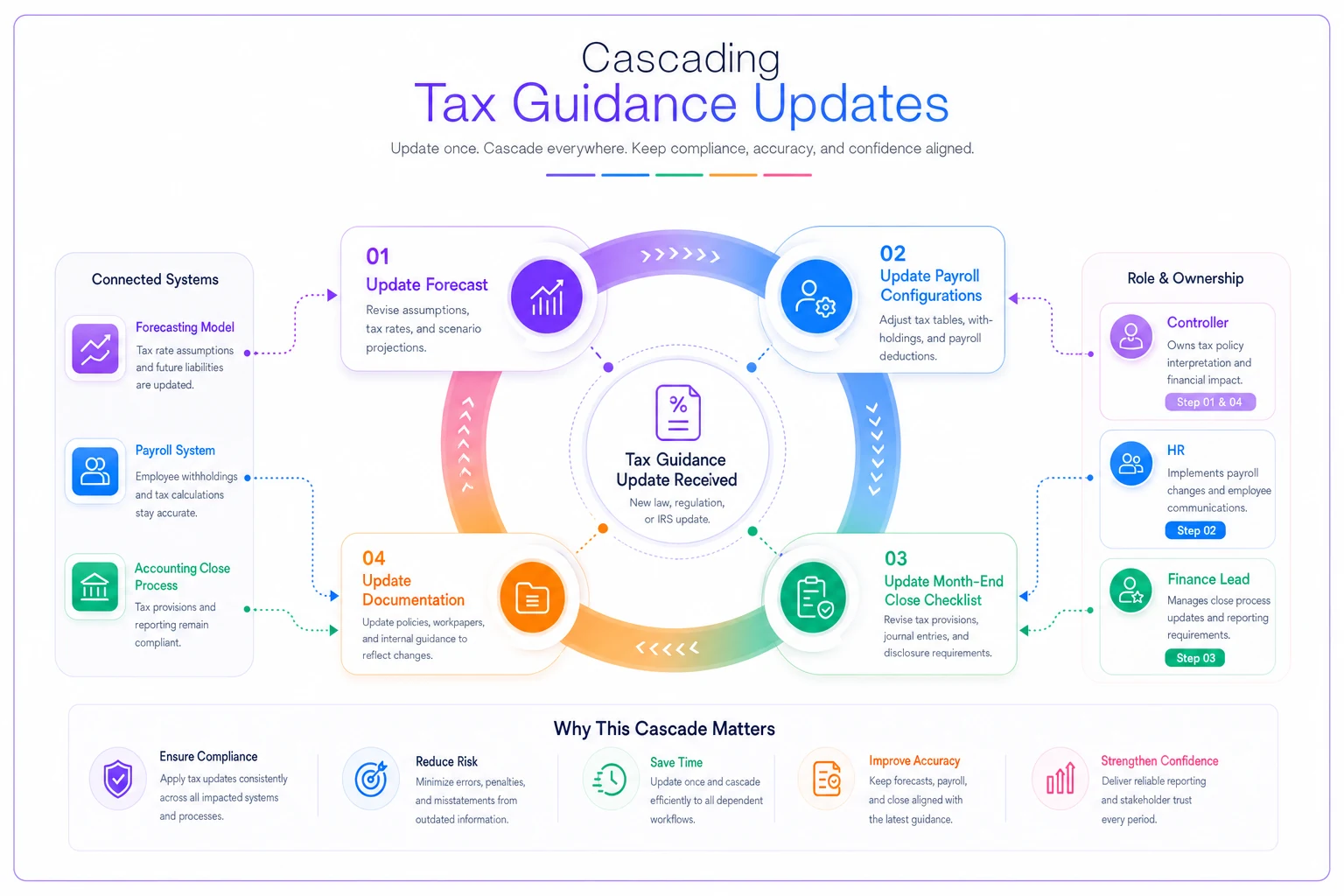
Cascade updates through systems: When tax guidance changes, work through a specific update sequence.
-
First, update your forecast model with new tax payment dates and amounts.
-
Second, adjust payroll configurations.
-
Third, modify your month-end close checklist to reconcile the new requirements.
-
Fourth, update documentation for the audit trail.
The order matters—forecast first, so you know the cash impact before you start implementing changes.
Visualizing the cascade can help teams follow the sequence.
A 28-person professional services firm got this right. When the guidance dropped, their finance lead pulled the 13-week forecast and modeled three scenarios: immediate compliance, phased implementation, and maximum deferral. They found that immediate compliance would create a $19,000 cash crunch in week 6. So they pushed AR collections to accelerate roughly $25,000 in receivables before implementing the payroll changes. No scramble, no surprise.
The hidden complexity in benefit-related reporting changes
The Working Families guidance includes provisions about employer benefit reporting that most SMBs ignore until audit season. These aren't just administrative headaches—they affect your cash position through potential penalties and compliance costs.
Consider how benefit reporting flows through a typical SMB. Your benefits administrator tracks enrollments. Payroll processes deductions. Accounting records the liability. But new reporting requirements pull data from all three systems, formatted specifically for IRS compliance. Missing or mismatched data triggers penalties that weren't in anyone's budget.
A distribution company with 45 employees ran into this when their benefit provider changed mid-year. The old provider's data export didn't match the new IRS reporting format. They spent around $8,000 on consulting fees reconstructing six months of benefit records—money that wasn't in any forecast because nobody had anticipated the gap.
Integrating tax changes into your existing 13-week forecast
You already have a cash forecast. It probably tracks AR, AP, payroll, and major expenses. But tax impacts often get lumped into a single "taxes" line that updates quarterly. That's not granular enough when regulations shift mid-stream.
Your 13-week rolling forecast needs dedicated rows for each tax impact category: federal withholding adjustments, state withholding changes, depreciation-driven tax liability shifts, and credit timing changes. And don't just update the amounts—update the timing. A $10,000 tax impact in week 8 versus week 12 completely changes how you manage working capital.
| Week | Base Payroll | Fed Withholding Adj | State Withholding Adj | Depreciation Impact | Credit Timing | Net Tax Cash Impact |
|---|---|---|---|---|---|---|
| 1 | $85,000 | -$420 | -$180 | $0 | $0 | -$600 |
| 2 | $85,000 | -$420 | -$180 | $0 | $0 | -$600 |
| 3 | $85,000 | -$420 | -$180 | $2,300 | $0 | $1,100 |
| 4 | $85,000 | -$420 | -$180 | $0 | -$5,000 | -$5,600 |
The adjustments column shows the incremental impact, not the total tax. This lets you see exactly how the Working Families changes affect your cash week by week, separate from your normal tax flows.
Common mistakes that amplify tax update impacts
Businesses make three consistent errors when tax guidance changes, and each one compounds the cash impact:
Treating payroll providers as compliance partners: Your payroll company will update their tax tables, but they won't tell you how it affects your specific cash position. They process payroll, not cash forecasts. Assuming they'll flag cash impacts is like assuming your bank will remind you about upcoming loan covenants—not their job.
Delaying documentation updates: The Working Families guidance requires specific documentation for various credits and deductions. Waiting until quarter-end to gather this doesn't just risk compliance—it delays your ability to accurately forecast the cash benefit. You might be running lean on working capital while eligible credits sit unclaimed because the paperwork isn't in order.
Ignoring state-level echoes: Federal tax changes often trigger state-level adjustments that lag by 30 to 90 days. Your forecast might account for federal impacts but miss the state changes that follow. A California manufacturer got hit with this when federal depreciation changes triggered California conformity adjustments two months later, creating an unexpected $31,000 state tax payment that nobody had planned for.
Building systematic tax response into your close process
Month-end close is where tax impacts become real. But most close processes treat tax as a single reconciliation line. When guidance changes mid-year, you need more granular control.
Reconcile each tax impact category separately. Don't just check that total tax matches—verify that withholding changes, depreciation adjustments, and credit modifications each reconcile independently. This catches errors before they compound.
Project the next 90 days of tax impacts based on current run rates. If withholding changes increased your weekly tax payment by $600, project that forward and compare to your forecast. Variances indicate either operational issues or forecast problems.
Document your guidance interpretation. The Working Families provisions leave room for interpretation on timing and application. Write down how you're interpreting each provision and what assumptions you're making. This protects you during audits and keeps things consistent as your team changes.
The technology gap that makes compliance harder than it should be
Here's the uncomfortable reality about SMB finance operations: your systems probably can't handle these changes cleanly. QuickBooks doesn't automatically update depreciation schedules when IRS guidance changes. Your payroll system doesn't push withholding changes into your forecast model. Excel doesn't know that tax credits have new limits.
So you end up with a maze of manual updates. Someone has to remember to change settings across three different systems, export data from each, manipulate it in a spreadsheet, and hope nothing gets lost along the way. Every manual step is a potential error, and errors in tax calculations compound fast.
That logistics company I mentioned earlier? Their controller spent about 12 hours over two weeks just coordinating updates across systems. Twelve hours not spent on analysis or strategic planning—just basic compliance coordination.
Modern operational platforms can centralize this. When tax guidance changes, you update rules once and they flow through payroll calculations, forecast models, and compliance reporting. AI-assisted platforms can also flag when tax impacts don't match between systems, catching disconnects before they turn into real problems.
What this means for your next 90 days
The Working Families Tax Cuts guidance isn't just another compliance update. It's an operational stress test that reveals how well your finance systems actually work together. The businesses that struggle aren't necessarily smaller or less sophisticated—they're running disconnected systems that don't share information effectively.
Your immediate priority is mapping the cash impact. Not just the compliance requirements, but the actual week-by-week cash flow changes. Pull your forecast, add the granular tax impact rows, and model the next 13 weeks with the new rules. You'll probably find surprises.
Then establish the update cascade process. When the next guidance update drops—and there will be more—you need a systematic way to flow changes through operations. Clear sequences and clear ownership matter more than perfect software.
Use this as a catalyst to evaluate your operational integration. If updating tax tables requires manual work across three systems, you have an integration problem that goes beyond tax compliance. The same disconnect that makes tax updates painful probably also makes month-end close longer and forecasting less accurate.
The Working Families guidance exposed what most SMBs already suspected but hadn't quantified: tax compliance and cash management are operationally intertwined but organizationally separated. Bridging that gap—through better processes, integrated systems, or operational platforms that handle the complexity automatically—is what separates businesses that absorb regulatory changes from the ones that get knocked sideways by them.
Ready to take control of your finances?
Join over 2,000 businesses using Acctaly to simplify accounting, accelerate cash flow, and ensure tax readiness.