

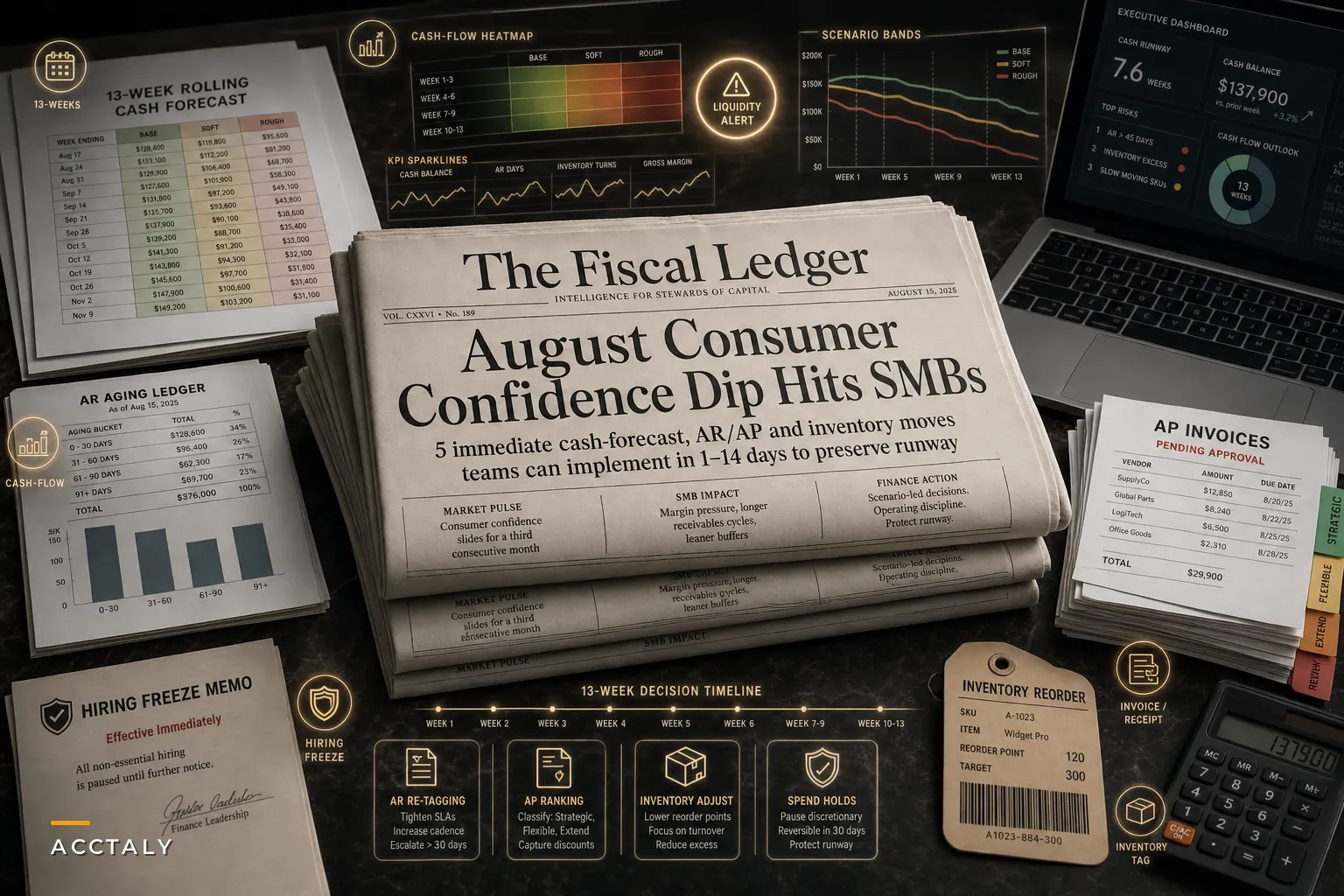

The Conference Board's August 2026 reading came in at 89.4, a step down that Reuters flagged as a pullback in households' short-term outlook. For a big-cap retailer, that's a data point for the next earnings call. For a business running on six to twelve weeks of cash, it's a warning that shows up first in your collections, then your shelves, then your payroll math.
Most SMBs either overreact — slashing everything at once — or dismiss it entirely because "confidence surveys don't mean anything for us." Both cost money. The right move is narrower: treat the dip as a trigger to re-run a handful of specific numbers and adjust a few operational levers, not to redesign your whole business.
Here are the five moves, in the order that actually protects cash.
Move 1: Re-forecast collections before you touch anything else
When confidence softens, the first place it lands isn't your top-line revenue — it's the timing of money you've already earned. Customers who paid in 30 days start paying in 40. B2B clients who were about to renew go quiet for two weeks. Your DSO creeps up before your sales pipeline visibly shrinks.
That's why the very first thing to re-run is your collections curve, not your sales forecast. Most owners get this backwards. They spend a week rebuilding revenue assumptions while a $40k receivable that was "definitely coming Friday" quietly slips into next month and blows a payroll run.
-
Splitting receivables into "will pay on time," "usually slow," and "at risk"
-
Looking at each customer's actual last-90-day payment behavior, not their terms
-
Flagging anything from a customer in a demand-sensitive sector — discretionary retail suppliers, event vendors, anyone selling "nice to have" goods
The customers who slip in a soft month aren't random. It's usually the same 15–20% of your book that was already paying slightly late. A confidence dip nudges them from 5 days late to 20 days late — and that concentration is what breaks a forecast that assumed averages.
Prioritize the 15–20% of accounts that historically pay late — shoring up those receivables gives you the most forecast lift.
Worth keeping in mind before you assume your AR is fine because the totals look okay.
Move 2: Rank your AP by "what actually happens if this is late"
Once you have a cleaner picture of money coming in, you look at money going out — but not to blanket-delay everything.
Stop letting accounting slow your business down.
Acctaly automates your financial operations so you can focus on growth and compliance.
- Automated bookkeeping
- Real-time financial reporting
- Integrated tax management
No credit card required
The mistake is treating all payables as equally deferrable. They aren't. Some suppliers charge nothing for a week's delay. Some cut you off. Some offer a 2% discount for early payment that's worth taking even now if your collections look solid.
Sort your AP into a simple grid based on two questions: how much leverage does this vendor have over your operations, and what's the real cost of paying late?
| Vendor type | If you delay 10–14 days | Action during a soft month |
|---|---|---|
| Sole-source / critical supply | Production or delivery stops | Protect this. Pay on time, always. |
| Easily replaceable, no penalty | Nothing meaningful | Safe to stretch to full terms |
| Early-pay discount offered | You lose ~1.5–2% | Only take discount if collections are confirmed |
| Utilities / rent / payroll | Legal / reputational / people risk | Never a lever. Fund these first. |
The point of the grid isn't to nickel-and-dime vendors. It's to know, in advance, exactly which three or four invoices you'd delay if a big receivable slips — so the decision takes ten minutes instead of a stressful afternoon. That's most of the value right there.
Move 3: Freeze the reorder, not the whole inventory plan
Inventory is where a confidence dip does the quietest damage. Demand softens gradually, but purchasing runs on old assumptions, so you keep buying at the same clip for another cycle or two. By the time it's obvious, you've got cash sitting on shelves.
A typical situation: a specialty home-goods retailer doing somewhere around $90k–$110k a month sees August foot traffic dip maybe 8%. Not dramatic. But their auto-reorder points were set on spring numbers. Two purchase cycles later they're carrying an extra $25k–$30k in slow-moving SKUs, right when they needed that cash for a lease renewal. Nobody made a bad call — the system just kept executing the old plan.
-
Fast movers / staples — keep ordering; these hold up even when demand softens
-
Discretionary / higher-margin "want" items — cut reorder quantities 15–25% and shorten the reorder window so you're buying closer to actual sell-through
-
Anything already slow before August — stop reordering entirely and plan a markdown to convert it back to cash
That third one gets skipped most often. A soft month is actually a reasonable time to run a controlled clearance on stale inventory — turning $15k of dead stock into $9k of cash is a decent trade when you're trying to protect runway. Owners resist it because it feels like admitting a mistake. It isn't. It's just a liquidity decision.
Move 4: Put discretionary spend and hiring on a two-week hold — with a defined exit
This is Move 4, not Move 1. Cutting spend is the instinct everyone reaches for first, and it's usually the wrong sequence — you end up cutting blind before you know how bad things actually are.
Do the collections and inventory work first. Then apply a light touch to discretionary spend, with the key word being reversible. A confidence dip is a short-term signal, and the Conference Board's own consumer confidence data bounces month to month. You don't want to lay off a person or kill a marketing channel over one reading and then scramble to rebuild in October.
-
Pause, don't cancel delay a discretionary hire by two to four weeks, don't rescind the role
-
Hold new tooling and subscriptions for the same window
-
Keep spend that directly drives collections or sales — this is not the time to cut the thing bringing customers in
-
Set an explicit review date so "temporary freeze" doesn't quietly become permanent paralysis
The businesses that handle a soft patch well aren't the ones that cut fastest. They're the ones that cut reversibly and already know what triggers the un-freeze. That distinction matters more than most people think.
Move 5: Run the whole thing through a 13‑week scenario, not a gut feel
Every move above is a lever. What tells you how hard to pull each one is a rolling 13‑week cash forecast — specifically, a version with two or three scenarios sitting side by side.
A single-line forecast tells you what happens if your assumptions hold. But the entire point of a confidence dip is that your assumptions might not hold. You want to see what a "collections slow by 10 days and discretionary sales drop 12%" week looks like before it arrives, so the AP and inventory decisions are already staged.
-
Base current collection behavior, current reorder plan
-
Soft DSO up ~10 days, discretionary revenue down 10–15%, staples flat
-
Rough DSO up ~20 days, a key customer delays, discretionary down 25%
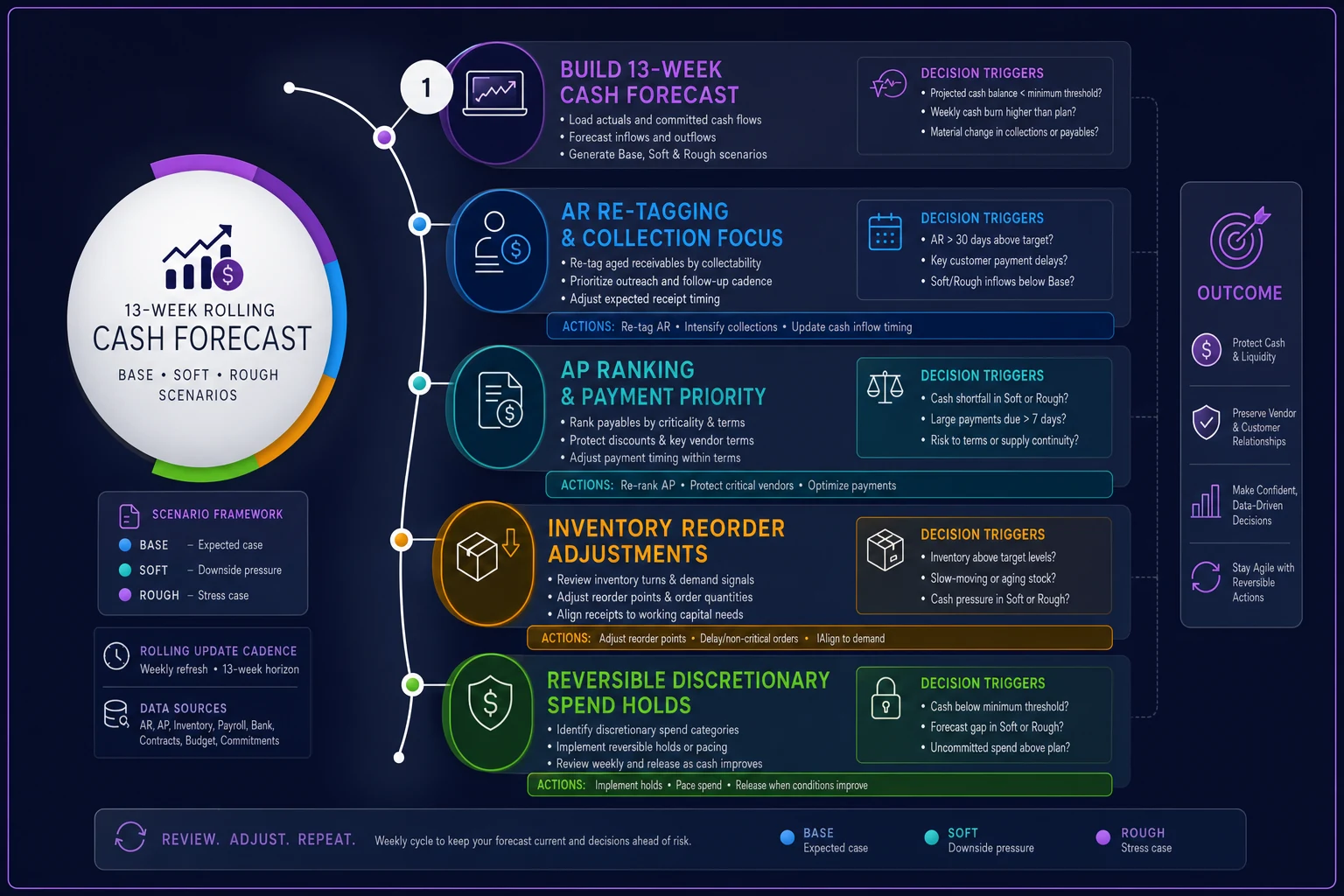
This diagram maps scenario outputs to the AP, AR, inventory, and discretionary spend actions so you know which levers to stage and when.
Then find the first week either the Soft or Rough case dips below your minimum cash floor. That week is your trigger point. Everything above — which AP to delay, which reorder to cut, when to launch the clearance — gets sequenced backward from there. You're no longer reacting; you're executing a plan you already made.
If you don't have a rolling forecast running yet, this is exactly when it earns its keep. We walked through building one end to end in this guide on turning short-term uncertainty into predictable liquidity, and a confidence dip is precisely the kind of event it's designed to absorb without a fire drill.
A quick real scenario
A regional catering company — around $1.4M in annual revenue, event-driven, genuinely exposed to discretionary spending — noticed two things in the weeks after the August reading: a couple of corporate clients pushed events to Q4, and one wedding deposit came in slow.
Nothing catastrophic. But their habit was to keep buying non-perishable supplies on the same schedule and pay all vendors on invoice date. Working through the five moves, they:
-
Re-tagged AR and caught roughly $22k of receivables that were realistically 2–3 weeks slower than booked
-
Delayed about $8k in non-critical supplier payments to full terms, while protecting their one sole-source specialty vendor
-
Cut reorder quantities on non-perishables by ~20% and paused a planned equipment purchase
-
Held one seasonal hire for three weeks with a defined review date
The result wasn't dramatic and didn't need to be. Their tightest projected week went from roughly $6k under their cash floor to about $11k above it — bought with decisions that were all reversible if September came back strong. That's the whole game: buy yourself margin without burning anything you'd regret rebuilding.
A single confidence number won't sink an SMB. What sinks them is running last quarter's operating plan for one or two cycles too long after demand quietly shifts. The dip is just a prompt to check whether your collections assumptions, your reorder points, and your AP timing still match reality.
Work through the five moves in order — collections, AP ranking, inventory, reversible spend holds, scenario forecast — and you convert a vague macro headline into four or five concrete decisions you can make this week. Skip the order and you'll either overcut on fear or find out too late that the slow-paying slice of your book quietly took your payroll cushion with them.
Ready to take control of your finances?
Join over 2,000 businesses using Acctaly to simplify accounting, accelerate cash flow, and ensure tax readiness.