



Most finance teams don't have an evidence problem until the moment they desperately do. The bank wants supporting docs for a loan covenant. A new investor's diligence checklist lands in your inbox. The sales-tax auditor picks three months and asks for everything behind the numbers. And suddenly a team that closes the books cleanly every month is digging through Slack threads, three email accounts, a shared drive nobody named consistently, and someone's desktop folder called finalFINALv2.
The numbers are usually fine. The evidence is a mess. That gap—clean books, scattered proof—is one of the most expensive and least-discussed weaknesses in SMB finance.
The fix isn't "organize your files better." It's treating evidence as something with a lifecycle: it gets created under a policy, captured at the right moment, retained for a defined period, archived when it goes cold, and retrieved on demand. Each stage has its own failure modes. When you design around the whole lifecycle instead of reacting at retrieval time, audit-readiness stops being a fire drill and becomes a background condition.
Why evidence breaks even when the books don't
Books are a system. Evidence is usually a byproduct. Your close has a cadence, owners, reconciliations, and a review step. Evidence—the invoice PDF, the approval screenshot, the signed contract, the bank confirmation—gets generated as a side effect of real work and then scattered wherever the work happened.
A typical example looks like this. The AP clerk approves an invoice inside the bill-pay tool. The approval lives there. The vendor contract lives in a legal folder. The W-9 is an email attachment from 14 months ago. The GL entry references a bill number but not a document path. Four systems, zero connective tissue. Everything is technically somewhere. Nothing is findable.
-
Volume grows and memory stops scaling
-
The person leaves and takes the mental map with them
-
Someone external asks for a specific document trail on a 48-hour deadline
Evidence quality is almost never tested until it's tested under pressure. There's no "evidence close." Nobody signs off that the proof exists and is retrievable. So the rot accumulates silently and only surfaces during the worst possible week.
The five stages, and what actually goes wrong in each
Think of evidence as moving through five stages. Each one has a distinct owner and a distinct way of failing.
Stop letting accounting slow your business down.
Acctaly automates your financial operations so you can focus on growth and compliance.
- Automated bookkeeping
- Real-time financial reporting
- Integrated tax management
No credit card required
| Stage | What it means | Primary owner | How it fails in practice |
|---|---|---|---|
| Policy | The rule that says what evidence must exist and for how long | Finance lead / controller | Rules exist in people's heads, never written down |
| Capture | Grabbing the document at the moment of the transaction | Whoever does the work (AP, AR, payroll) | Capture is optional, so it's inconsistent |
| Retention | Keeping it accessible for a defined active period | Finance ops | No defined period, so everything is kept forever or nothing is kept |
| Archival | Moving cold evidence to cheaper, immutable storage | Finance ops / IT | Archive = "the old drive," which is neither safe nor indexed |
| Retrieval | Finding and producing it on demand with context | Finance lead | Takes days, requires the original person, often incomplete |
The insight most teams miss: capture is the cheapest stage to fix and the one everyone ignores. Catching the document at the moment the transaction happens costs almost nothing. Reconstructing it eight months later—emailing a vendor for a duplicate invoice, screenshotting an approval that's since scrolled out of view—can cost hours per item. The economics of evidence are brutally front-loaded. A minute at capture saves an hour at retrieval.
The master-index model
The single structural change that fixes most of this is a master index: one lightweight registry that maps every piece of evidence to the transaction, control, or report it supports. You don't move all your documents into one place. You create one index that points to where everything lives and carries the metadata that makes it findable.
Think of it as the card catalog, not the library. The invoice PDF can stay in your bill-pay tool. The contract can stay in your document system. The index just needs to know it exists, where it is, what it supports, and how long you're keeping it.
A workable master-index row has these core fields:
-
Evidence ID — a unique, sortable identifier
-
Evidence type — invoice, contract, bank statement, approval, reconciliation, journal support, W-9, payroll register
-
Supports — what it proves (GL account, control ID, report line, period)
-
Source system — where the original lives
-
Location / link — direct path or URL
-
Owner — who's accountable for it existing
-
Capture date — when it entered the system
-
Retention class — which retention rule applies
-
Retention-through date — the computed "safe to archive/delete" date
-
Status — active / archived / under legal hold
Start the index as a simple spreadsheet and add metadata fields only as you need them so the index stays lightweight and used.
The power of this model is that it decouples where things live from how you find them. Your systems can be messy and distributed. The index stays clean and single-source. When the auditor asks for "support behind the Q2 deferred revenue balance," you filter the index on that report line and the period, and you get a list of linked artifacts in seconds instead of a scavenger hunt.
A naming and metadata schema that survives growth
YYYYMMDD[type][counterparty-or-ref][amount][period]
So an invoice becomes 20240615INVacme-supply48202024-06. It sorts by date, tells you what it is at a glance, and is unique enough to avoid the final_v2 problem. The exact format matters less than picking one and enforcing it. Inconsistent naming is worse than ugly naming—ugly-but-consistent is at least searchable.
The metadata schema is where the real leverage sits. At minimum, tag every artifact with: period, entity (if you have multiple), transaction reference, control reference, and retention class. Those five tags turn a pile of files into a queryable dataset.
One-page policies that people actually follow
Evidence policies fail when they're 11-page documents nobody reads. What works at SMB scale is a one-page policy per evidence domain—AP, AR, payroll, bank, revenue recognition—that answers four questions and nothing else:
-
What must be captured? (the specific artifacts)
-
When and by whom? (the trigger and the owner)
-
How long do we keep it? (the retention class)
-
Where does it get indexed? (the master-index requirement)
A policy that fits on one page gets followed. A policy that reads like a legal brief gets ignored and then cited defensively after something goes wrong.
The enforceable part is the capture trigger. "Capture the invoice when you approve the bill" works because it's bolted to an action people already take. "Make sure invoices are filed" fails because it becomes a separate task competing with everything else. Good evidence policy rides on existing workflows rather than adding new ones.
Retention: stop keeping everything and keep the right things
Two failure modes, opposite directions. Some teams keep nothing past a year because storage feels cluttered. Others keep everything forever because deleting feels risky. Both are wrong, and both create liability.
Retention should be tiered by evidence type, because different artifacts have genuinely different useful lives and legal requirements. Here's a retention matrix that works for most SMBs—confirm specifics against your jurisdiction and any lender or regulatory requirements:
| Evidence type | Active retention | Archive retention | Notes |
|---|---|---|---|
| Tax returns & support | 3 years active | Keep 7+ years | Longer if there are loss carryforwards |
| Payroll records | 3 years active | Keep 4–7 years | Varies by jurisdiction |
| Bank statements & recs | 1 year active | Keep 7 years | Core audit trail |
| AP/AR invoices | 1 year active | Keep 7 years | Supports revenue & expense |
| Contracts | Life of contract | Keep 7 years post-termination | Disputes surface late |
| Fixed-asset records | Life of asset | Keep 7 years post-disposal | Depreciation support |
| Reconciliations | 1 year active | Keep 3–5 years | Control evidence |
| Board & approval docs | 3 years active | Permanent for key decisions | Governance trail |
"Active" means instantly retrievable—it's in your working systems and the master index. "Archive" means moved to cheaper, immutable storage but still indexed, so you can produce it in days rather than never. Keeping everything instantly accessible is expensive and noisy, but losing cold evidence entirely is a real exposure. The distinction matters.
Archival that isn't just "the old drive"
Archival is the stage SMBs do worst. The default is an external drive in a drawer, or a shared folder nobody touches, or—genuinely common—a former employee's Google account that's still paying $6 a month because someone's afraid to cancel it.
Real archival has three properties:
-
Immutable — archived evidence can't be quietly edited, which is the whole point of evidence
-
Indexed — it stays in the master index with status
archived, so you still know it exists -
Recoverable on a schedule — you know how long retrieval takes and have tested it
The mistake to avoid: treating archival as deletion-adjacent. Archived evidence isn't gone; it's one tier colder. If it falls out of the index when it's archived, you've effectively lost it—you just haven't noticed yet.
Retrieval and QA: the stage that proves the rest worked
Everything upstream exists to make retrieval fast and complete. So retrieval deserves its own workflow and its own quality check.
A practical retrieval workflow:
-
Translate the request into index filters — period, report line, control ID, counterparty
-
Pull the matching index rows and their linked locations
-
Verify each link resolves to a real, readable artifact
-
Check completeness against the control or report line (did we get all the support, or just most?)
-
Package with a cover note explaining what each artifact proves
-
Log the retrieval so repeat requests are faster next time
The workflow below shows the retrieval process.
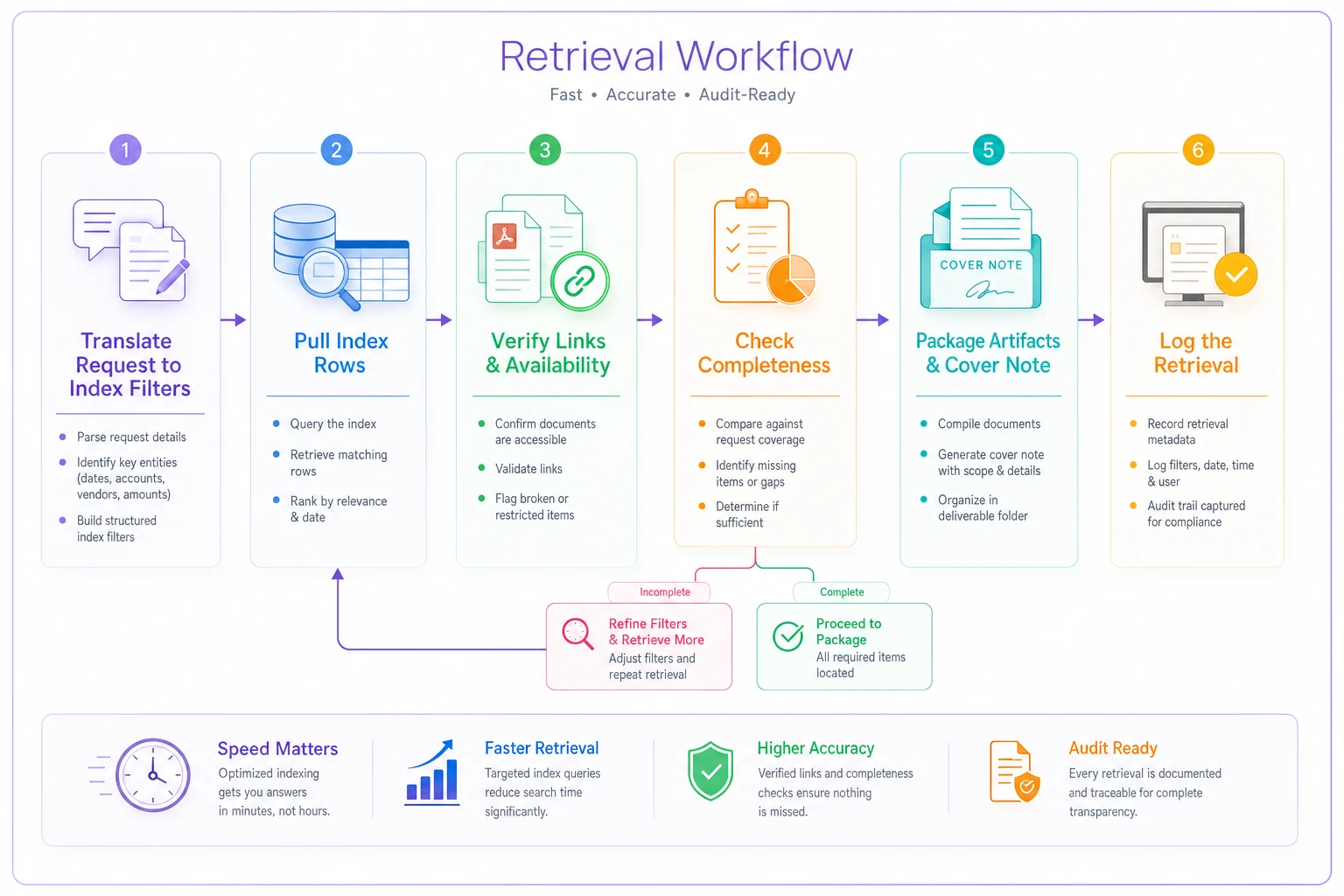
The QA layer most teams skip is step 4—completeness. It's not enough to produce some evidence. For a given balance or control, you need to know what should exist and confirm it all does. This is where a periodic self-test pays off: pick a handful of transactions or control points each month, run them through the full retrieval workflow, and see what breaks. Broken links, missing captures, orphaned documents—you want to find those during a quiet Tuesday, not during diligence.
Remediation cadence: what to do when the index finds gaps
The index will surface problems. That's its job. The point is having a standing cadence for fixing them instead of letting gaps pile up:
-
Weekly — confirm new high-value transactions (anything over a threshold you set) have captured, indexed evidence
-
Monthly — run a retrieval spot-check on 5–10 items across domains; fix every broken link or missing artifact found
-
Quarterly — review retention classes, archive what's gone cold, confirm archive is still recoverable
-
Annually — full index audit, policy refresh, and a dry-run of a real external request
Remediation works when it's small and constant. A missing W-9 found this week takes ten minutes to chase. The same gap found during an audit two years from now, with the vendor long gone, can be genuinely unresolvable.
A real scenario
A specialty wholesaler, roughly $6M in revenue, about nine people, two of them in finance. Clean monthly close, books nobody worried about. Then a lender refinancing their line asked for supporting evidence behind 18 months of a specific expense category plus all related contracts.
It took them close to three weeks. The invoices were spread across an old bill-pay tool and the current one after a mid-period switch. Several contracts only existed in a departed employee's email. Two vendors had to be contacted for duplicate copies. The finance lead estimated she burned somewhere around 50–60 hours on retrieval alone, and the delay nearly pushed the refinancing past a rate lock.
Afterward they built a master index—nothing fancy, a structured sheet to start—and enforced capture at the point of approval with a one-page AP evidence policy. They set retention classes and started a monthly 10-item spot-check. Eight months later a sales-tax inquiry hit. They produced the full requested trail in under a day. Same team, same systems underneath. The only thing that changed was that evidence had a lifecycle instead of a last-minute scramble.
When this level of structure makes sense (and when it doesn't)
When it makes sense: You're past roughly $2–3M in revenue, you have external parties who ask for evidence (lenders, investors, auditors, tax authorities), you've switched systems at least once, or you've had turnover in finance. Any of those and the lifecycle approach pays for itself the first time someone external asks.
When it's overkill: A true solo operation under $500k with one system and no external evidence demands probably doesn't need a formal master index yet—though even then, consistent naming and capture-at-the-moment habits cost nothing and prevent future pain.
Who should not do this: Nobody should try to retrofit everything at once. The failure mode here is deciding to index ten years of history in one heroic month. Don't. Start the index at today's date, enforce capture going forward, and backfill only the high-value historical items you're actually likely to be asked about.
Where tooling fits—quietly
You can run a master index in a spreadsheet, and plenty of SMBs should start exactly there. The friction shows up in enforcement: capture that depends on someone remembering, index rows that depend on someone pasting a link, retention dates that depend on someone doing the math. That's where operational platforms with AI-assisted automation start to earn their place—auto-capturing documents at the transaction moment, tagging metadata consistently, computing retention-through dates, and flagging broken links or missing support before anyone asks.
The tool shouldn't replace the lifecycle thinking; it should remove the manual steps that make the lifecycle fall apart under volume. The discipline comes first. Automation just keeps it from degrading as you scale.
The point
Evidence isn't a folder you fill before an audit. It's a lifecycle that runs continuously whether you manage it or not—and if you don't manage it, it runs toward entropy.
Policy defines what must exist. Capture grabs it cheaply at the source. Retention and archival keep it the right length of time in the right tier. Retrieval and QA prove the whole thing worked. A master index stitches all five stages together so your books and your proof finally live in the same reality.
The teams that stay audit-ready aren't the ones who panic better. They're the ones who made evidence boring—captured on time, indexed once, retrievable on demand. If you want a sense of exactly which artifacts outside reviewers scrutinize most, it's worth understanding what auditors actually look for so your lifecycle prioritizes the evidence that carries the most weight. Build the index, enforce capture, set a remediation cadence, and the next time someone asks for proof, you answer in an afternoon instead of three weeks.
Ready to take control of your finances?
Join over 2,000 businesses using Acctaly to simplify accounting, accelerate cash flow, and ensure tax readiness.