



Late September 2026, a U.S. federal court certified a class of payment-card issuers suing Apple over the fees it charges on Apple Pay transactions. The plaintiffs claim Apple collects 0.15% on credit and half a cent on debit, and they're after recovery plus changes to how Apple prices the service. As Payments Dive reported, certification clears the way for thousands of issuers to join—which raises the real possibility of refunds, revised fee structures, or new pricing norms working their way through the payments stack over the next several quarters.
The part most SMB finance teams miss: you're not the defendant, you're not the plaintiff, and you probably don't even see "Apple Pay" as a distinct line on your merchant statement. That's exactly the problem. When fee flows shift upstream—between Apple and issuers—the downstream effects eventually land in interchange, in processor markups, or in retroactive credits that nobody on your team is set up to catch. If your books can't isolate the mobile-wallet slice of your card volume, you won't know whether a pricing change helped you, hurt you, or did nothing at all.
This isn't about the lawsuit's merits. It's about whether your fee accounting is granular enough to survive a period where card economics are in motion.
Why this lands on finance teams who've never thought about Apple Pay
Most small businesses treat card acceptance as a single blended cost. You see a monthly processing bill, maybe an effective rate of 2.6% or 2.9%, and you book it to one expense account. Done. That approach works fine right up until a fee component changes and someone asks: "Did our mobile-wallet costs go down last quarter, or are we imagining it?"
-
You can't attribute cost changes to a cause. If your processor adjusts pricing because their issuer economics shifted, you'll see a different effective rate and have no idea why.
-
Retroactive credits get misfiled. Any settlement or pricing correction that flows back as a lump credit tends to get dumped into "miscellaneous income" or netted against the current month's fees, which quietly corrupts your trend data.
-
Your forecast assumes fees are static. Most 13-week models carry processing cost as a flat percentage of revenue. That assumption is about to get tested.
The Digital Transactions coverage of the ruling frames this as an issuer-side fight, and technically it is. But payment pricing is a chain. When one link gets renegotiated under legal pressure, the repricing rarely stays contained. Merchants who've lived through interchange adjustments know the pattern: the headline change happens somewhere else, and the statement line that moves is yours.
The underlying problem: fee data that's too coarse to act on
Strip away the lawsuit and you're left with a structural weakness that's been sitting in most SMB books for years. Payment fees are recorded at the wrong grain.
Stop letting accounting slow your business down.
Acctaly automates your financial operations so you can focus on growth and compliance.
- Automated bookkeeping
- Real-time financial reporting
- Integrated tax management
No credit card required
A typical setup looks like this: the processor deposits net settlements—gross sales minus fees—into the operating account. The bookkeeper records the deposit, maybe splits out a monthly fee total pulled from the statement, and moves on. No per-transaction fee capture, no breakdown by card type, and definitely nothing by funding method or wallet. The business ends up with revenue data at the transaction level and fee data at the monthly-blob level. Those two things never reconcile cleanly, and nobody notices because the variance gets absorbed into a rounding tolerance.
-
Businesses with heavy in-person volume—coffee shops, quick-serve, salons—often run 30–50% of transactions through tap-to-pay, much of it Apple Pay and Google Pay. That's a meaningful chunk of volume with zero visibility.
-
E-commerce shops using express-checkout wallets rarely tag those orders separately in the GL, even when the platform passes the wallet type in the transaction metadata.
-
Multi-location operators almost never reconcile fees per location against per-location card mix, so a fee anomaly at one store disappears into the consolidated total.
The fix isn't exotic. It's getting fee allocation down to the transaction level so that whatever happens upstream, you can see it in your own numbers. We walked through the mechanics of this—rounding rules, allocation recipes, the monthly reconciliation pivots that make it stick—in a detailed guide on allocating payment-processor fees per transaction. If you haven't set that foundation yet, this ruling is a reasonable forcing function to finally do it.
The 6 short-term steps to run now
These are ordered by how fast you can execute and how much protection each one buys.
You don't need all six live by month-end, but steps one through three should happen in the next two weeks.
1. Pull three months of merchant statements and map every fee line
Don't trust the blended rate. Export the raw statement detail—most processors offer a line-item interchange breakdown if you ask or dig into the portal. Build a simple map of every fee descriptor to a category: interchange, assessment, processor markup, and any wallet or network surcharge. The goal is a reference sheet that tells you what each cryptic line code actually means.
What you're hunting for specifically: any descriptor that references mobile wallet, tokenized, or a device-based transaction type. Some processors already itemize these. Many bury them. If you can't find Apple Pay as a distinct cost today, document that gap—it's your starting point.
2. Tag transactions by funding and wallet type at the source
Your point-of-sale and e-commerce platforms usually capture whether a transaction came through a mobile wallet. That data exists; it's just not flowing into your accounting. Set up the export so each transaction carries a wallet flag through to your reconciliation layer.
If your export can't include a wallet flag, use a consistent proxy like a 'tap' or express-checkout identifier so you can backfill wallet tagging later.
If your systems genuinely can't pass that field, create a proxy. In-person tap transactions above a certain speed threshold, or orders using express checkout, give you a usable estimate even without clean tagging.
3. Build a per-transaction fee allocation and reconcile it to the statement total
Take the blended fee, allocate it down to each transaction using the actual rate structure, and then roll it back up by category. Your allocated total should tie to the statement within a tight tolerance. When it doesn't, the gap tells you where your assumptions are wrong—often an unaccounted assessment or a wallet surcharge you didn't know existed.
| View | What you see | What you can't do |
|---|---|---|
| Blended monthly rate | One effective % (e.g., 2.74%) | Attribute a change to any cause |
| Fee split by card type | Credit vs debit cost | Isolate wallet impact |
| Per-transaction + wallet tag | Cost by funding method and wallet | — (this is the target) |
Getting to that third row is the whole point. Most businesses are stuck on row one and don't realize it until something moves.
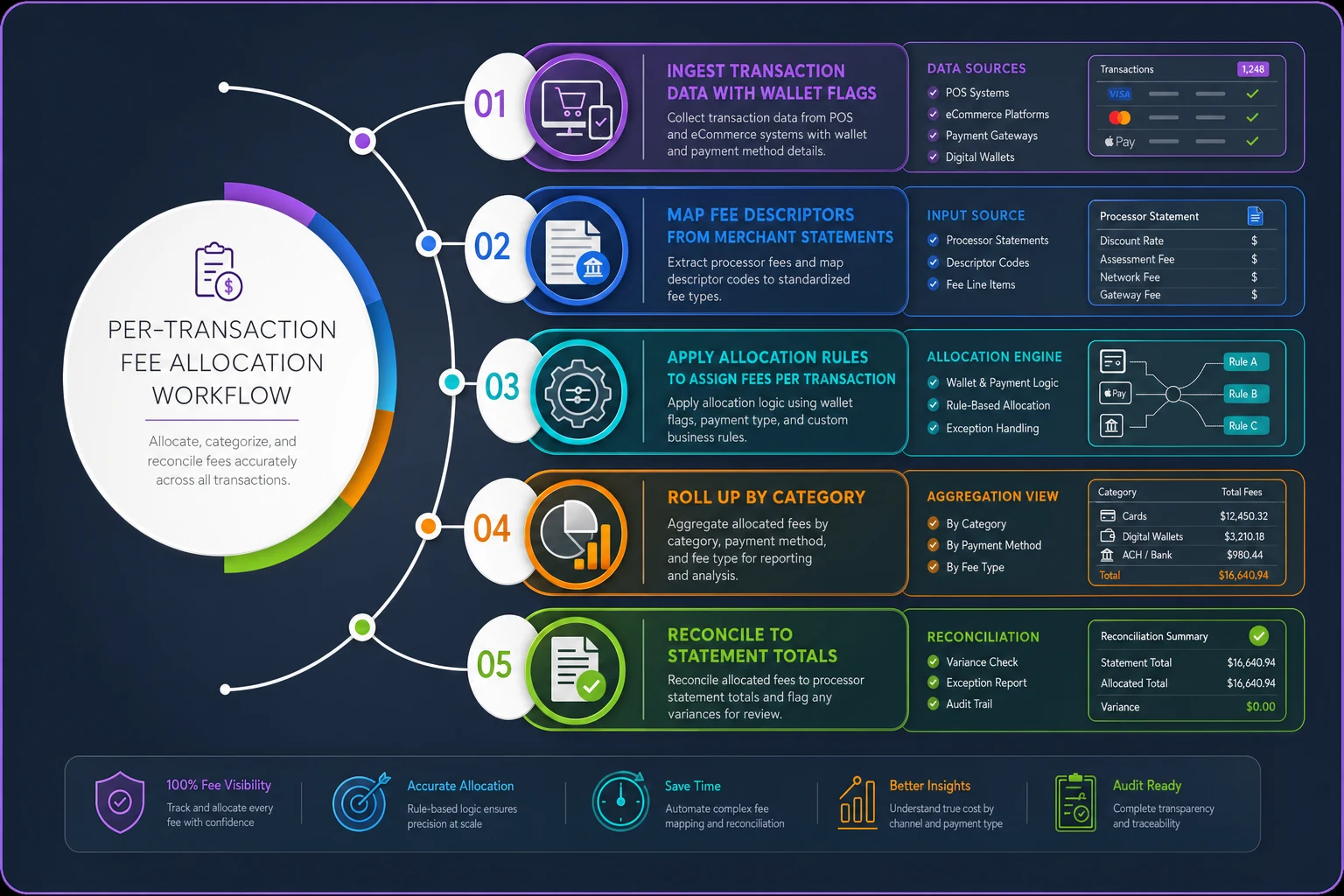
A simple workflow diagram like this helps non-technical finance teammates see where data must flow and where gaps show up.
4. Create a holding account for any retroactive credits or disputed fees
If a settlement or pricing correction ever flows back, you do not want it netted against current fees. Set up a dedicated GL account now—something like "Payment fee adjustments – pending" as a contra-expense or liability depending on your treatment. Any unexplained credit lands there until you've matched it to a cause.
This single habit prevents the most common error after any industry-wide repricing: a one-time credit quietly flattering a month's margin and distorting the trend.
5. Stress-test your 13-week forecast with a fee-shift scenario
Most forecasts carry processing cost as a flat percentage. Add two scenarios: one where your effective rate drops 10–15 basis points, and one where it rises by a similar amount. On meaningful card volume, even a 0.15% swing isn't nothing. A business running roughly $180k a month in card sales is looking at a swing of around $270 monthly, or a bit over $3k a year—small, but it compounds, and it's exactly the kind of variance that makes your actuals miss forecast for no obvious reason.
The point isn't the dollar figure. It's building the muscle to model fee changes at all, so you're not caught flat-footed if pricing norms shift.
6. Prep your AR/AP and billing reconciliations for adjustment volume
If credits, disputes, or corrections start flowing, your reconciliation process needs to handle a higher volume of non-standard adjustments without breaking the close. Decide now how you'll categorize them, who approves the treatment, and how they map to the period they relate to versus the period they land in.
A messy pile of adjustments at month-end is how a clean close turns into a three-day scramble.
A realistic scenario
Consider a regional café group with four locations, running close to $190k a month in combined card volume. Tap-to-pay is big for them—roughly 40% of in-person transactions, heavily Apple Pay given their customer base.
Before this work, their books carried a single blended processing expense around 2.7%, booked monthly from the statement total. No wallet breakdown, no per-location fee detail. When their processor adjusted pricing earlier in the year, their effective rate drifted from about 2.68% to 2.81% and nobody caught it for two months. That drift cost them somewhere in the $450–$500 range over that window—not catastrophic, but it was invisible. And invisible is the real issue.
After running steps one through four, they could see fees by location and by wallet type. The next time a rate component moved, it showed up in their reconciliation pivot within the first close, flagged against their baseline. They didn't recover the earlier drift, but they stopped flying blind—and when any fee-structure change arrives now, they can actually measure whether it helped them.
When this level of granularity is worth it—and when it isn't
It's worth it if: card volume is a material share of revenue (above $50k–$75k a month, roughly), mobile wallets make up a real chunk of that, or you operate multiple locations where blended totals hide per-site anomalies. In those cases, the attribution gap is a genuine risk and the setup pays for itself the first time a fee moves.
It's probably overkill if: you run very low card volume, almost everything is ACH or invoice-based, or wallet transactions are a rounding error. Don't build per-transaction fee allocation for a business where total monthly fees are a few hundred dollars. Spend that effort somewhere with more leverage.
Who should hold off entirely: if your books aren't yet reconciling card deposits to the statement at all, fix that first. Per-wallet granularity on top of an unreconciled base is building the second floor before the foundation sets.
The quick-start checklist
-
[ ] Export 3 months of itemized merchant statements
-
[ ] Build a fee-descriptor-to-category map
-
[ ] Confirm whether wallet type flows from POS/e-commerce into your data
-
[ ] Set up a per-transaction fee allocation that ties to statement totals
-
[ ] Create a holding account for retroactive credits and disputed fees
-
[ ] Add rising and falling fee scenarios to your 13-week forecast
-
[ ] Define how adjustment volume gets categorized and approved at close
Where this leaves you
The certification is a headline. Whether it produces refunds, forced pricing changes, or nothing at all is genuinely unknown—and it may be a long time before anything concrete reaches merchants. But the exercise it prompts is worth doing regardless of how the case resolves.
Payment economics are a chain, and SMB finance teams almost always sit at the end of it with the least visibility. The teams that get caught out aren't the ones who guessed wrong about a lawsuit—they're the ones whose books couldn't tell them what their payment costs were actually doing. Get your fee data to the right grain now, and whatever happens upstream becomes something you can see, measure, and plan around instead of a surprise waiting in next quarter's statement.
Ready to take control of your finances?
Join over 2,000 businesses using Acctaly to simplify accounting, accelerate cash flow, and ensure tax readiness.